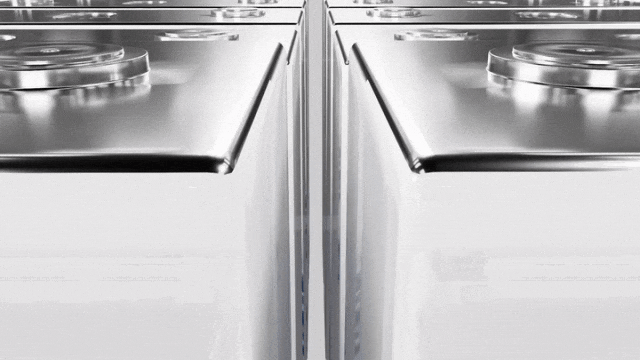
BAK Battery’s prismatic 314Ah large-capacity energy storage cell delivers an ultra-long cycle life of 10,000 cycles, a high energy density of 190 Wh/kg, high power capability supporting 2P configuration, and a discharge efficiency exceeding 95%, setting a new benchmark for energy storage cells in terms of longevity, economy, and reliability.
This leap in cell performance stems from BAK’s deep innovation in multi-material systems and structural design. Its 10,000-cycle lifespan significantly reduces the levelized cost of storage over the system’s full lifecycle, providing fundamental economic assurance for long-term operation. Moreover, the cell has passed the most stringent nail penetration test, ensuring safety and reliability at the root level.
In terms of application, the 314Ah cell demonstrates broad adaptability. In residential energy storage scenarios, its long lifespan and high safety perfectly meet household users’ demands for durability and peace of mind, helping to maximize the self-consumption of photovoltaic power. For commercial and industrial energy storage, the cell’s high-power response and ultra-long cycle characteristics enable effective peak shaving, load management, and substantially improve project investment returns. Furthermore, this cell also serves as an ideal core unit for large-scale applications such as generation-side energy storage and grid-side standalone energy storage stations.
Currently, competition in energy storage cells has moved beyond single metrics like capacity, shifting toward comprehensive considerations of full lifecycle cost, safety, and technological depth. With continuous technological innovation, BAK Battery directly addresses the market’s core demands for “cost reduction and efficiency improvement” and “long-term reliability,” providing more valuable solutions for the global energy transition.
Next:None
Previous:Understanding the Cycle Life of LiFePO4 Batteries