When building any battery-powered system—whether for solar storage, RV setups, electric vehicles, marine applications, or backup power—the way you wire your batteries directly affects voltage, capacity, runtime, and overall performance. Understanding the difference between series and parallel battery wiring is essential for designing a power solution that is safe, dependable, and efficient.
What follows is a detailed, original guide that explains each wiring method, walks you through how to do it safely, and helps you decide which configuration best suits your needs.
Before choosing a wiring method, it's important to know how each configuration changes your battery bank's output.
How Series Wiring Works: Increasing Voltage
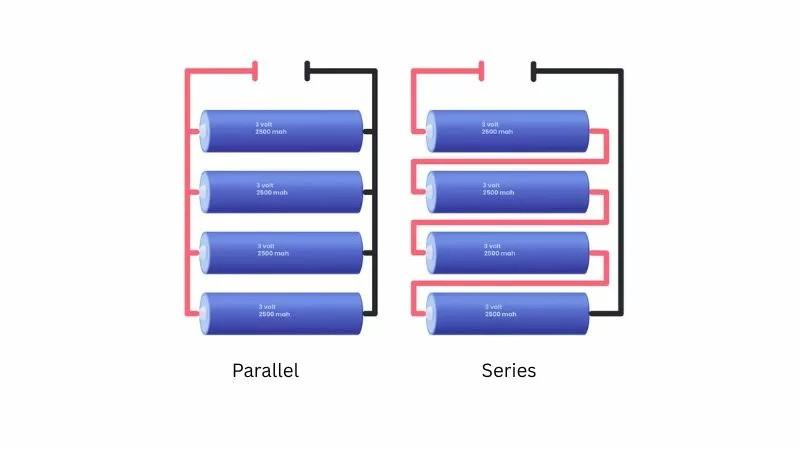
Wiring batteries in series means connecting the positive terminal of one battery to the negative terminal of the next, creating a chain.
This setup increases total voltage while capacity (measured in amp-hours) stays the same.
Examples of voltage increases in series wiring:
- Four 3.6V Li-ion cells → 14.4V
- Six 2V lead-acid cells → 12V
- Two 12V batteries → 24V
Series wiring is ideal for:
- Electric vehicles
- Solar inverters that require higher voltage
- Power tools
- UPS systems
When wiring in series, always use batteries with identical voltage and capacity to avoid imbalance and overheating.
How Parallel Wiring Works: Increasing Capacity
In parallel wiring, all positive terminals are connected together, and all negative terminals are connected together.
This configuration increases total capacity (Ah) while keeping voltage the same.
Example:
- Two 12V batteries in parallel → still 12V, but with double the capacity
Parallel wiring is ideal for:
- RV house batteries
- Solar storage banks
- Backup power systems
- Applications that need extended runtime
This method provides steady, long-lasting power for devices that require continuous operation over time.
| Aspect | Series Wiring | Parallel Wiring |
| Voltage | Increases | Stays the same |
| Capacity (Ah) | Stays the same | Increases |
| Best For | High-voltage systems | Long-runtime systems |
| Risk | A single weak battery affects the whole pack | One bad battery only reduces total capacity |
Wiring in series boosts voltage, making it a good fit for systems that need higher power output.
Step-by-Step Instructions
1. Gather materials
Use matching batteries (same voltage and Ah rating), suitable wiring cables, and a multimeter.
2. Position batteries
Place the batteries side by side with terminals easily accessible.
3. Connect terminals
Link the positive terminal of one battery to the negative terminal of the next. Repeat until all batteries are connected.
4. Identify output terminals
You will have one unused positive terminal and one unused negative terminal—these will connect to your system.
5. Test voltage
Use a multimeter to check total voltage. It should equal the sum of all individual battery voltages.
Safety Tips for Series Wiring
Series wiring comes with higher voltage risks, so follow these guidelines:
✔ Use matching batteries
Mismatched voltages or capacities can lead to thermal runaway or permanent damage.
✔ Inspect terminals regularly
Loose or corroded terminals can cause resistance, heat buildup, and energy loss.
✔ Use a Battery Management System (BMS)
A BMS helps prevent overcharging, over-discharging, and voltage imbalance.
✔ Follow regional safety standards
- PSE (Japan): Ensures battery safety compliance
- EU Battery Directive: Limits harmful materials and promotes safe use
- BMS Integration: Monitors battery health and prevents overvoltage conditions
Where Series Wiring Is Commonly Used
Series wiring is used wherever higher voltage output is needed:
- Electric vehicles – to power high-voltage drive motors
- Solar energy systems – to meet inverter voltage requirements
- Cordless power tools – for strong bursts of energy
- UPS systems – to deliver high-voltage backup power
Wiring in parallel increases capacity and runtime while keeping voltage unchanged.
Step-by-Step Instructions
1. Gather your tools
You’ll need matching batteries, appropriate cables, and a multimeter.
2. Arrange batteries
Position them so terminals are easy to reach and connections are straightforward.
3. Connect all positive terminals together
Use properly sized wiring to link all positive terminals.
4. Connect all negative terminals together
Ensure solid, clean connections for all negative terminals.
5. Test your system
Total voltage should match that of a single battery (e.g., 12V), while total current capacity increases.
Parallel systems benefit from basic electrical knowledge—Ohm’s Law can help you anticipate resistance and current flow.
Safety Tips for Parallel Wiring
✔ Use identical batteries
Mixing batteries of different ages or capacities can lead to uneven charging.
✔ Tighten all connections
Loose connections waste energy and can create hot spots.
✔ Install a BMS or balancing system
Even in parallel, a weak cell can reduce overall performance.
✔ Understand risk profiles
A failed cell in a parallel configuration is less dangerous than in series, but it will still reduce total capacity.
Where Parallel Wiring Is Commonly Used
Parallel wiring is used in systems that prioritize long runtime:
- Backup power systems and UPS
- RVs and campers
- Solar storage banks
- Industrial power grids, where parallel cables help maintain stability during short-circuit events
Use Series Wiring When:
- You need higher voltage
- You're powering motors, inverters, or industrial equipment
- You want strong performance with fewer batteries
Use Parallel Wiring When:
- You need longer runtime
- You're powering appliances, lights, or electronics
- You want redundancy—if one battery weakens, the system can still operate
Advanced battery banks—such as those used in solar homes or commercial systems—often combine both methods.
Example hybrid setup:
- Two sets of batteries wired in series for higher voltage
- Those sets then wired in parallel for increased capacity
Important considerations:
- Mismatched batteries can increase heat
- Lifespan may be reduced by up to 40%
- Voltage levels may become inconsistent
A BMS is essential for balancing temperature, voltage, and resistance across the entire system.
| Wiring Type | Voltage | Capacity | Best Use Case | Pros | Cons |
| Series | Increases | Same | High-power systems | Efficient high voltage | One bad battery affects whole bank |
| Parallel | Same | Increases | Long runtime systems | Redundant and expandable | Higher current may require thicker cables |
Choosing between series and parallel battery wiring comes down to your power goals:
- Need more voltage? Go with series.
- Need more capacity? Choose parallel.
- Need both? Combine them with a well-planned hybrid layout.
With careful planning, matched batteries, and a good BMS, you can build a battery system that is safe, efficient, and long-lasting for nearly any application.
Next:Hina Battery Predicts Sodium Ion Battery Costs to Match Lithium by 2028
Previous:CALB launches 400 Wh/kg Semi Solid State Battery for Light Truck