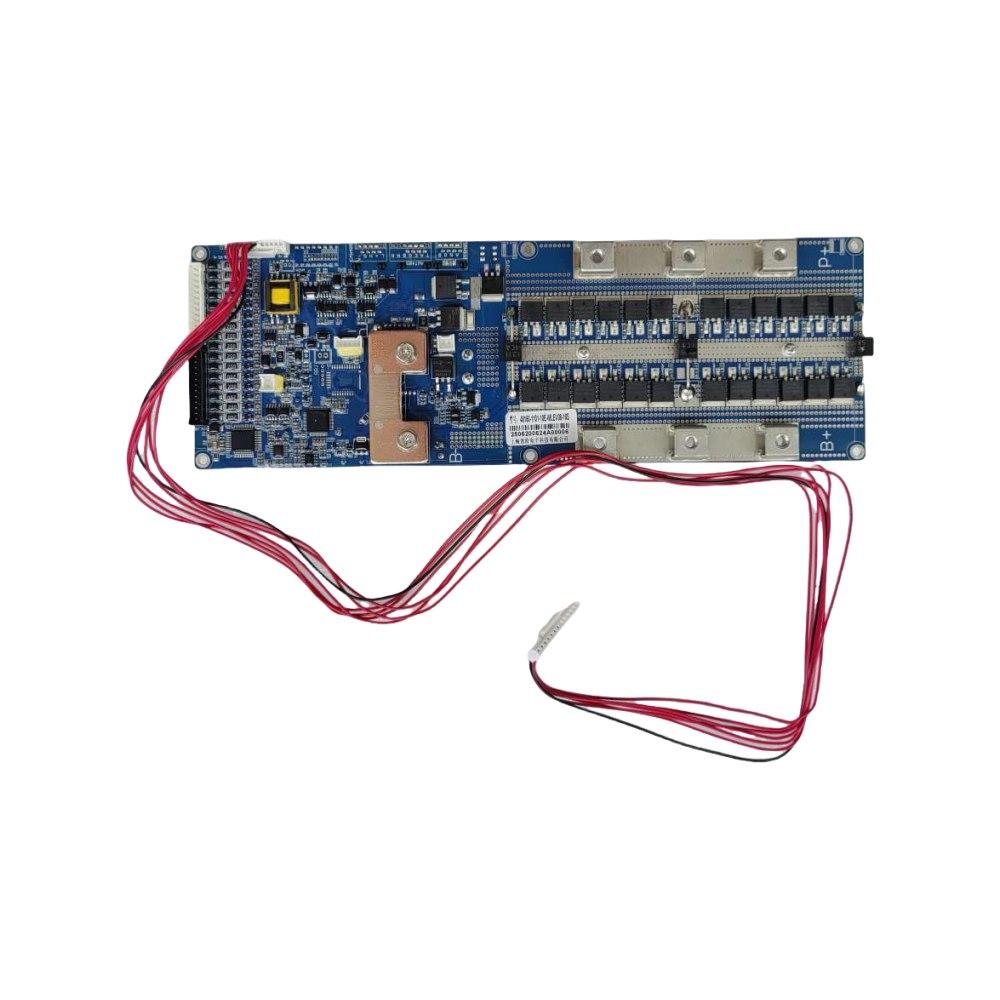
With the accelerating shift toward renewable energy and the expanding use of battery-powered technology, energy storage systems (ESS) have become a cornerstone of the global energy transition. Whether they support solar arrays, commercial backup power, industrial machinery, or electric vehicles, batteries need intelligent oversight to perform reliably. At the core of every advanced battery pack sits the Battery Management System (BMS) — the technology that maximizes safety, efficiency, and service life.
A Battery Management System is far more than a simple protection circuit. It functions as the intelligent control center of an energy storage installation, constantly monitoring cell conditions, fine-tuning performance, and heading off failures before they arise. Without a dependable BMS, even the most premium lithium battery cannot realize its full potential.
A Battery Management System is an electronic control platform built to supervise, safeguard, and enhance rechargeable battery packs. It captures real-time data from individual cells and ensures each one stays within safe electrical and thermal boundaries.
The BMS performs essential tasks, including:
- Tracking cell voltage
- Measuring charge and discharge current
- Monitoring battery temperature
- Balancing voltages across cells
- Estimating State of Charge (SOC)
- Calculating State of Health (SOH)
- Guarding against abnormal operating states
- Sharing battery data with external controllers and monitoring interfaces
By intelligently orchestrating these functions, a BMS strengthens overall battery dependability while cutting maintenance demands and operational costs.
A contemporary Battery Management System brings together several hardware and software modules that cooperate to preserve battery health and operational security.
The monitoring circuitry continuously records voltage, current, and temperature for every cell in the pack. This persistent supervision lets the BMS instantly recognize irregular conditions such as:
- Overvoltage
- Undervoltage
- Overcurrent
- Excessively high temperature
- Excessively low temperature
- Internal faults
Early identification prevents irreversible cell damage and markedly improves operational safety.
No two battery cells are perfectly identical. During charging and discharging, minor discrepancies progressively widen, generating voltage imbalances across the pack.
The balancing circuit corrects these differences by shifting energy between cells or dissipating surplus charge. Effective balancing delivers several gains:
- Greater usable capacity
- Enhanced charging efficiency
- Slower cell aging
- Extended overall battery life
- Improved pack uniformity
Without proper balancing, the weakest cell ends up determining the entire pack’s performance.
Often described as the “brain” of the BMS, the battery controller processes data gathered from the monitoring modules and makes intelligent operational decisions.
The controller governs:
- Charging thresholds
- Discharging limits
- Current regulation
- Thermal management
- Protective responses
- Battery operating modes
Sophisticated controllers can also evaluate battery health and forecast remaining useful life through advanced algorithms.
Modern energy storage solutions demand seamless interaction among batteries, inverters, chargers, and monitoring software.
A BMS commonly supports communication standards such as:
- CAN Bus
- RS485
- UART
- Modbus
- Bluetooth
- Wi-Fi
These connections allow live battery tracking, remote diagnostics, firmware updates, and integration with smart energy management platforms.
Safety stands as the top priority for lithium battery systems. A quality Battery Management System embeds multiple defense mechanisms to prevent hazardous scenarios.
These safeguards include:
- Overcharge protection
- Over-discharge protection
- Overcurrent protection
- Short-circuit protection
- Thermal protection
- Reverse polarity protection
- Cell imbalance protection
Such features dramatically lower the risk of battery malfunction, overheating, or thermal runaway.
Battery performance hinges on keeping every cell within its ideal operating window.
A BMS intelligently manages charge and discharge cycles to avoid placing excessive stress on the cells. Consequently, batteries deliver:
- Higher efficiency
- Stable voltage output
- Better energy utilization
- Consistent power delivery
This optimization is particularly valuable for commercial and industrial storage systems that run around the clock.
Lithium batteries pack high energy density, making proper management non-negotiable.
Whether it’s an advanced 48V BMS, an ESS BMS, or a 12V battery BMS, the system persistently monitors conditions and instantly isolates the battery if an unsafe situation develops.
Real-time protection minimizes the dangers tied to:
- Overheating
- Thermal runaway
- Fire hazards
- Equipment damage
- Unexpected system shutdowns
That makes Battery Management Systems indispensable for residential, commercial, and utility-scale storage.
Battery replacement represents one of the biggest long-term costs in any storage deployment.
A Battery Management System helps maximize return on investment by slowing battery degradation through:
- Controlled charging profiles
- Balanced cell voltages
- Temperature management
- Current limitation
- Deep discharge prevention
These protective actions can significantly raise cycle life, trimming ownership costs over years of operation.
Today’s BMS technology reaches well beyond elementary protection.
Advanced systems continuously harvest operational information, including:
- Battery voltage
- Current
- Temperature
- State of Charge (SOC)
- State of Health (SOH)
- Remaining capacity
- Cycle count
- Fault history
Cloud connectivity and IoT integration let operators remotely oversee battery systems via mobile apps or centralized dashboards.
This real-time transparency enables:
- Predictive maintenance
- Early fault detection
- Performance optimization
- Reduced downtime
- Heightened operational efficiency
For utility-scale battery energy storage installations, these analytical capabilities are invaluable.
Electric vehicles depend on large lithium battery packs containing hundreds or even thousands of cells.
The Battery Management System guarantees:
- Safe fast charging
- Balanced cells
- Accurate range estimation
- Peak driving performance
- Extended battery lifespan
Without advanced BMS technology, modern EVs would not reach their current levels of reliability or efficiency.
Home battery systems paired with solar panels rely on intelligent battery management to store surplus daytime energy and supply power during evenings or grid interruptions.
A trustworthy BMS helps homeowners achieve:
- Greater energy independence
- Higher battery efficiency
- Safe everyday operation
- Longer battery life
This makes residential storage both safer and more cost-effective.
Solar farms and wind plants frequently produce electricity that outstrips immediate consumption.
Battery Energy Storage Systems (BESS) outfitted with advanced BMS technology store excess power and discharge it when generation dips or demand climbs.
The BMS orchestrates battery charging, energy dispatch, and system protection to maximize renewable energy utilization while sustaining grid stability.
Large utility-scale storage installations demand sophisticated Battery Management Systems capable of overseeing thousands of battery modules simultaneously.
An advanced ESS BMS facilitates:
- Peak shaving
- Frequency regulation
- Grid stabilization
- Load shifting
- Renewable energy integration
- Backup power support
These functions are growing ever more critical as power grids shift toward cleaner energy sources.
Battery Management Systems keep evolving alongside advances in battery chemistry and digital tools.
Several innovations are molding the next wave of BMS solutions.
AI-driven algorithms analyze battery behavior to refine charging strategies and accurately predict cell aging, boosting both performance and longevity.
Machine learning models continuously sharpen battery performance forecasts based on real-world operating data, improving reliability and maintenance planning.
IoT connectivity allows real-time oversight across distributed battery fleets, enabling remote diagnostics, cloud analytics, and site-wide energy management.
Digital twins build virtual replicas of battery systems, letting engineers simulate operating conditions, pinpoint potential failures, and optimize performance before problems materialize.
As networked battery systems proliferate, cybersecurity becomes an essential element of modern Battery Management Systems, safeguarding operational data and blocking unauthorized access.
Selecting the appropriate BMS hinges on several considerations:
- Battery chemistry (LiFePO4, NMC, LTO, sodium-ion, lead-acid)
- Battery voltage
- Current rating
- Number of cells
- Communication protocol needs
- Environmental conditions
- Application type
- Scalability and future expansion
A well-engineered BMS should not only deliver comprehensive protection but also supply precise monitoring, intelligent diagnostics, and effortless integration with inverters, chargers, and energy management platforms.
Battery Management Systems form the bedrock of safe, efficient, and dependable energy storage. From electric vehicles and home solar setups to commercial backup power and utility-scale battery storage, a BMS keeps every battery running at peak capability while minimizing safety risks and prolonging service life.
As battery technology progresses and renewable energy adoption keeps climbing, intelligent Battery Management Systems will grow even more advanced. Breakthroughs in artificial intelligence, IoT connectivity, predictive analytics, and cloud-based monitoring will reshape battery management, making energy storage smarter, safer, and more efficient than ever.
Investing in a high-quality Battery Management System isn’t just about safeguarding a battery pack — it’s about maximizing energy efficiency, boosting long-term reliability, lowering operating expenses, and powering the next generation of sustainable energy infrastructure.
Welcome to contact us:
Inquire more product details from the: Lithium Ion Battery Suppliers
WhatsApp/Wechat/Mobile: +86 13326321310
Email: info@battery-energy-storage-system.com
Website: www.battery-energy-storage-system.com
Ready to power your energy systems with the best in the industry?
Contact us today to get the latest pricing and discuss your needs with our team!
Next:Gotion 3.7V 50Ah NMC Battery Cells Shipped to Italy
Previous:3.3kW 48V 45A On Board Battery Charger Shipped to New Zealand