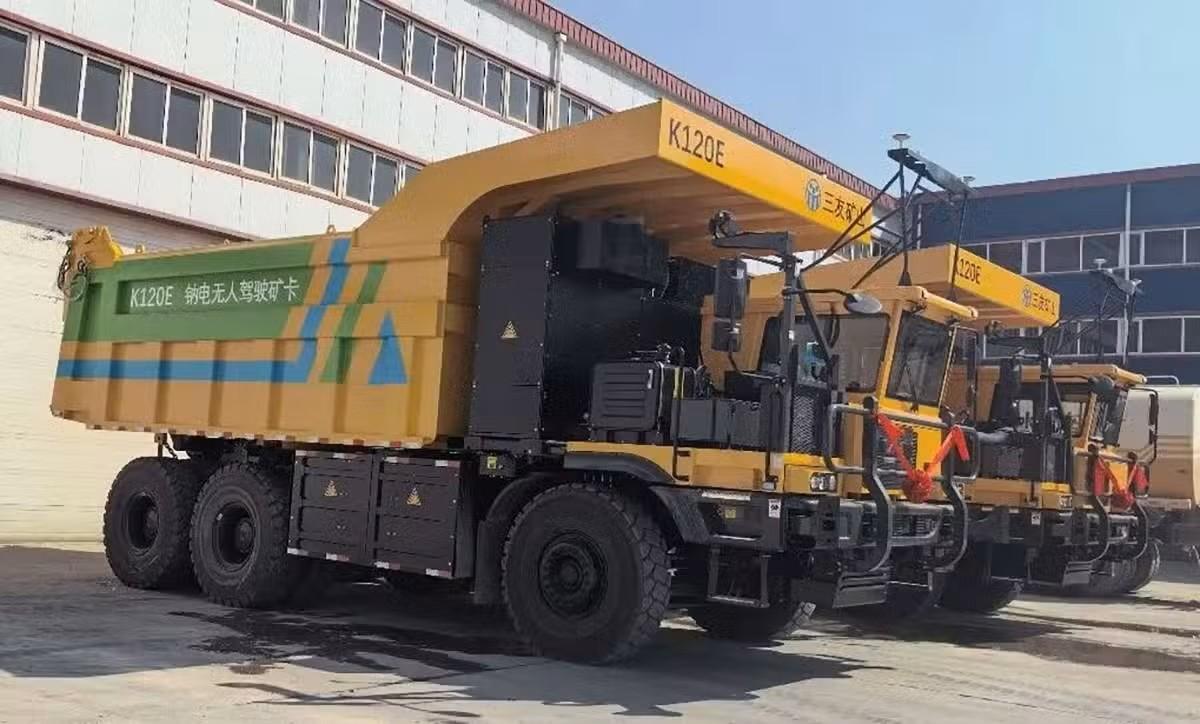
On August 4, China’s first pure electric mining truck equipped with sodium-ion batteries was officially delivered to the Tangshan Sanyou mine. The vehicle represents the outcome of a collaborative development project between Hina Battery and Tonly Heavy Industry. Based on Tonly’s TLE120 platform, the electric mining truck integrates Hina Battery’s Haixing series sodium-ion battery system, featuring a total capacity of 676 kWh and a cell-level energy density of 165 Wh/kg. These specifications are designed to meet the demands of short-distance transportation and high-load operations in mining applications.
According to Hina Battery, the truck supports rapid charging from 0% to 100% within 20 to 25 minutes. The sodium-ion battery system is also claimed to maintain a cycle life of more than 8,000 cycles under frequent fast-charging conditions, which is expected to align with the vehicle’s overall operational lifespan.
One of the key advantages of sodium-ion battery technology is its strong performance across a wide temperature range. Compared with conventional lithium-ion batteries, sodium-ion cells experience much less capacity degradation in cold environments. This makes the electric mining truck especially suitable for open-pit mining operations in northern China, where harsh winter conditions can significantly affect the driving range of lithium-powered vehicles.
Compared with traditional diesel-powered mining trucks, the sodium-ion electric model offers zero direct emissions and lower operating noise, helping mines achieve cleaner and more environmentally friendly operations. After delivery, the truck will be deployed at the Tangshan Sanyou mine for commercial operation. Real-world performance data collected under heavy-load working conditions will be used to further improve future versions of the vehicle.
Meanwhile, other companies are also exploring sodium-ion battery applications in heavy-duty transportation. Recently, FAW Jiefang completed full-scenario testing of a heavy-duty truck equipped with Hina Battery’s sodium-ion technology. However, sodium-ion batteries still face challenges compared with lithium iron phosphate (LFP) batteries, particularly in terms of energy density.
For example, Tonly’s LFP-powered version of the TLE120 platform introduced last year was equipped with an 801 kWh battery pack, while the newly launched sodium-ion version uses a 676 kWh battery system. The difference in battery capacity highlights the current energy density gap, which may also be one reason why sodium-ion technology has yet to see widespread adoption in passenger electric vehicles.
Nevertheless, with advantages in cost potential, low-temperature performance, and cycle durability, sodium-ion batteries are gaining attention as a promising solution for heavy-duty applications such as mining trucks, commercial vehicles, and industrial energy storage systems.
Welcome to contact us:
Inquire more product details from the: Lithium Ion Battery Suppliers
WhatsApp/Wechat/Mobile: +86 13326321310
Email: info@battery-energy-storage-system.com
Website: www.battery-energy-storage-system.com
Ready to power your energy systems with the best in the industry?
Contact us today to get the latest pricing and discuss your needs with our team!
Next:3kW 24V 100A and 18kW 48V 300A Forklift Battery Chargers Shipped to Brazil
Previous:6kW, 9kW, and 18kW Forklift Battery Chargers Shipped to Thailand