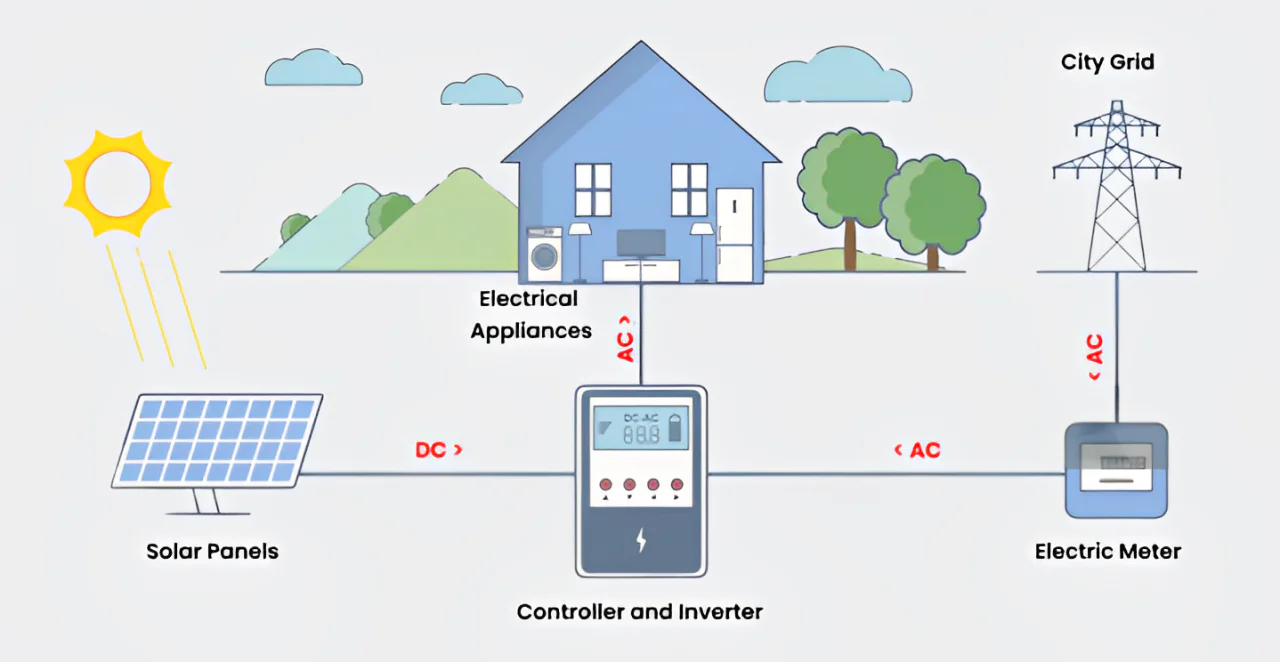
In our electricity-driven era, inverters have become indispensable components in homes, industry, and renewable energy installations. Their primary job is simple yet powerful: converting direct current (DC) into alternating current (AC), which enables us to run everyday appliances and critical equipment smoothly. Whether supporting solar power systems, running devices in recreational vehicles, or backing up essential equipment during blackouts, inverters sit at the heart of modern energy dependability and efficiency.
This guide explains what an inverter is, how it functions, where it is used, and the advantages it offers in boosting power stability, sustainability, and convenience.
An inverter is an electronic device that turns DC electricity into AC electricity. Since the vast majority of household appliances, consumer electronics, and grid infrastructure rely on AC power, inverters serve as the bridge that allows DC sources – such as batteries, solar panels, and wind turbines – to deliver usable electricity.
Inverters come in a wide range of sizes, from compact portable units for camping and emergency use to large-scale industrial models designed for manufacturing plants and renewable energy farms. Their reliability and high efficiency make them irreplaceable in today’s power systems.
While the core function of an inverter is DC-to-AC conversion, its role goes well beyond simple power transformation. Some of the key tasks inverters perform include:
- Solar Energy Conversion: Solar panels produce DC electricity. Inverters transform this DC power into AC so it can be used in homes, businesses, and on the utility grid. They also synchronize the output with the grid’s frequency and voltage.
- Backup Power Supply (UPS Systems): In uninterruptible power supply configurations, inverters instantly switch to battery power during an outage, ensuring computers, medical systems, and other critical devices keep running without interruption.
- Electric Vehicle Power Coordination: In electric vehicles, inverters regulate the flow of electricity between the battery and the motor, directly influencing acceleration, efficiency, and speed control.
- Power Conditioning and Voltage Regulation: Many modern inverters improve overall power quality by stabilizing voltage levels, reducing electrical noise, and protecting against voltage spikes.
- Smart Energy Management: Advanced inverters offer Wi-Fi connectivity for real-time monitoring, performance tracking, and remote control.
With these capabilities, inverters support energy independence, strengthen system reliability, and widen access to renewable power solutions.
An inverter operates using electronic switching techniques that convert steady DC electricity into a waveform that resembles AC power.
Basic Operation:
1. The inverter receives a DC input from a battery or renewable source.
2. Electronic switches, typically transistors, rapidly reverse the current direction to create a series of pulses.
3. These pulses are shaped and filtered to produce a smooth AC sine wave output.
Advanced Technology Used:
- Pulse-Width Modulation (PWM): Allows precise control over voltage and frequency, resulting in a cleaner, more stable AC output.
- Microprocessor Controls: Continuously monitor system performance and adjust the output in real time to maximize efficiency.
- Pure Sine Wave Output Design: Ensures safe and reliable operation of sensitive electronics such as laptops, refrigerators, and medical equipment.
The exact design and performance of an inverter depend on its intended application, capacity, and quality standards.
| Advantage | Description |
| Makes Renewable Energy Usable | Transforms solar and wind energy into electricity suitable for appliances and the grid. |
| Enables Off-Grid and Backup Power | Maintains electricity supply during outages and in remote locations. |
| Enhances Power Quality | Stabilizes voltage levels and filters out harmonic distortion. |
| Reduces Electricity Costs | Allows households to use self-generated or stored energy, lowering utility bills. |
| Smart Monitoring Features | Modern inverters provide performance data tracking and remote access via apps. |
Inverters help build more resilient, sustainable, and cost-efficient power systems.
- Home Backup Systems: Keep essential appliances running when the grid goes down.
- Solar Energy Systems: Convert solar panel output into grid-ready AC power.
- RVs, Boats, and Vehicles: Enable the use of household electronics while traveling.
- Portable Power Stations: Useful for outdoor work, camping, and emergency situations.
- UPS and IT Equipment: Provide backup power to prevent data loss and protect sensitive hardware.
- Place the inverter in a cool, dry, well-ventilated area.
- Connect only devices that fall within the inverter’s recommended wattage range.
- For home solar systems, always use certified professional installers.
- Monitor the power load to prevent overheating or automatic shutdown.
- Turn off the inverter before plugging in or unplugging any devices.
Inverters are a vital part of modern energy systems, especially as we move towards sustainable power. They enable solar and wind installations to power homes and businesses, deliver stable backup electricity, and support energy self-sufficiency. As renewable energy adoption continues to grow, inverters are evolving to offer higher efficiency, smarter grid connectivity, and greater overall reliability.
Choosing a high-quality inverter ensures optimal performance, a long service life, and significant energy savings.
1. When do you need an inverter?
You need an inverter whenever you want to run AC appliances from a DC power source, such as batteries or solar panels.
2. What does an inverter do in an RV?
It converts 12V DC power from the RV battery into AC power, allowing you to use household appliances without an external electricity supply.
3. How do I size a solar inverter?
As a general guideline, the inverter should be rated at 1.1 to 1.3 times the total wattage of your solar panels to ensure stable power handling.
4. What types of solar inverters are available?
- Pure sine wave inverters: Ideal for all types of electronic devices.
- Modified sine wave inverters: More affordable but less compatible with sensitive electronics.
5. How long will a 12V battery run a 2000W inverter?
Runtime depends on the battery’s capacity and the actual power draw. With a 100Ah battery at full 2000W load, you can expect around 30 minutes of operation; lower loads will extend the runtime considerably.
Welcome to contact us:
Inquire more product details from the: Lithium Ion Battery Suppliers
WhatsApp/Wechat/Mobile: +86 13326321310
Email: info@battery-energy-storage-system.com
Website: www.battery-energy-storage-system.com
Ready to power your energy systems with the best in the industry?
Contact us today to get the latest pricing and discuss your needs with our team!
Next:80pcs Winston 3.2V 100Ah LiFePO4 batteries to manila of Philippines by sea
Previous:CATL 3.7V 50Ah NCM Batteries to Sweden and Germany