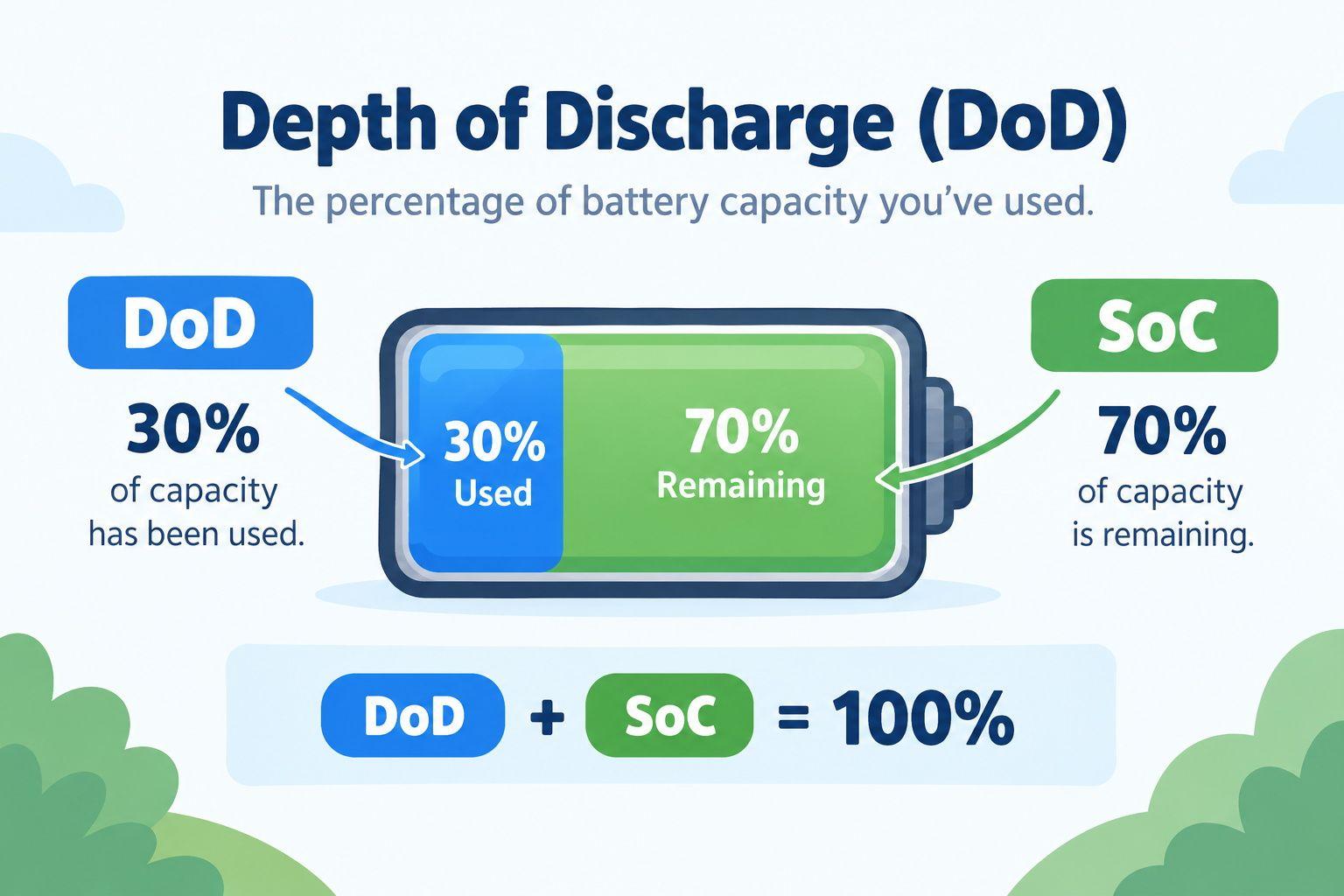
Depth of discharge, or DoD, expresses how much of a battery’s rated or usable capacity has already been consumed in service. It is a central measure for judging how intensively a battery is being used, how long its cycle life may last, and how well an energy storage system performs.
A simple illustration: a battery rated at 100 kWh that has supplied 30 kWh has a DoD of roughly 30%. The remaining 70% is its state of charge, or SoC, provided both figures are based on the same capacity reference.
DoD and SoC therefore move in opposite directions:
- DoD is the share of capacity that has been used.
- SoC is the share of capacity that remains.
When calculated on a consistent capacity basis, the two normally total 100%. This inverse relationship gives engineers, battery makers, and system operators a practical way to judge how much energy can be drawn from a battery without unnecessarily speeding up degradation.
Once the battery capacity and the amount of energy taken from it are known, DoD can be calculated directly:
DoD = (Capacity Used / Reference Capacity) × 100%
For a 100 Ah battery that has delivered 40 Ah:
DoD = (40 / 100) × 100% = 40%
That battery is at 40% DoD, which leaves about 60% SoC under the same capacity assumptions.
The same method applies to energy storage systems measured in kilowatt-hours. A 200 kWh battery that has delivered 120 kWh is at a calculated DoD of 60%, assuming the calculation uses a consistent capacity basis and properly reflects system losses.
Discharging a battery involves electrochemical reactions that turn stored chemical energy into electrical energy. The deeper the discharge, the larger the portion of the battery’s operating range that is used. Depending on the chemistry and operating conditions, this can accelerate degradation.
Frequent deep cycling can stress electrode materials, raise internal resistance, and reduce the energy a battery can hold over time. The strength of this effect, however, differs greatly among battery technologies.
Lead-acid batteries are especially vulnerable to deep discharge. Repeated operation at high DoD can cause lead sulfate crystals to build up on the plates. When sulfation persists, capacity falls and full recharging becomes harder.
Deep discharge can also contribute to active material shedding and other electrode damage. For this reason, many conventional lead-acid batteries are used more successfully when routine discharge is kept to about 50% DoD. Some models can tolerate deeper discharge, but frequent deep cycling may shorten service life.
Actual cycle counts are influenced by battery design, temperature, charging practice, discharge rate, and maintenance.
Lithium-ion batteries generally handle deeper discharge better than conventional lead-acid batteries, but they are not immune to degradation from repeated charge and discharge cycling.
Lithium iron phosphate (LiFePO4 or LFP) batteries are common in solar storage, industrial equipment, marine systems, and electric vehicles because of their cycle-life characteristics and thermal stability. Depending on the product, an LFP battery may deliver thousands of cycles at a relatively high DoD. Lowering discharge depth can extend service life further, although the gain depends on cell chemistry, temperature, charging voltage, and other operating conditions.
The fact that lithium-ion chemistry can tolerate deep cycling does not mean a battery should routinely be taken to 100% DoD. Manufacturer-recommended operating limits should always be followed.
A battery’s actual capacity may not match its nominal rating. Several operating conditions affect the relationship between delivered energy and calculated DoD:
- Temperature: Cold can reduce usable capacity, while excessive heat can speed up degradation.
- Discharge rate: High currents can reduce the capacity available before the battery reaches its voltage cutoff, especially in lead-acid batteries.
- Aging: As a battery degrades, its real capacity declines, so calculations based only on the original rating become less representative.
- Voltage limits: Protection systems may stop discharge before the battery reaches its theoretical minimum state.
- Conversion losses: In systems with inverters and other power electronics, energy delivered to the load may differ from energy taken from the battery.
A battery management system (BMS) can estimate DoD from current, voltage, temperature, and historical operating data. For more dependable results, system designers should use suitable monitoring methods and account for changes in actual battery capacity.
Battery chemistries have different operating requirements. The figures below are general planning guidelines, not universal limits.
| Battery type | Typical planning range for routine DoD | Main planning consideration |
| Flooded lead-acid | About 50% or lower | Deep discharge can speed up sulfation and wear. |
| AGM lead-acid | About 50–70% | Check the manufacturer’s cycle-life data. |
| Lithium-ion (general) | About 70–90% | Limits depend on the specific chemistry and design. |
| LiFePO4 | About 80–90% | Often suitable for frequent cycling at relatively high DoD. |
| Lithium titanate (LTO) | Application-dependent | Built for demanding cycling, but operating limits vary. |
These ranges show common design practice rather than guaranteed cycle-life thresholds. Some batteries can support higher DoD; others need more conservative operation.
When comparing batteries, cycle-life specifications should be compared at the same DoD, temperature, charge rate, discharge rate, and end-of-life capacity criterion.
Solar battery systems usually cycle every day, so DoD management matters for long-term performance and cost control.
For example, a household using a lead-acid battery may benefit from limiting routine discharge to about 50%. A lithium iron phosphate system may be designed around a higher usable DoD, depending on the manufacturer’s specifications and the homeowner’s energy needs.
A well-designed solar storage system should account for:
- Daily energy consumption: How much electricity the battery must supply overnight or during peak demand.
- Usable battery capacity: The nominal capacity required to meet the target DoD.
- Solar generation variability: Reserve capacity for cloudy days and seasonal changes.
- Battery aging: The gradual loss of available capacity over the system’s lifetime.
- System efficiency: Inverter and other conversion losses when sizing the battery.
If a system must deliver 10 kWh of usable energy and targets 80% DoD, its theoretical minimum nominal capacity is:
(10 kWh) / 0.80 = 12.5 kWh
In practice, designers may need a larger battery to cover conversion losses, reserve requirements, temperature effects, and capacity degradation.
Electric vehicles use battery management systems to balance driving range, charging performance, safety, and battery longevity. Drivers do not necessarily need to use the full available capacity on every trip.
Avoiding unnecessary operation near the battery’s upper and lower limits may help preserve long-term battery health. The best charging and discharging strategy, however, depends on the vehicle manufacturer’s recommendations and the battery chemistry.
Backup power systems have different priorities. An uninterruptible power supply (UPS), for example, must retain enough energy to support critical equipment during an outage.
For backup systems used frequently, conservative DoD limits may improve long-term reliability. Systems intended for rare emergencies may need to provide a larger usable energy reserve during an extended outage.
Industrial equipment such as forklifts and golf carts also benefits from battery management strategies tailored to operating schedules, charging opportunities, and daily energy requirements.
A higher DoD lets a battery deliver more energy per cycle, potentially reducing the amount of installed capacity required. However, deeper discharge may also shorten cycle life, depending on the battery technology.
A lower DoD generally requires a larger battery bank to supply the same amount of energy. The benefit is that the batteries may experience less stress and last longer.
The best choice depends on total cost of ownership (TCO), not simply the initial purchase price.
When comparing battery systems, evaluate:
- Initial battery and installation costs.
- Expected cycle life at the intended DoD.
- Round-trip efficiency and energy throughput.
- Maintenance and replacement expenses.
- Warranty conditions and usable capacity.
- Expected operating conditions and service life.
For commercial and industrial energy storage, these factors can significantly influence project economics. A battery with a higher upfront cost may offer better long-term value if it provides more lifetime energy throughput and reduces replacement frequency.
To improve battery performance and extend service life, follow these practical recommendations:
- Follow manufacturer specifications. Use the recommended DoD, voltage limits, and charging settings for your battery model.
- Avoid unnecessary deep discharge. Use only the capacity required for your application whenever practical.
- Control operating temperature. Protect batteries from excessive heat and respect low-temperature charging restrictions.
- Use a suitable BMS. Ensure the system monitors cell voltage, temperature, current, and protection limits where applicable.
- Maintain appropriate charging practices. Avoid prolonged operation outside the battery manufacturer’s recommended charge range.
- Monitor actual capacity. Review battery performance over time and adjust system planning as the battery ages.
A well-designed battery system combines appropriate capacity sizing, intelligent monitoring, and chemistry-specific operating limits rather than relying on DoD alone.
Depth of discharge is a fundamental metric for understanding battery utilization, cycle life, and energy storage economics. It helps determine how much energy a battery can deliver during each cycle and how operating conditions may influence its long-term performance.
Lead-acid batteries generally benefit from conservative discharge limits, while lithium-ion batteries, particularly LiFePO4 models, often support higher DoD levels. Nevertheless, the ideal operating range depends on the specific battery design, application, and manufacturer’s specifications.
For solar energy storage, electric vehicles, backup power, and industrial equipment, effective DoD management can improve system reliability and help control lifetime costs.
When evaluating a battery, compare its usable capacity, cycle-life data at the intended DoD, efficiency, warranty, and operating requirements. These factors provide a more accurate basis for selecting a battery than nominal capacity alone.
Welcome to contact us:
Inquire more product details from the: Lithium Ion Battery Suppliers
WhatsApp/Wechat/Mobile: +86 13326321310
Email: info@battery-energy-storage-system.com
Website: www.battery-energy-storage-system.com
Ready to power your energy systems with the best in the industry?
Contact us today to get the latest pricing and discuss your needs with our team!
Next:12V/24V Lithium LiFePO4 Battery Packs
Previous:32 Pcs of EVE 3.2V 22Ah LiFePO4 Cells Shipped to Australia