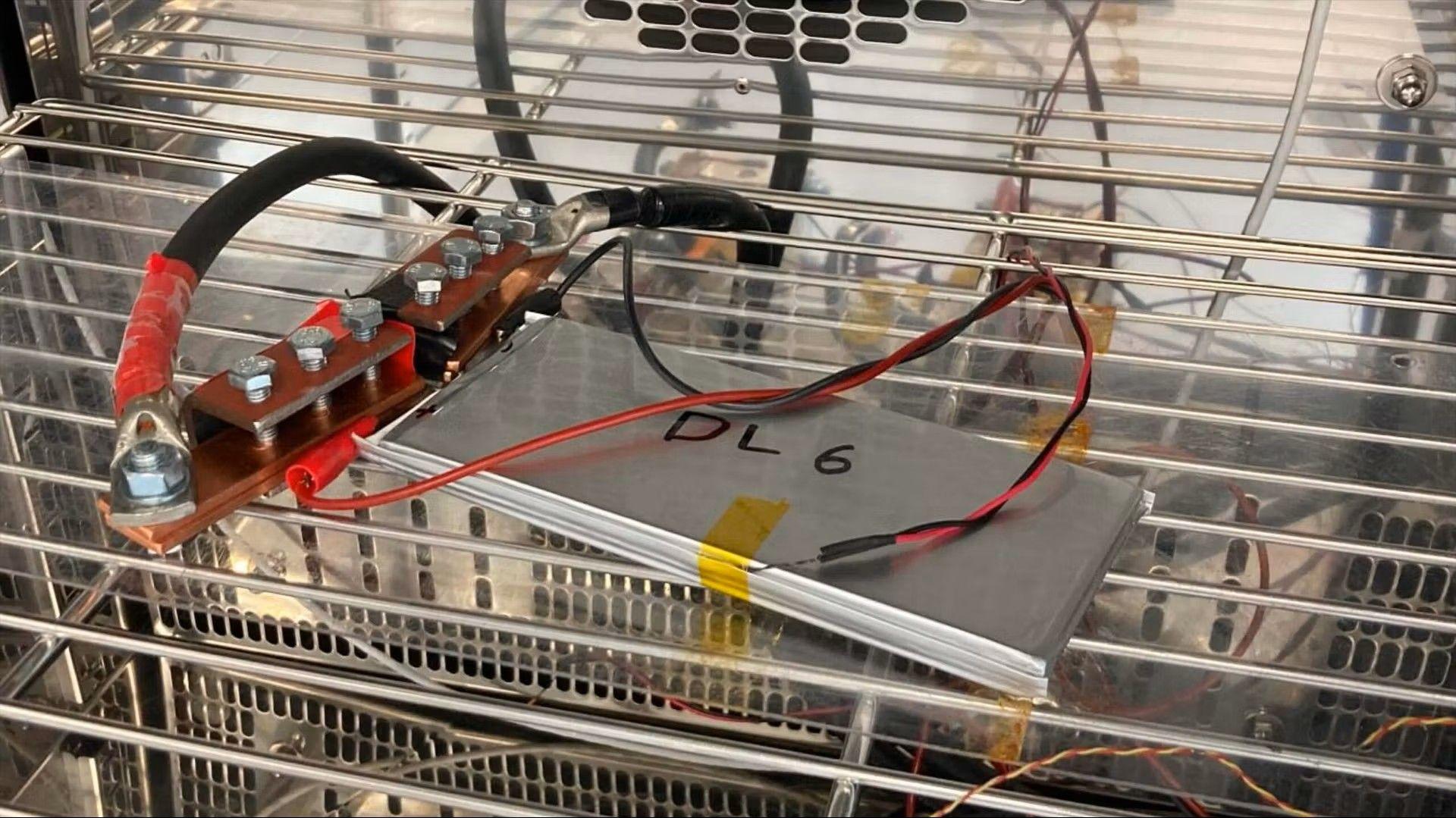
Donut Lab has announced that independent testing of its battery technology yielded an energy density of 409 watt-hours per kilogram and 805 watt-hours per liter. The figures come from a report issued by VTT, a research organization.
According to Ville Piippo, the company’s CTO, the evaluation was simple in principle because energy density is determined by how much energy a cell can store relative to its mass or volume. He added that the cell tested by VTT used the same chemistry as in the organization’s previous work, but had been tuned specifically for energy as part of Donut Lab’s broader development program.
During the evaluation, VTT first recorded the cell’s weight and dimensions. The battery was then charged and discharged across its entire voltage range at 25 degrees Celsius to measure the total extractable energy. Dividing that energy by mass produced the gravimetric figure, while dividing by volume gave the volumetric result.
Marko Lehtimäki, CEO of Donut Lab, described the latest data, along with other capabilities demonstrated earlier in the spring, as evidence that the Donut Battery is more than a single innovation. He said the results point to the technology’s wider potential, which can be expanded through relatively modest optimizations. Since the product launch, the company has shifted its focus to manufacturing next-generation cells and intends to bring production to an industrial scale.
Donut Lab serves customers across vehicles, drones, and battery energy storage systems. Rather than offering one standard product, the company creates customized battery variants designed to meet the technical demands of different sectors.
The company is also collaborating with Intertek on testing its next-generation cells. Intertek’s examination of the internal structure confirmed a bipolar design, in which several electrochemical layers are connected in series inside a single cell. Donut Lab notes that such an architecture is compatible only with a solid electrolyte, since a liquid electrolyte would not support the configuration. In a separate nail penetration test, Intertek drove a steel nail through a fully charged cell and left it in place for one hour to simulate a permanent internal short circuit. The cell remained stable for the duration of the test.
Welcome to contact us:
Inquire more product details from the: Lithium Ion Battery Suppliers
WhatsApp/Wechat/Mobile: +86 13326321310
Email: info@battery-energy-storage-system.com
Website: www.battery-energy-storage-system.com
Ready to power your energy systems with the best in the industry?
Contact us today to get the latest pricing and discuss your needs with our team!
Next:17 pcs REPT 320Ah LiFePO4 Cells Shipped to Reunion
Previous:15 pcs Sinopoly 100Ah LiFePO4 Cells Shipped to Canada