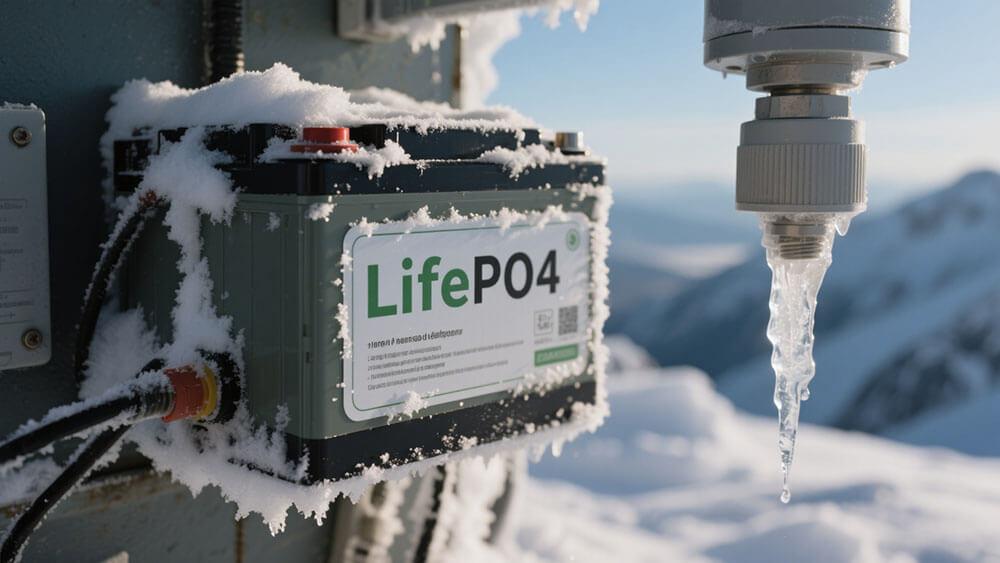
When LiFePO4 batteries are specified for industrial machinery, grid-connected storage, robotics, medical devices, infrastructure, or other equipment that must work in severe conditions, cold-weather behavior becomes a central engineering issue. The chemistry is valued for safety, thermal stability, and long service life, yet low temperatures still constrain how much energy the pack can hold, how quickly it can be recharged, and how reliably it can deliver power.
Market demand for lithium batteries capable of ultra-low-temperature operation continues to rise. By 2032, that market is expected to reach USD 2.8 billion, expanding at a compound annual growth rate of 9.8%. For designers, the challenge is not only choosing a cell but building a complete system that can manage temperature, charging, and protection.
Cold conditions can sharply cut usable capacity and charging efficiency. From -20°C to 0°C, as much as half the rated capacity may become unavailable, and charging can be severely restricted.
The most serious issue occurs when charging below 0°C. Under freezing conditions, lithium can plate onto the graphite anode. This may permanently reduce capacity and introduce safety hazards.
LiFePO4 cells generally compare favorably with NMC cells in thermal stability and cycle life. Even so, both chemistries need charging limits, heating, insulation, and BMS control when they operate in cold climates.
| Temperature window | Effect on usable capacity | Effect on charging |
| -20°C to 0°C | Losses can reach 50% | Severe limitation; charging may fail |
| 0°C to 10°C | Losses commonly around 20–30% | Slower charging; excessive current can cause damage |
Cold affects LiFePO4 batteries through several linked mechanisms:
- Less energy can be withdrawn.
- Ohmic and charge-transfer resistance rise.
- Charging becomes less efficient.
- Lithium ions move more slowly.
- Discharge voltage may sag because polarization grows.
- Sub-freezing charging raises lithium-plating risk.
- Heating and thermal management become more critical.
For cold-climate applications, these factors must be designed into the pack from the start.
The electrolyte is the medium through which lithium ions travel between electrodes. As temperature drops, the electrolyte becomes more viscous, and its ability to conduct ions falls.
One source reports ionic conductivity dropping from about 2.5 mS cm⁻¹ at 30°C to 0.22 mS cm⁻¹ at -20°C. That change makes ion transport harder, raises internal resistance, and slows charge-transfer reactions. The temperature dependence can be described with the Arrhenius relationship, which reflects the higher activation energy needed for ion movement at low temperature.
Improved electrolyte formulations can help preserve ionic conductivity and support better cold-weather operation.
Polarization is the gap between a battery’s theoretical voltage and the voltage observed under real operation. In cold conditions, polarization increases because electrochemical reactions slow and charge-transfer resistance rises.
LiFePO4 cathodes use an olivine structure with narrow lithium-ion diffusion paths. Their electronic conductivity also depends heavily on carbon coating, so charge-transfer impedance can climb significantly in the cold. The graphite anode likewise becomes more resistant to lithium-ion intercalation. If charging conditions are poor, this can encourage lithium-metal deposition.
Thermal management and preheating help by moving cells closer to their preferred operating temperature, which reduces polarization.
Diffusion is essential during both charge and discharge. At low temperatures, lithium ions move more slowly because processes such as desolvation and intercalation into graphite require more energy.
The source material notes that at about -2°C, charging above C/2 can increase lithium precipitation, with up to 9% capacity loss reported at 1C. Slower diffusion raises electrochemical polarization and can promote metallic lithium precipitation. Low-temperature charging therefore demands tightly controlled current and robust battery protection.
Reduced capacity is one of the most visible cold-weather effects. LiFePO4 packs simply cannot store and release as much energy when they are cold.
From roughly -20°C to 0°C, capacity loss may reach 50%, while charging efficiency can fall so far that charging fails. From 0°C to 10°C, capacity loss can still be about 20% to 30%, and charging takes longer.
The root cause is slower electrochemistry. As temperature falls, electrolyte viscosity rises and ionic conductivity drops, so lithium ions move less effectively between electrodes. This matters greatly in robotics, medical equipment, infrastructure systems, and other uses that depend on stable energy output.
Cold also raises the internal resistance of LiFePO4 batteries. Lower ionic mobility and slower charge-transfer reactions make lithium-ion movement less efficient.
Higher internal resistance causes extra losses during both charging and discharging. Under load, it produces larger voltage drops and reduces the usable efficiency of the pack.
In transportation equipment, security systems, industrial machinery, and consumer electronics, the result can be shorter runtimes and slower charging. Battery designers can limit these effects with optimized cell materials, thermal management, and preheating systems that keep cells in a more favorable temperature range.
Lithium plating is one of the most important low-temperature risks.
During normal charging, lithium ions enter the graphite anode structure. In the cold, lower ionic conductivity and slower lithium-ion diffusion can prevent that reaction from proceeding normally. Instead, metallic lithium may deposit on the anode surface.
This is lithium plating.
It can reduce capacity and contribute to internal short-circuit risks. In medical equipment, robotics, and other applications where reliability and safety are critical, preventing plating is especially important.
A practical approach is to avoid charging LiFePO4 batteries below 0°C unless the pack has been specifically engineered for low-temperature charging. Preheating can raise cell temperature above the critical threshold before charging starts.
LiFePO4 chemistry is generally chosen for thermal stability and long cycle life, while NMC offers different energy-density trade-offs. In cold environments, however, neither chemistry removes the need for careful system design.
Both require appropriate charging limits, battery heating, insulation, and BMS protection. For LiFePO4, the primary cold-weather concerns remain reduced capacity, higher resistance, slower ion movement, and lithium-plating risk below freezing.
Preheating is one of the most direct ways to improve LiFePO4 performance in cold environments.
A Battery Thermal Management System (BTMS) can use active, passive, or hybrid heat-transfer methods to regulate cell temperature.
| Method | Function |
| Active heat transfer | Uses external energy to control battery temperature |
| Passive heat transfer | Relies mainly on natural heat flow |
| Hybrid system | Combines active and passive approaches |
In cold-weather applications, a heating system can raise cell temperature before charging, lowering lithium-plating risk and helping restore usable performance.
Pack architecture strongly influences low-temperature behavior.
Designers can add thermal components such as cold plates and optimized heat-transfer structures to improve temperature regulation. Flow dynamics, thermal-channel geometry, and material selection all affect thermal efficiency.
For industrial transportation, infrastructure, and other demanding uses, an optimized pack design can improve temperature uniformity, reliability, and operating consistency.
Electrolyte engineering offers another route to better cold-weather performance.
Research into binary solvent systems and multifunctional additives has shown potential for maintaining ionic conductivity at lower temperatures. Components such as ethylene carbonate and lithium hexafluorophosphate (LiPF6) can support charge-transfer performance when properly formulated.
The goal is to reduce resistance, preserve lithium-ion mobility, and improve charge and discharge behavior in cold environments.
For systems exposed to freezing or sub-zero conditions, consider these principles:
- Do not charge below 0°C unless the battery is explicitly designed for low-temperature charging.
- Preheat the battery before charging in freezing conditions.
- Use BMS temperature protection to control charging based on cell temperature.
- Optimize thermal management for consistent cell temperatures.
- Choose electrolyte technology suited to the expected operating environment.
- Design the pack for thermal uniformity, especially in high-power applications.
- Address cold-weather performance during initial design, not as a later add-on.
Low temperatures affect LiFePO4 batteries by reducing usable capacity, increasing internal resistance, slowing lithium-ion diffusion, raising polarization, and creating lithium-plating risk during charging.
The answer is not simply to switch chemistries. Reliable cold-weather performance depends on the whole battery system: cell chemistry, electrolyte formulation, BMS protection, thermal management, preheating, charging strategy, and mechanical pack design.
For equipment that must operate in harsh environments, these factors should be evaluated together so the battery system can deliver dependable performance across its intended temperature range.
Recharging below 0°C raises the chance of lithium plating on the graphite anode. That can cause permanent capacity loss and may create safety issues. Preheating the battery before charging is an important way to reduce this risk.
Preheating, thermal management, optimized pack design, and suitable electrolyte formulations can all help. A properly configured BMS should also monitor cell temperature and block unsuitable charging conditions.
Cold temperatures lower electrolyte ionic conductivity, slow electrochemical reactions, and increase internal resistance. The battery therefore cannot deliver energy as efficiently as it can in warmer conditions.
Yes, provided the battery system is properly designed. The critical issue is controlling charging, especially when cell temperatures drop below freezing.
A heater or preheating system is valuable when a battery must charge or operate reliably in very cold environments. The right thermal-management approach depends on the application, operating temperature, charging current, pack design, and battery specifications.
Welcome to contact us:
Inquire more product details from the: Lithium Ion Battery Suppliers
WhatsApp/Wechat/Mobile: +86 13326321310
Email: info@battery-energy-storage-system.com
Website: www.battery-energy-storage-system.com
Ready to power your energy systems with the best in the industry?
Contact us today to get the latest pricing and discuss your needs with our team!
Next:None
Previous:3 Pcs 3.7V 30Ah Solid-State Lithium-Ion Batteries Shipped to the USA