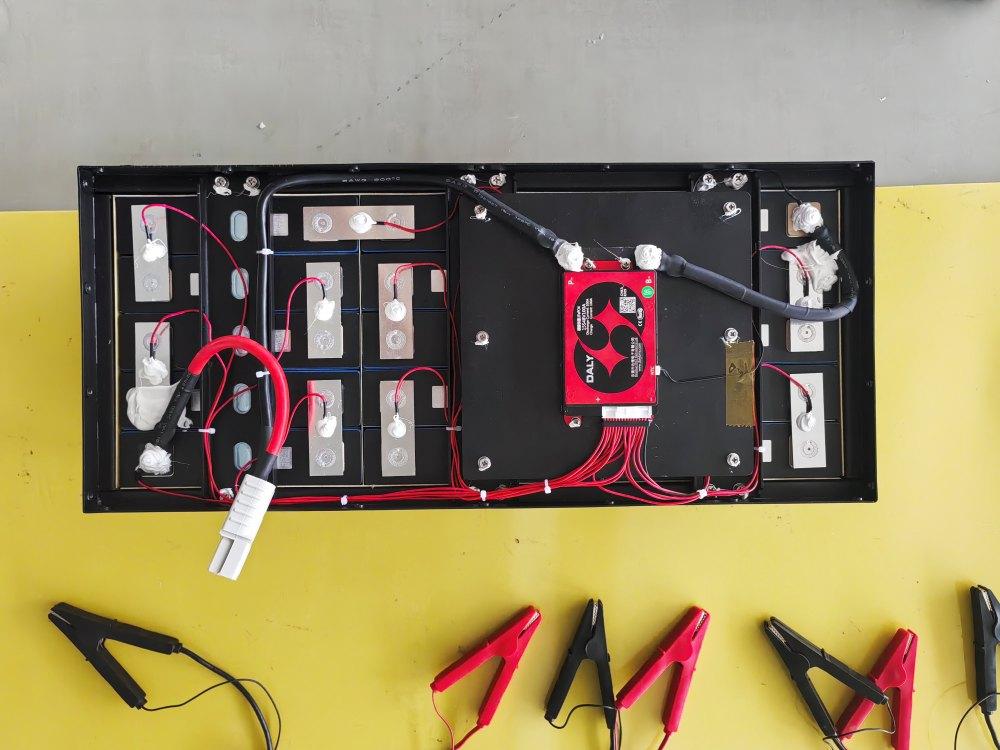
Assembling your own LiFePO4 battery pack is one of the most satisfying DIY energy projects out there — provided you nail the cell configuration before you pick up a single busbar. This manual walks you through:
- The exact series and parallel setups for 12V, 24V, and 48V systems
- The critical choice between series-first (4S2P) and parallel-first (2P4S) wiring — and when each wins
- How to pick the right BMS for every voltage level
- Physical layout strategies that protect performance and safety
- Common wiring blunders that kill cells (and how to dodge them)
Whether you’re building a DIY solar storage bank, powering an RV, or running an off-grid cabin, this guide gives you everything you need to do it right from the start.
Every prismatic LiFePO4 cell has a nominal voltage of 3.2V, a full-charge voltage of 3.65V, and a low-voltage cutoff of 2.5V. The chemistry’s famously flat discharge curve means the cell delivers steady power across most of its capacity — a huge advantage for system stability.
Since 3.2V alone matches no standard system voltage, you connect cells in series to raise the voltage and in parallel to increase amp-hour capacity. You can also combine both methods.
Non-Negotiable Rules
- Series connection → voltages add up, capacity stays the same
- Parallel connection → amp-hours add up, voltage stays the same
- Series-parallel (or parallel-series) → both voltage and capacity increase
| System Voltage | Cells in Series | Nominal Voltage | Working Range | Typical Use |
| 12V | 4S | 12.8V | 10V – 14.6V | RV, marine, small solar |
| 24V | 8S | 25.6V | 20V – 29.2V | Mid-size solar, e-bikes |
| 48V (true) | 15S | 48.0V | 37.5V – 54.75V | Inverters, off-grid |
| 48V (recommended) | 16S | 51.2V | 40V – 58.4V | Powerwall, large solar |
Pro Tip: A 16S (51.2V) pack beats 15S (48V) almost every time. You gain about 6.5% more energy per cell and vastly better compatibility with popular 48V inverters from Victron, Deye, and Growatt, which actually expect a 51.2V nominal input.
To hit a nominal 12V, you need 4 cells in series (4S). This is the workhorse for RV house batteries, marine applications, and compact solar setups.
4S1P — The Basic 12V Block
Configuration: 4 cells in series, 1 parallel group
Result: 12.8V, capacity = capacity of one cell
This is the simplest 12V build. Connect four cells positive-to-negative in a single chain. Pack voltage is 4 × 3.2V = 12.8V. Capacity equals whatever a single cell is rated.
Example: 4 × 280Ah cells in 4S1P = 12.8V 280Ah = 3.58 kWh
Best physical layout: Straight line, all cells facing the same direction. The main positive and negative terminals end up at opposite ends, maximizing separation and reducing the chance of accidental shorts.
8-Cell 12V Setups: 4S2P vs. 2P4S
When you want double the capacity, you use 8 cells. Here’s where the big decision lives: series-first (4S2P) or parallel-first (2P4S)?
Option A: 4S2P (Series-First)
Build two separate 4S strings at 12.8V each, then connect those strings in parallel.
Result: 12.8V, Ah = 2 × single cell Ah
Advantages:
- Each string operates independently until the final parallel hookup
- Pre-balancing individual strings before joining is straightforward
- If a cell fails, you can quickly identify which string has the issue
Disadvantages:
- You must match the string voltages precisely before connecting in parallel
- The BMS has to manage the combined current from both strings
Option B: 2P4S (Parallel-First) — Usually the Winner
Pair cells in parallel first (two cells side-by-side at each position), then connect the four parallel groups in series.
Result: 12.8V, Ah = 2 × single cell Ah (identical capacity to 4S2P)
Why experienced builders lean toward parallel-first:
- Cells self-balance within each parallel pair before any series voltage stress kicks in
- Busbar runs stay shorter, cutting voltage drop
- A symmetrical layout makes cell compression easier to maintain
- The BMS sees a clean 4S string — simpler wiring
Example: 8 × 280Ah cells in 2P4S = 12.8V 560Ah = 7.17 kWh
Expert Note: There’s no one-size-fits-all answer. If your cells are tightly matched (within 5mV and 1% of rated Ah from the same batch), parallel-first works beautifully. For mixed-age or slightly mismatched cells, series-first gives you more granular monitoring and control.
To reach 24V nominal, you need 8 cells in series (8S).
8S1P — The Foundation 24V Pack
Configuration: 8 cells in series
Result: 25.6V at single-cell capacity
Example: 8 × 280Ah cells = 25.6V 280Ah = 7.17 kWh
24V systems hit a sweet spot for mid-sized solar arrays, e-bikes with large packs, and as building blocks for 48V systems.
16-Cell 24V Setups: 8S2P vs. 2P8S
The logic mirrors the 12V builds. You can go series-first (8S2P) or parallel-first (2P8S).
8S2P (Series-First)
Build two independent 8S strings at 25.6V each, then parallel them.
2P8S (Parallel-First) — Preferred for Large Cells
At 24V, cells are physically large (280Ah–314Ah prismatics). The 2P8S layout keeps busbars short and symmetric, which really matters when these beefy cells push high current.
Example: 16 × 280Ah cells in 2P8S = 25.6V 560Ah = 14.34 kWh
Physical layout possibilities for 16-cell 24V packs:
- Block (2×8 grid): Compact, suits square enclosures
- Straight (1×16 line): Excellent for long, narrow spaces like under RV slides
- Long double row: Two rows of 8, ideal for standard battery boxes
48V is the standard for serious off-grid solar, whole-home backup, and high-powered inverters. It’s where most experienced DIYers eventually land.
Why 48V Beats 12V or 24V?
Higher voltage means lower current for the same power. A 5,000W load demands:
- 417A at 12V → massive cables, huge heat, complex BMS
- 208A at 24V → still heavy wiring
- Only 104A at 48V → manageable cables, less heat, safer
That’s why professional installers almost always go 48V for systems over 3kW.
15S vs. 16S: Which 48V Pack Should You Build?
| 15S (48V) | 16S (51.2V) | |
| Cells in series | 15 | 16 |
| Nominal voltage | 48.0V | 51.2V |
| Full charge | 54.75V | 58.4V |
| Energy (per 280Ah cell) | 13.44 kWh | 14.34 kWh |
| Inverter match | Limited | Wide (Victron, Growatt, Deye, etc.) |
| BMS availability | Scarce | Abundant |
| Recommended? | No | Yes |
Verdict: Build 16S. The extra cell costs a bit more but unlocks 6.5% more energy, far better inverter compatibility, and a huge selection of off-the-shelf 16S BMS units.
16S1P — The Standard 48V DIY Pack
Configuration: 16 cells in series
Result: 51.2V at single-cell Ah
Example: 16 × 280Ah cells = 51.2V 280Ah = 14.34 kWh
Example: 16 × 304Ah cells = 51.2V 304Ah = 15.56 kWh
Example: 16 × 314Ah cells = 51.2V 314Ah = 16.08 kWh
This is the classic Powerwall-style build — one BMS, one pack, clean wiring.
Physical layout options:
- Block (4×4 grid): Most compact, great for cube-shaped boxes
- Straight (1×16 line): Long but extremely safe, terminals at opposite ends
- 2×8 double row: Popular for custom plywood or aluminum enclosures
32-Cell 48V Configurations: 16S2P vs. 2P16S
This is the big league — 32 large prismatic cells creating 28+ kWh in a single pack.
16S2P (Series-First)
Assemble two complete 16S strings at 51.2V each, then parallel them.
Best for: Builders who want to test and balance each string independently. Also smart when cells come from different batches or have slightly mismatched internal resistance.
Critical warning: The two 16S strings must be within 0.1V of each other before paralleling. Use a multimeter. Connect through a pre-charge resistor to tame inrush current if possible.
2P16S (Parallel-First) — Recommended for Matched Cells
Pair cells in parallel first, then connect the 16 parallel groups in series.
Best for: Well-matched cells from a single batch. Keeps busbar runs short and symmetric. The BMS sees a simple 16S configuration.
Example: 32 × 280Ah cells in 2P16S = 51.2V 560Ah = 28.67 kWh
Example use case: Whole-home backup for a 3-bedroom house running 2+ days without solar.
The Battery Management System is the brain and guardian of your pack. Getting it wrong is the #1 mistake DIY builders make.
12V System BMS (4S)
- Rating: 4S, 12.8V nominal
- Current: Size for your peak load. For a 3000W inverter: 3000W ÷ 12V = 250A peak → use a 250–300A BMS
- Popular: Daly 4S, JK BMS 4S, ANT BMS 4S
- Active balancing recommended for packs over 200Ah
24V System BMS (8S)
- Rating: 8S, 25.6V nominal
- Current: 3000W ÷ 24V = 125A → use 150–200A BMS
- Popular: Daly 8S, JK BMS 8S
48V System BMS (16S)
- Rating: 16S, 51.2V nominal
- Current: 5000W ÷ 48V ≈ 104A → use 150–200A BMS
- For 32-cell builds: Either one 16S BMS with dual-string parallel output or a BMS designed for 2P configurations
- Popular: JK BMS 16S Active Balancer, Daly 16S Smart BMS, JKBMS with CAN/RS485 for Victron integration
BMS Tip for Inverter Integration: If you’re pairing with a Victron Multiplus, Growatt, or Deye inverter, pick a BMS with CAN bus or RS485 communication. This lets the inverter read state-of-charge, cell voltages, and temperature directly from the BMS, enabling much smarter charge/discharge control.
Busbar Current Capacity
Busbars carry the full pack current. Undersized bars create heat and resistance, degrading performance and safety.
| Pack Voltage | Typical Peak Current | Minimum Busbar Cross-Section |
| 12V 4S | 200–300A | 50mm² copper / 80mm² aluminum |
| 24V 8S | 100–150A | 35mm² copper / 50mm² aluminum |
| 48V 16S | 80–120A | 25mm² copper / 35mm² aluminum |
Factory busbars are sized for series connections only. For parallel (2P) builds, you need heavier busbars — at minimum double the thickness of the stock bars, or dedicated heavy-duty parallel busbars.
Busbar Length and Voltage Drop
Long busbars spanning multiple cells in parallel setups create small but meaningful voltage differences between the first and last cell on the bar. Because the LiFePO4 curve is so flat, even a 5–10mV delta can make cells drift over hundreds of cycles.
Best practice: Keep parallel busbars as short as possible. If you must span more than two terminals, use a single multi-hole busbar rather than chaining two-hole bars — each inter-busbar joint adds more resistance than the bar itself.
The Straight Layout: Safest by Design
The straight (single-row) layout positions all cells in a line with alternating terminal orientations. The pack’s final positive lands at one end, final negative at the opposite end, maximizing physical separation and drastically cutting the risk of accidental shorts during assembly and maintenance.
Block (grid) layouts are more compact but put the main terminals closer together. Always install a main fuse or breaker between the pack and the load when using block configurations.
Before connecting anything, verify your cells are truly matched. Mismatched cells in series force the weakest one to hit cutoff first on discharge and overcharge first on charge, rapidly aging that cell — and soon, the whole pack.
Matching Checklist Before Assembly
- Voltage match: All cells within 5mV (ideally within 2mV)
- Capacity match: Test each cell. Group cells within 1–2% of rated Ah
- Internal resistance match: Measure with a battery tester. Match within 0.1mΩ for parallel connections
- Same batch: Cells from the same manufacturing lot are naturally closest
- Temperature: Let all cells stabilize to room temperature before measuring or connecting
- Top-balancing before first use: Before sealing the pack, parallel all cells for 24–48 hours to equalize their voltages. Then disassemble and arrange in your final configuration. This top-balance dramatically improves long-term cell health.
| Application | Recommended Configuration | Example Build |
| RV house battery (small) | 4S1P | 4 × 100Ah = 12.8V 100Ah (1.28 kWh) |
| RV house battery (large) | 4S2P or 2P4S | 8 × 280Ah = 12.8V 560Ah (7.17 kWh) |
| Off-grid cabin, small | 16S1P | 16 × 280Ah = 51.2V 280Ah (14.34 kWh) |
| Off-grid cabin, large | 16S2P or 2P16S | 32 × 280Ah = 51.2V 560Ah (28.67 kWh) |
| Powerwall / home backup | 16S1P | 16 × 314Ah = 51.2V 314Ah (16.08 kWh) |
| Marine trolling motor | 4S1P | 4 × 100Ah = 12.8V (replaces group 27) |
| E-bike / EV conversion | 8S or 16S custom | Based on motor controller voltage |
| Grid-tied solar buffer | 16S1P or 2P16S | With Victron/Deye inverter + CAN BMS |
Run through this list before connecting your pack to any load or charger:
- All cell voltages within 5mV of each other
- All busbars torqued to manufacturer spec (typically 4–6 Nm for M6 terminals)
- BMS wiring harness connected in correct sequence (usually B- first)
- Main fuse or breaker sized correctly between pack and load
- Enclosure provides adequate compression (1–2 PSI recommended for prismatic cells)
- BMS temperature sensor in direct contact with cells, not just sensing ambient air
- Every connection verified with a multimeter before closing the enclosure
- Charge/discharge voltage cutoffs programmed correctly in the BMS
Can I mix cell brands in the same pack?
No. Different brands use distinct internal chemistry formulations, leading to different internal resistance and capacity curves. Even with matching specs on paper, cells will drift apart over time. Stick to one brand, ideally one batch.
Can I add more cells to an existing pack?
You can parallel additional cells into an existing pack only if the new cells are top-balanced to match the existing pack voltage first. Expanding a series string is not recommended — it alters the pack voltage and makes your current BMS incompatible.
My cells arrived at 3.3V. Is that normal?
Absolutely. Cells ship at a partial state of charge (usually 30–50%) for transport safety. 3.3V on a LiFePO4 cell represents roughly 30–40% SoC. Always top-balance them before the first assembly.
How many cycles will my DIY pack deliver?
Grade A LiFePO4 cells from top manufacturers (CATL, EVE, Lishen) are rated for 3,000–6,000 cycles to 80% capacity. With one full cycle per day, that’s 8–16 years of useful service. The BMS often fails first — put your money into a quality unit.
Is 4S2P or 2P4S better?
For well-matched cells from the same batch: go 2P4S (parallel-first). For cells of different ages or from different batches, 4S2P (series-first) lets you monitor each series string independently and intervene sooner if drift appears.
Inquire more product details from the: Lithium Ion Battery Suppliers
WhatsApp/Wechat/Mobile: +86 13326321310
Email: info@battery-energy-storage-system.com
Website: www.battery-energy-storage-system.com
Next:Ganfeng Lithium Begins Small-Scale Production of 500 Wh/kg Solid-State Batteries
Previous:Svolt Will Start Mass Production of Hybrid Solid-Liquid Batteries in September