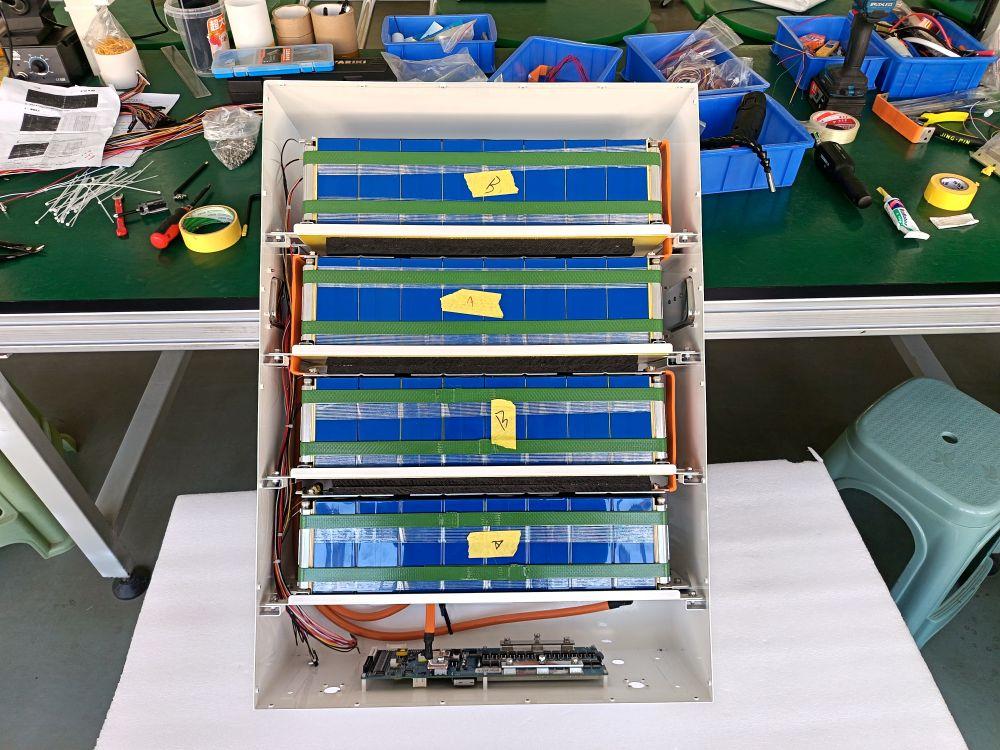
When designing battery packs for electric vehicles, consumer electronics, robotics, and industrial systems, lithium-ion battery weight and energy density rank among the most critical factors. Higher energy density allows a battery to store more energy while keeping weight low, which directly improves performance, efficiency, and operating range.
Today’s commercial lithium-ion batteries can reach energy densities around 350 Wh/kg. This progress enables manufacturers to create lighter packs that offer longer runtimes and better overall energy efficiency.
Energy density indicates how much energy a battery can hold relative to its weight or volume. It serves as a key metric for evaluating battery efficiency and performance.
| Term | Definition | Unit |
| Gravimetric Energy Density | Energy stored per unit of battery weight | Wh/kg |
| Volumetric Energy Density | Energy stored per unit volume | Wh/L |
| Battery Weight | Total battery mass including casing and electronics | kg |
| Lithium-ion Battery Density | General measurement of energy storage capability | Wh/kg or Wh/L |
Of these, gravimetric energy density is especially important in weight-sensitive applications like electric vehicles, drones, and portable electronics.
Electric Vehicles
Battery weight directly influences driving range, acceleration, and energy efficiency. A lighter battery pack helps improve vehicle handling and lowers energy consumption.
Portable Electronics
Smartphones, laptops, and medical devices depend on lightweight batteries to stay portable while achieving long operating times.
Robotics and Industrial Systems
Reducing battery weight allows robots and industrial machinery to operate more efficiently, enhancing both mobility and runtime.
| Battery Technology | Energy Density | Key Advantage |
| Commercial Lithium-Ion Batteries | ~350 Wh/kg | Current industry standard |
| Theoretical Li-ion Limit | 400–500 Wh/kg | Maximum possible density with safety challenges |
| Solid-State Batteries | 500–700 Wh/kg | Next-generation high density and safety |
| Nickel-Rich NCM Cathodes | +10–20% vs NMC | Higher energy capacity |
| LFP Batteries | 160–180 Wh/kg | Excellent safety and long lifespan |
Battery packs typically deliver 30–40% lower energy density than individual cells because of structural components such as cooling systems, wiring, and enclosures.
Battery Size and Cell Design
Cell design details—including electrode thickness and active material particle size—directly affect capacity, thermal behavior, and overall battery weight.
Battery Chemistry
| Chemistry | Energy Density | Characteristics |
| LiFePO4 (LFP) | 90–160 Wh/kg | Safe with long cycle life |
| NMC | 150–250 Wh/kg | High energy density |
| NCA | 200–260 Wh/kg | Lightweight and high performance |
| LCO | 150–200 Wh/kg | Common in consumer electronics |
| LTO | 50–80 Wh/kg | Extremely long lifespan |
Engineers often use a straightforward formula to estimate battery weight during system design:
Battery Weight (kg) = Battery Capacity (Ah) × Nominal Voltage (V) ÷ Energy Density (Wh/kg)
Example: Laptop Battery
Capacity: 7800 mAh
Voltage: 11.1 V
Total Energy: 86.58 Wh
Chemistry: LMO (120 Wh/kg)
Estimated Weight: 0.72 kg
Example: Portable Power Station
Capacity: 2000 Wh
Chemistry: NMC (150 Wh/kg)
Estimated Weight: 13.3 kg
| Application | Weight per Wh | Example |
| Consumer Electronics | 3.8–10 g/Wh | Smartphones and laptops |
| Electric Vehicles | 6–8 g/Wh | EV battery packs |
| Lead-acid Batteries | ~25 g/Wh | Backup power systems |
Battery cells usually make up about 60% of the total pack weight. The remaining mass comes from support systems and structural elements.
| Component | Typical Weight Share |
| Cathode | 20–25% |
| Electrolyte | 10–15% |
| Anode | 5–10% |
| Separator | 3–5% |
- Cell-to-Pack (CTP) Technology – removes intermediate modules to improve space utilization.
- Larger Battery Modules – cut down structural mass and connection complexity.
- Integrated Cell Structures – boost mechanical strength while lowering overall weight.
- Lightweight Materials – aluminum alloys and composites reduce enclosure weight.
Research continues on advanced battery technologies aimed at further increasing energy density and cutting battery weight.
Promising directions include silicon anodes, lithium-sulfur batteries, and solid-state electrolytes. Some experimental cells have already shown energy densities above 600 Wh/kg.
These breakthroughs could significantly extend electric vehicle driving range and enable lighter energy storage systems for robotics, aerospace, and portable electronics.
Lithium-ion battery weight and energy density are key factors that determine the efficiency, performance, and practicality of modern battery systems. Choosing the right battery chemistry and optimizing pack design allow manufacturers to build lighter, safer, and more efficient energy storage solutions across a broad range of industries.
Inquire more product details from the: Lithium Ion Battery Suppliers
WhatsApp/Wechat/Mobile: +86 13326321310
Email: info@battery-energy-storage-system.com
Website: www.battery-energy-storage-system.com
Next:CORNEX Secures 12GWh New Strategic Agreements at SNEC 2026
Previous:CATL to Launch Mass Production of Sodium Ion Batteries in 2026