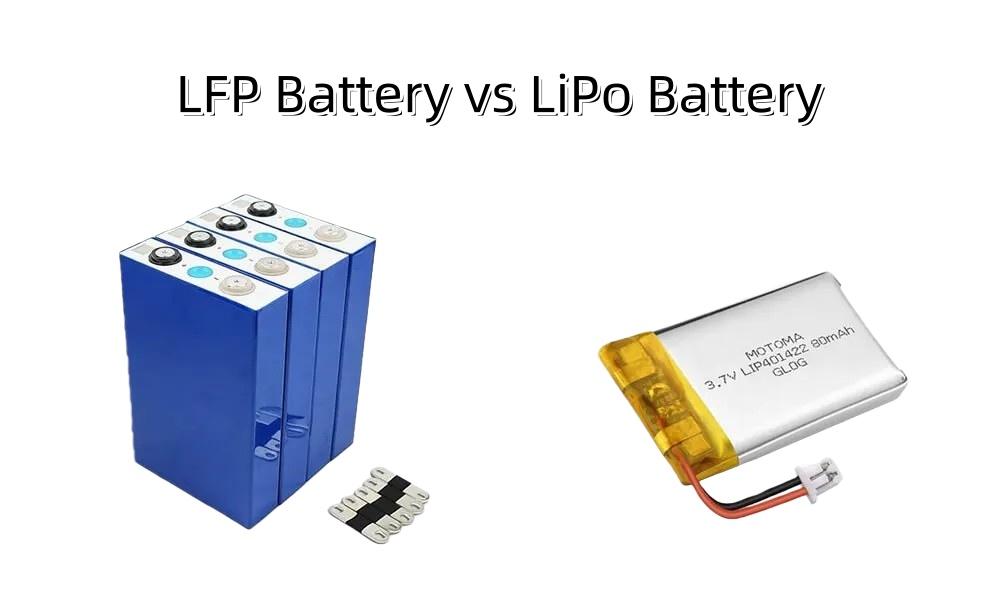
Within the realm of lithium battery technologies, two prominent options emerge: LiFePO4 (Lithium Iron Phosphate) batteries and Lithium-Ion Polymer (LiPo) batteries. While both are members of the wider lithium-ion family, they exhibit substantial differences in performance, safety, lifespan, and practical uses. Grasping these distinctions is key when choosing a battery for applications ranging from solar power and electric vehicles to marine gear and consumer electronics.
A Lithium-Ion Polymer (LiPo) battery is a rechargeable lithium battery that operates on the movement of lithium ions between electrodes. It typically employs a lightweight polymer electrolyte, which enables flexible, slim, and ultra-lightweight packaging.
Common cathode materials in LiPo batteries include:
Lithium Cobalt Oxide (LCO)
Lithium Manganese Oxide (LMO)
Lithium Nickel Manganese Cobalt Oxide (NMC/NCA)
Lithium Iron Phosphate (LiFePO4/LFP)
Thanks to their capability for high discharge rates, LiPo batteries are extensively used in:
Drones
RC hobby models
High-performance power tools
Wearable consumer electronics
This ability to deliver energy rapidly makes them perfect for applications demanding high power output.
A LiFePO4 battery, or LFP battery, is a lithium-ion subtype that uses lithium iron phosphate as its cathode material. This chemistry is renowned for its exceptional safety, stability, and remarkably long cycle life. The anode is usually graphitic carbon with a metal backing.
Key Advantages of LiFePO4 Chemistry:
Outstanding Safety: Features a highly stable thermal and chemical structure.
Long Service Life: Often delivers over 2,000–3,000 charge cycles, with premium batteries exceeding 5,000 cycles.
Lightweight & Compact: Significantly lighter than equivalent lead-acid batteries.
Deep Discharge Tolerance: Can safely be drained to 100% Depth of Discharge (DOD).
Environmentally Friendly: Non-toxic and contains no cobalt.
These benefits make LiFePO4 the preferred choice for:
Solar energy storage systems
Golf carts and mobility vehicles
Marine batteries
Outdoor power stations
Electric motorcycles
Lead-acid battery replacement
| Feature | LiFePO4 (LFP) | LiPo (Standard Li-Ion Polymer) |
| Cycle Life | 2,000–3,000+ cycles | 300–800 cycles (average) |
| Safety | Very High (inherently stable) | Moderate (risk of overheating/swelling) |
| Nominal Voltage | 3.2V per cell | 3.7V per cell |
| Energy Density | Lower | Higher |
| Discharge Rates | Moderate | Very High (up to 150C pulse) |
| Typical Applications | Energy storage, EVs, marine, off-grid power | Drones, RC models, portable electronics |
A standout advantage of LiFePO4 batteries is their extended cycle life. Where a typical LiPo may last only a few hundred cycles, a well-maintained LiFePO4 can often operate for 3,000+ cycles.
Furthermore, LiFePO4 batteries tolerate full depth of discharge without major impact on lifespan, allowing users to access more of the battery's total capacity. This longevity translates to significant cost savings over time, making LiFePO4 highly valuable for long-term energy storage and heavy-duty industrial uses.
LiFePO4 batteries are frequently designed as direct 12V replacements for lead-acid batteries. Since a standard lead-acid unit uses six 2V cells to achieve 12V, connecting four LiFePO4 cells in series creates a compatible voltage:
3.2V × 4 = 12.8V (nominal)
Common LiFePO4 pack configurations include 12V (12.8V), 24V (25.6V), and 48V (51.2V). Higher-voltage banks (e.g., 220V to 380V) are used in forklifts, industrial machinery, and EV power systems. LiFePO4's safety edge over chemistries like NMC or LCO makes it ideal for these high-voltage, high-load environments.
Compared to some LiPo and lead-acid batteries, LiFePO4 generally has poorer low-temperature performance.
Typical operating ranges are:
Discharge: -10°C to -20°C
Charge: 0°C and above
Specialized LFP systems can operate down to -30°C or -40°C for aerospace or deep-sea use, but cold climates often require built-in heaters, temperature-controlled enclosures, or smart Battery Management Systems (BMS). Despite this, many users prioritize LiFePO4 because its safety and long-term durability outweigh the reduced cold-weather performance.
Choose LiFePO4 if you need:
Long service life (years of reliable use)
High safety and thermal stability
Dependable power for solar or off-grid systems
A lightweight, high-performance lead-acid replacement
Choose LiPo if you need:
High burst power output
The lightest possible cells for drones, RC devices, or compact electronics
Very high discharge rates in a minimal space
LiFePO4 and LiPo batteries each play vital but distinct roles. While LiPo batteries excel in power density and compact design, LiFePO4 batteries lead in safety, longevity, and storage stability. By assessing your specific performance demands and application environment, selecting the right battery becomes straightforward.
If long-term value, reliability, and safety are your priorities, LiFePO4 is the superior choice.
If maximum power-to-weight ratio and high discharge rates are critical, LiPo batteries will better meet your needs.
Next:EVE Energy Ships 110 MWh High-Rate Energy Storage Systems to Turkey
Previous:Sunwoda and Zhongwei Partner on Solid-State EV Batteries