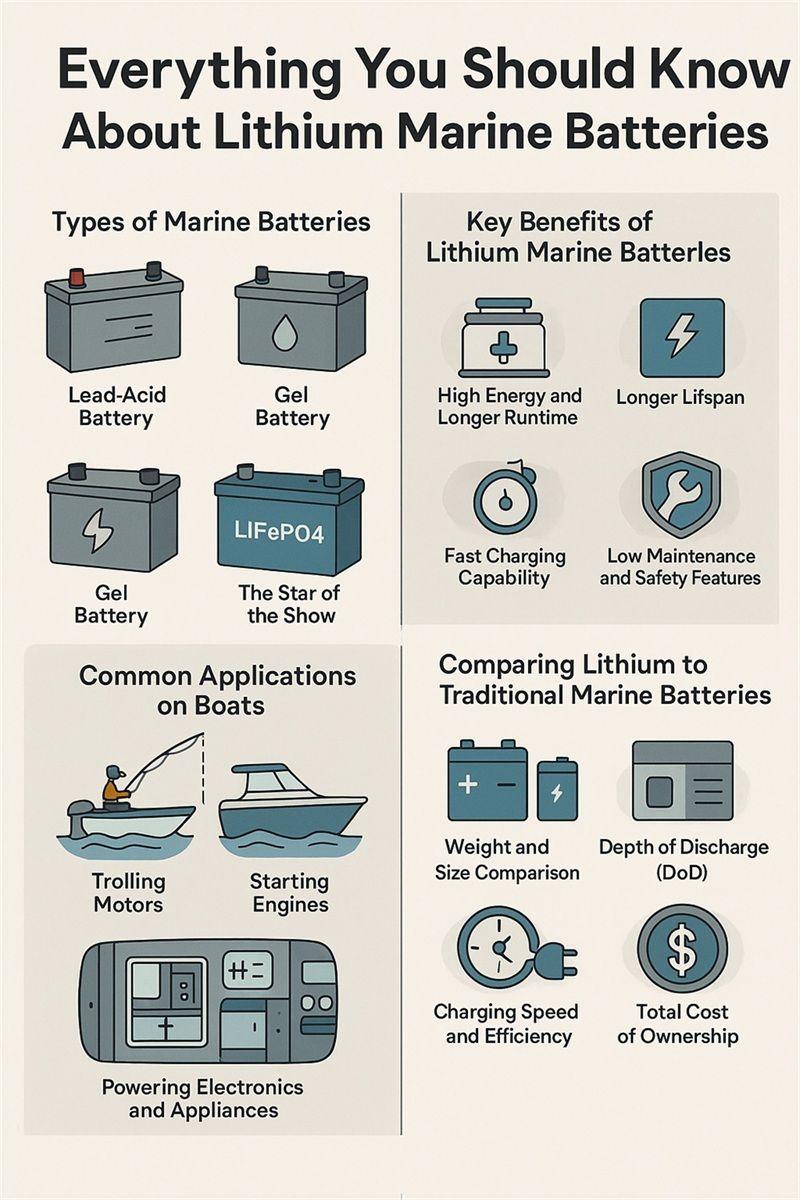
Lithium marine batteries, especially LiFePO4 (lithium iron phosphate) types, are rechargeable power packs purpose-built for life on the water. Stacked against traditional lead-acid batteries, these workhorses deliver more usable energy, last far longer, and recharge way faster — all while being noticeably lighter and safer.
From weekend anglers to full-time cruisers, people are ditching heavy, outdated lead-acid setups for sleek, efficient lithium models. The reason? They’re fed up with the extra weight and constant fuss — and honestly, who wouldn’t want more hours out on the water with fewer headaches?
These are the old guard — cheap up front but bulky, heavy, and high-maintenance. They also lose charge faster and don’t handle deep cycling well at all.
A step above flooded lead-acid, AGMs are sealed and maintenance-free, but they still lag behind lithium when it comes to weight, cycle life, and energy density.
Gel batteries are stable and shrug off vibration, but they’re picky about charging voltages. They cost more than AGMs yet still can’t match lithium’s overall performance.
These are today’s gold standard. LiFePO4 batteries bring unbeatable longevity, top-tier safety, and exceptional performance, especially in demanding marine conditions.
Often up to 70% lighter than their lead-acid counterparts. That translates to better boat handling, quicker planing, and extra room for your gear.
You get more usable power out of every charge, so you can cruise, troll, or just hang out longer without hunting for a recharge.
A quality LiFePO4 battery can easily last 8–10 years, delivering 3,000–5,000 cycles depending on use. Compare that to a typical 300–500 cycles from lead-acid!
Spend less time tied to the dock. Lithium batteries can charge up to five times faster than old-school batteries.
No more topping off with distilled water. Plus, a built-in Battery Management System (BMS) guards against overcharging, overheating, and short circuits.
They deliver steady, long-lasting power — ideal for pulling cranks or drifting all day without battery anxiety.
Lithium starting batteries crank engines quickly and reliably, even after sitting idle for long stretches.
Fish finders, refrigerators, sound systems, you name it — lithium keeps everything humming from sunup to well after sunset.
Lithium batteries are compact and significantly lighter — a huge plus when every pound on a boat matters.
You shouldn’t regularly drain lead-acid past 50%. Lithium can safely be discharged to 80–100% without damage.
Lithium soaks up energy fast with minimal waste. Lead-acid? Slower and far less efficient.
Yes, lithium costs more out of the gate, but it pays for itself over time through extreme longevity, better efficiency, and near-zero maintenance.
Most lithium marine batteries are available in 12V, 24V, or 48V configurations, with capacities from 50Ah to 300Ah. Choose based on how much power your boat actually draws.
Think of the BMS as the battery’s brain. It constantly monitors temperature, voltage, and current — preventing damage and maximizing life.
With over 3,000 cycles, lithium dramatically reduces how often you’ll need to replace batteries, giving you a much better return on investment.
They hold up well in extreme temperatures and deliver steady voltage even under heavy loads.
Choose a dry, cool spot that’s easy to access for monitoring or maintenance. Avoid areas with excessive vibration when possible.
Wiring in series increases voltage, while parallel boosts capacity. Carefully match your setup to your boat’s system requirements.
Lithium batteries don’t off-gas, so ventilation isn’t a big concern. Still, bolt them down properly to handle pounding waves and constant vibration.
Stick to chargers designed for lithium or equipped with a dedicated lithium mode. Using the wrong charger can cause serious damage.
Pairing lithium with solar is a total game-changer for off-grid boating — clean, quiet, and impressively efficient.
Never charge in tight, poorly ventilated spaces. Always follow the manufacturer’s guidelines to the letter.
For long-term storage, leave the battery at about 50% charge in a cool, dry place. Disconnect it if it won’t be used for a while.
Use a battery monitor or companion app to keep an eye on the state of charge, temperature, and overall performance.
Install disconnect switches or low-voltage cutoffs to stop sneaky parasitic loads from draining your battery dead.
Expect to shell out 3–5 times more initially, but the lifetime savings from fewer replacements and greater efficiency far outweigh the early sting.
Most lithium batteries come with 5- to 10-year warranties — yet another sign they’re a rock-solid investment.
Thanks to a robust BMS and non-combustible LiFePO4 chemistry, these batteries rank among the safest on the market.
Use only compatible chargers, keep the battery out of excessive heat, and consider installing temperature sensors for extra peace of mind.
Compared to lead-acid, absolutely. They last far longer and contain no toxic lead or acid.
They still need to be properly recycled. When it’s finally time to retire one, use a certified battery recycling service.
- Your energy needs (amps and volts)
- Desired run time between charges
- Your budget
- Charger compatibility
- Available space
- Mixing lithium with other battery types in the same bank
- Ignoring BMS compatibility
- Overlooking installation requirements
“I switched to lithium last season. Now my fishing trips last twice as long, and I don’t even think about recharging midday.”
Even in saltwater spray and blistering heat, lithium batteries have proven to be reliable, rugged, and remarkably consistent.
Lithium marine batteries are the modern boater’s ultimate companion — powerful, dependable, featherlight, and built to go the distance. While the upfront price may seem steep, the long-term payoff in performance, savings, and worry-free operation is unbeatable. Whether you’re an occasional angler or a full-time liveaboard, making the switch is truly a game-changer.
Yes, especially LiFePO4 types. They come loaded with safety features like thermal protection, short-circuit prevention, and a full BMS.
Absolutely — just be sure your charger is lithium-compatible and your system can handle the upgrade.
They do, but charging in sub-freezing temperatures can be tricky. Some models include built-in heaters for cold climates.
With proper care, most last 8–10 years or well over 3,000 cycles.
It depends on your power consumption. A 100Ah 12V battery is a solid starting point for trolling motors, but always calculate your total daily amp-hour needs to be sure.
Welcome to contact us:
Inquire more product details from the: Lithium Ion Battery Suppliers
WhatsApp/Wechat/Mobile: +86 13326321310
Email: info@battery-energy-storage-system.com
Website: www.battery-energy-storage-system.com
Ready to power your energy systems with the best in the industry?
Contact us today to get the latest pricing and discuss your needs with our team!
Next:GBS 3.2V 400Ah Prismatic LiFePO4 Cells Shipped to the US
Previous:Winston 3.2V 40Ah LiFePO4 Battery Cells Shipped to the US