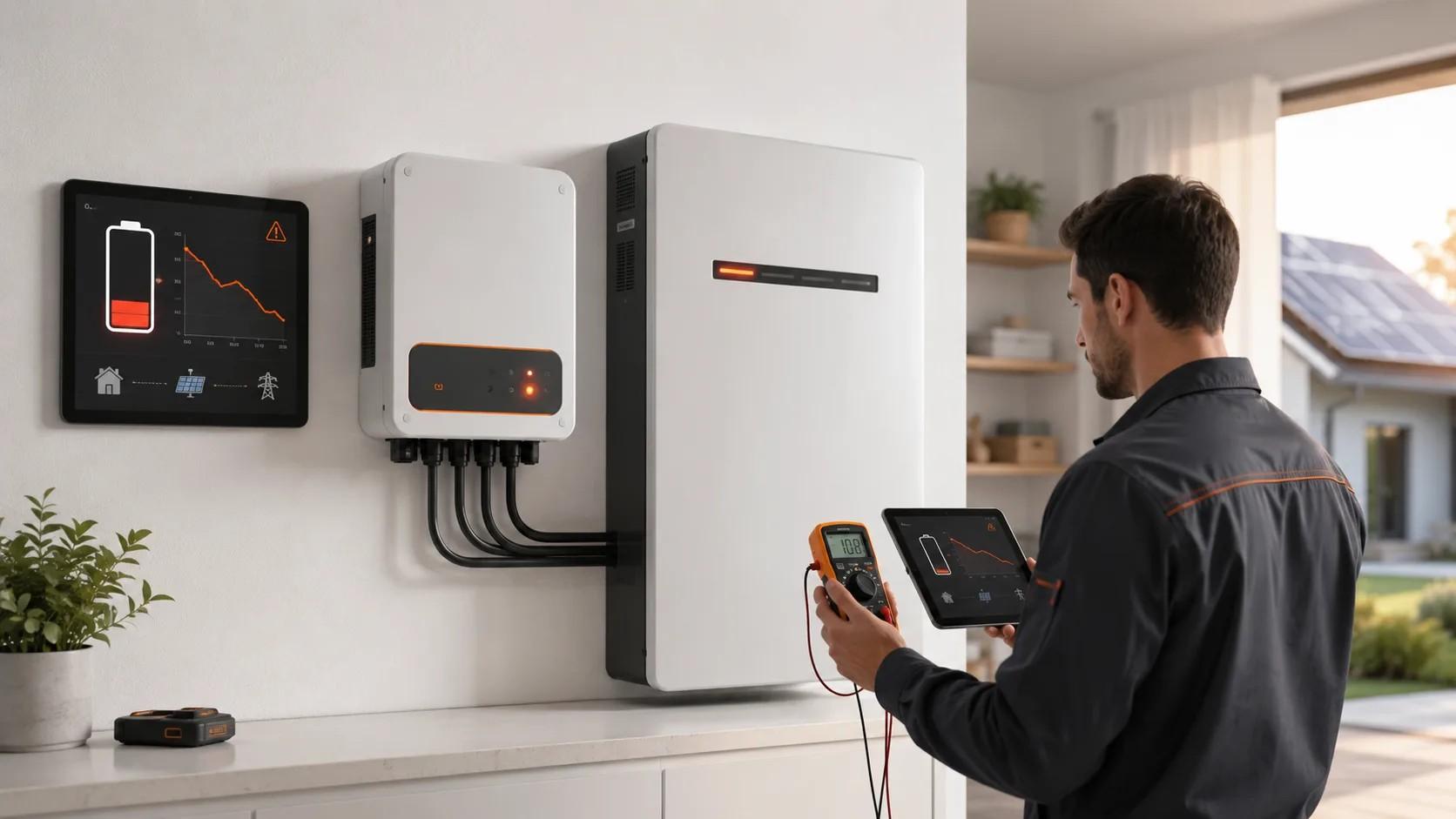
When a vehicle, power inverter, UPS, solar storage bank, RV, boat, or any other battery-run system reports low battery voltage, the alert is telling you that the battery’s output has dropped below what the equipment needs to operate normally.
That warning is not an automatic death sentence for the battery. Voltage can fall because the battery is not fully charged, because too many devices are drawing power, because the charger or alternator is not doing its job, because cables and terminals are restricting current, because temperatures are extreme, or simply because the battery is getting old. If you know what the message is really saying, you can track down the source before the equipment shuts off or the battery suffers lasting harm.
At its most basic, a low-voltage warning means the battery is not delivering enough electrical pressure to run the connected system.
Voltage is the force that moves current through a circuit. Once it drops below a device’s required threshold, that device may behave erratically, sound an alarm, reboot on its own, or stop working altogether.
The condition can come from a battery that just needs a recharge. It can also come from a charging circuit that is failing, or from a battery that is no longer capable of holding a useful charge. So the message should not be read as “replace the battery” right away. It is a prompt to check the battery, the charging path, the wiring, the load, and the environment.
There is no single voltage number that applies to every battery. The right range depends on the battery’s chemistry, how it is wired, its temperature, the load it is carrying, and what it is powering.
For a common 12V battery at rest, a rough guide is:
- 12.6V to 12.8V: charged
- 12.4V to 12.5V: slightly below full
- 12.0V to 12.3V: low
- Under 12.0V: severely low
Treat those figures as general reference points, not absolute rules. A battery can show a temporary voltage dip while powering a large load.
Chemistry matters just as much. Flooded lead-acid, AGM, gel, lithium-ion, and LiFePO4 designs each behave differently and have their own acceptable voltage windows. For any specific battery, the manufacturer’s specifications should be the final authority.
A low-voltage warning can be traced to several different problems.
The battery has been drained. This is the simplest and most frequent explanation. If the battery gives out more energy than it takes in, its voltage will steadily decline. Long run times and several devices operating at once make this more likely.
The battery is old. Age reduces capacity. A worn battery may accept a charge and look fine at first, but its voltage can plummet as soon as it has to supply current. If the warning keeps coming back after proper charging, aging is a strong suspect.
The charging system is not working properly. A battery cannot stay at normal voltage if its charger is failing. Depending on the setup, the fault may lie in a bench charger, an alternator, a solar charge controller, or an inverter-charger. When charging is inadequate, even a good battery can remain undercharged.
Connections are loose or corroded. Resistance rises when terminals, cables, or connectors are dirty, loose, or damaged. That resistance creates voltage loss. The battery may still be healthy, but the equipment cannot receive full current.
The load is too large. Drawing too much power causes voltage to sag temporarily. This is common in RVs, boats, off-grid systems, and backup power setups. If voltage falls mainly when high-power devices start at the same time, the battery bank or load profile needs review.
Temperature is a factor. Cold can reduce available output, while excessive heat speeds up battery deterioration and shortens life. An unexpected low reading should always be considered alongside the operating temperature.
Something is draining power in the background. Certain devices keep using a small amount of electricity even when they appear to be off. Over time, that parasitic draw can pull a battery down, especially if the equipment sits unused for long periods.
Low voltage often shows up as performance problems before the battery fails completely. You may notice:
- Engine cranking that is slow or sluggish
- Lights that are dim or flicker
- Inverter alarms or automatic shutdowns
- Shorter backup run time
- Devices that restart without warning
- Motors that run weakly or slowly
- Battery warnings or fault codes
In a car, slow cranking is often an early clue. In solar and inverter systems, the problem may be most obvious when demand is high or charging is poor. These signs are helpful, but they do not prove what is causing the issue.
It should not be dismissed, particularly if it keeps happening.
Running equipment at low voltage can cause shutdowns, poor performance, and shorter battery life. Repeated deep discharge is especially harmful to lead-acid batteries and can permanently reduce their capacity.
In a vehicle, low voltage can eventually leave you unable to start the engine. In a backup system, it can cut the run time available when you need power most. Solar and inverter systems may also go into protection mode once voltage falls below their limits.
Still, a single low-voltage event does not prove the battery is finished. Diagnosis should come before replacement.
A logical approach works better than guessing or immediately buying a new battery.
Measure the battery directly. Use a multimeter and, when possible, take the reading after the battery has rested. Avoid testing immediately after charging or while a heavy load is connected. Compare the result with the manufacturer’s specification for that battery type.
Look at terminals and cables. Check for corrosion, looseness, damaged insulation, hot connectors, and other visible faults. A bad connection can make a good battery look weak.
Test the charging source. Confirm that the charger, alternator, solar controller, or inverter-charger is actually delivering current. If charging is insufficient, the battery will keep returning to a low state.
Review the load. Add up what the battery is powering and decide whether the battery bank is large enough. Frequent voltage sag under normal use suggests the load is too high or the battery capacity is too small.
Assess the battery’s age and health. A battery that charges slowly, drops voltage quickly, or repeatedly triggers warnings may be near the end of its service life.
Check the BMS or monitoring data. Many modern lithium systems include a Battery Management System or monitoring platform. Voltage history, charging records, protection events, and other data can reveal patterns behind repeated low-voltage warnings.
The right fix depends on what is causing the voltage to fall.
Recharge the battery. If it is simply undercharged, use a charger that matches the battery chemistry and system voltage.
Reduce the load. Shut off unnecessary equipment and avoid drawing more power than the system can safely provide. If low voltage happens often during normal operation, more battery capacity may be needed.
Clean and tighten connections. Inspect terminals, cable ends, connectors, and fuse points. Remove corrosion where needed and make sure everything is secure.
Repair the charging system. If the charger, alternator, solar controller, or inverter-charger is faulty, fixing it may solve the problem without an immediate battery replacement.
Reset the system if needed. Some equipment keeps a low-voltage fault stored even after the real problem is fixed. Depending on the design, a restart or fault reset may be required.
Replace the battery. A new battery may be necessary if the old one cannot hold a charge, loses voltage soon after charging, or keeps setting low-voltage warnings even when charging and loads are normal.
Good maintenance lowers the chance of unexpected low-voltage problems.
Check battery voltage regularly, especially in systems that support critical equipment. Do not leave batteries deeply discharged for long periods, and use charging settings that match the battery chemistry.
Keep terminals and connections clean, inspect wiring on a schedule, and keep an eye on energy consumption.
For solar, inverter, and backup systems, a battery monitoring platform can show voltage trends, charging behavior, and unusual power use before they become failures.
The basic meaning stays the same, but the likely causes and results change with the application.
Cars: A weak battery, charging problem, or parasitic drain may be responsible. Slow cranking is a common symptom.
Solar battery systems: Insufficient charging, heavy consumption, poor solar input, or an undersized battery bank can all cause low voltage.
Inverters and UPS systems: Low voltage may mean the stored backup energy is running out or the battery bank can no longer carry the required load.
RVs and boats: Long operating hours, limited charging chances, heavy accessory loads, and poor maintenance all contribute to low voltage.
One low-voltage event does not automatically mean a new battery is needed. Sometimes a full recharge is enough.
Replacement becomes more likely when the same warning returns even though charging is correct and the electrical load is normal.
It may be time to evaluate replacement if:
- The battery cannot hold a charge for a reasonable period
- Voltage drops quickly after charging
- Performance has clearly declined
- The case is swollen, leaking, or otherwise damaged
- Low-voltage warnings keep coming back
A low battery voltage warning is a clue, not a complete diagnosis. It can point to a discharged battery, aging cells, too much load, bad connections, weak charging, temperature stress, or hidden power drain.
The best response is to measure the battery, inspect the wiring, verify charging, review the load, and consider the battery’s age and condition. Once the cause is clear, the fix may be as simple as recharging the battery—or it may involve repairing the charging system or replacing a worn-out battery.
By watching voltage and keeping the charging and electrical system in good shape, you can reduce unexpected shutdowns, improve reliability, and get more useful life from your battery system.
Welcome to contact us:
Inquire more product details from the: Lithium Ion Battery Suppliers
WhatsApp/Wechat/Mobile: +86 13326321310
Email: info@battery-energy-storage-system.com
Website: www.battery-energy-storage-system.com
Ready to power your energy systems with the best in the industry?
Contact us today to get the latest pricing and discuss your needs with our team!
Next:None
Previous:325 pcs 30Ah High Power Pouch Cells Shipped to Northeast China