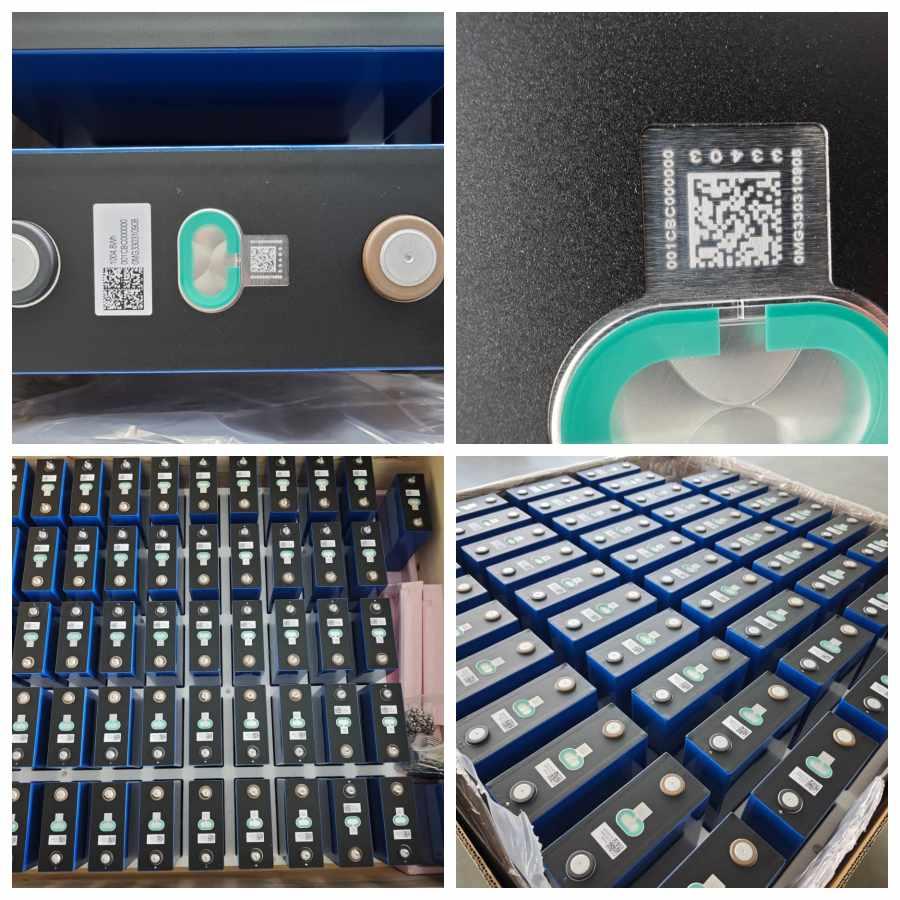
Lithium iron phosphate cells in prismatic form have become a go-to solution for engineers building commercial battery systems. Their combination of high per-cell capacity, stable chemistry, and a space-efficient rectangular profile makes them especially attractive for energy storage, electric mobility, marine power, and backup applications where reliability and ease of integration matter more than chasing maximum energy density.
This guide explains how prismatic LiFePO4 cells are constructed, how they perform under real operating conditions, what makes them advantageous in industrial projects, and which factors procurement and design teams should evaluate before committing to a particular cell platform.
A prismatic LiFePO4 cell is a rechargeable lithium-ion unit enclosed in a hard rectangular shell, typically aluminum or steel. The positive electrode is based on lithium iron phosphate, while the negative electrode normally uses graphite. During charge and discharge, lithium ions travel through the electrolyte between the two electrodes.
Internally, the electrodes are arranged in alternating cathode and anode layers. A microporous polymer separator sits between them, preventing direct electrical contact while still permitting ionic movement. Manufacturers either stack individual electrode sheets or wind an electrode pair into a flat jelly roll. Large cells frequently use stacked construction because it tends to distribute current more evenly and gives better thermal behavior under load.
One reason LiFePO4 is favored in stationary and industrial applications is the inherent thermal stability of its olivine crystal structure. Compared with several other lithium-ion cathode materials, it resists decomposition at elevated temperatures. This lowers the probability of thermal runaway during abuse, although it does not remove the need for robust protection electronics.
The outer case serves several functions. It shields the internal electrode assembly from mechanical damage, helps transfer heat away from the cell, and contains the electrolyte. On top of the cell, the positive and negative terminals are usually designed as threaded studs or bolt points to allow secure busbar connections. Many high-capacity models come with hardware kits that include busbars, washers, nuts, and insulating terminal covers.
A pressure relief vent is built into most prismatic LiFePO4 cells. If internal gas pressure rises beyond a safe limit—because of overcharge, internal short circuit, or extreme temperature—the vent opens and releases gas in a controlled manner. This feature prevents the casing from bursting and is particularly important in large installations where multiple cells are packed closely together.
The thin plastic film covering the outside of the cell is not cosmetic. It provides electrical isolation between the conductive metal shell and nearby conductive parts. If the film is peeled, cut, or worn through during assembly, it can create a short-circuit hazard. System integrators should treat the insulation layer as a safety component.
Each cell has a nominal voltage of around 3.2 V. For charging, the upper limit is usually set at 3.65 V per cell, while discharge is typically stopped at about 2.5 V per cell. Operating beyond these windows accelerates degradation and may permanently damage the cell.
Capacity is quoted in ampere-hours under defined laboratory conditions, often at discharge rates of 0.5C or 1C and at a fixed ambient temperature. A 280 Ah rating means the cell can theoretically supply 280 A for one hour, but the usable energy will be lower if the cell is discharged faster, operated at low temperature, or has aged. Datasheet conditions should always be reviewed, because capacity figures are test-dependent.
LiFePO4 cells are known for long cycle life. Under controlled conditions, a well-made prismatic cell may deliver between 3,000 and 6,000 cycles before its capacity falls to 80% of the original value. Manufacturers generally specify cycle life at a given depth of discharge, such as 80% or 100% DOD, and at a stable temperature, often 25°C. Field results depend heavily on charge voltage, discharge current, thermal conditions, storage practices, and cell-to-cell consistency.
Temperature limits differ for charging and discharging. Charging is normally permitted from 0°C to 45°C, while discharging can often occur from -20°C to 60°C. Charging a cold cell below 0°C can cause lithium metal to plate onto the anode. This process permanently reduces capacity and creates a safety risk, so battery management systems typically block charging at low temperatures. At the high end, heat accelerates both capacity loss and electrolyte breakdown. Large systems may require liquid cooling or forced-air thermal management to keep cells within a safe operating window.
Prismatic cells offer clear practical advantages in larger battery packs. The most obvious is capacity per cell. A single 200 Ah, 280 Ah, or 300 Ah prismatic unit can replace many smaller cylindrical cells. A 100 kWh system may need fewer than 100 large prismatic cells, whereas an equivalent cylindrical design could involve thousands. Fewer cells mean fewer electrical joints, fewer sense wires, and a lower chance of loose connections or uneven current sharing.
The rectangular shape also uses space more efficiently. Cylindrical cells leave gaps between adjacent units, which reduces pack-level volumetric energy density. Prismatic cells can be stacked tightly in rows with minimal wasted volume. This characteristic is especially useful in containerized storage systems, rack-mounted battery modules, and electric vehicle battery compartments where every millimeter counts.
System assembly tends to be simpler as well. The rigid rectangular housing provides a stable surface for mounting. Threaded terminals allow busbar connections to be made, inspected, and serviced without special welding equipment. For BESS integrators, this lowers assembly time and improves maintainability over the life of the installation.
Even though prismatic LiFePO4 cells are robust, they still require careful mechanical and electrical design.
Cells can change thickness slightly during cycling. Most manufacturers recommend holding the stack under controlled compression using rigid end plates and tie rods. This compression keeps internal layers in consistent contact, reduces the risk of delamination, and helps maintain capacity over thousands of cycles. A pack built without proper compression may show early degradation or physical deformation.
Thermal management also needs attention. High-rate charging or discharging generates heat inside the cell, and large-format cells can develop internal temperature gradients. These gradients accelerate aging and may reduce usable pack capacity. The cooling approach—liquid plates, forced air, or passive conduction—must match the application’s power profile and ambient environment.
Cell matching is another critical factor. In a series string, the lowest-capacity or highest-resistance cell limits the entire pack. Reputable manufacturers sort cells by capacity and internal resistance into matched bins. On the system side, the BMS must provide balancing, overvoltage and undervoltage protection, overcurrent detection, and temperature monitoring. Without these safeguards, small differences between cells grow over time and can lead to premature failure.
Prismatic LiFePO4 cells appear in a broad range of commercial and industrial systems. Common examples include utility-scale and commercial energy storage, residential solar batteries, electric buses and trucks, marine and RV auxiliary power, telecom backup, data center UPS systems, forklifts, automated guided vehicles, and off-grid power stations. The same cell platform can often be scaled from a compact 48 V telecom battery to a multi-megawatt-hour containerized installation simply by changing the series-parallel configuration.
Before selecting a prismatic LiFePO4 cell, procurement teams should verify several factors beyond the headline capacity.
First, confirm that the rated capacity, nominal voltage, and maximum continuous current match the system design. A cell that meets capacity requirements but cannot handle the expected charge or discharge rate will overheat or degrade quickly.
Second, examine the cycle life specification closely. A single number such as “4,000 cycles” is not meaningful unless the test conditions—depth of discharge, temperature, and charge voltage—are clearly stated.
Third, check mechanical details. The cell dimensions and weight must fit within the enclosure, and the terminal type must be compatible with the planned busbars and torque settings.
Fourth, review certifications. Depending on the market and installation location, relevant approvals may include UN 38.3 for transport, IEC 62619 for industrial applications, and CE marking.
Finally, ask for batch test data and quality control documentation. Consistency between cells is essential for pack performance, and a manufacturer that cannot provide this data should be treated with caution.
Large-format prismatic LiFePO4 cells remain a practical foundation for commercial and industrial battery systems. Their high single-cell capacity reduces complexity, their rectangular housing uses space efficiently, and their stable chemistry supports long service life when supported by appropriate engineering.
Yet cell selection is only one part of a successful project. Mechanical compression, thermal control, cell matching, and battery management all influence whether a system meets its performance and lifetime targets. Designers and buyers should therefore evaluate cells not as isolated components, but as part of a fully engineered pack.
As demand for stationary storage and commercial electric vehicles continues to grow, prismatic LiFePO4 technology is likely to remain a central choice for integrators seeking dependable, cost-effective, and serviceable battery solutions.
A single cell operates at about 3.2 V nominal. Four cells in series produce roughly 12.8 V, while sixteen cells in series produce approximately 51.2 V, which is common for 48 V systems.
In laboratory conditions, quality cells can achieve 3,000 to 6,000 cycles at 80% depth of discharge. Real-world cycle life depends on temperature, charge voltage, discharge rate, and the effectiveness of the battery management system.
LiFePO4 chemistry is widely considered stable and is used in many indoor energy storage systems. However, overall safety depends on proper mechanical design, thermal management, BMS protection, and compliance with local electrical and fire codes.
Prismatic cells use a rectangular case and are available in large capacities, typically above 50 Ah. Cylindrical cells are smaller and round, requiring many more units to reach the same pack capacity. Prismatic cells reduce interconnection count and simplify assembly, while cylindrical cells offer greater shape flexibility and are easier to produce in automated high-volume lines.
Yes. Parallel connections increase total capacity. Before connecting cells in parallel, all units should be at the same voltage and well matched in capacity and internal resistance. Proper busbar design and fusing are also necessary to ensure safe current sharing.
Welcome to contact us:
Inquire more product details from the: Lithium Ion Battery Suppliers
WhatsApp/Wechat/Mobile: +86 13326321310
Email: info@battery-energy-storage-system.com
Website: www.battery-energy-storage-system.com
Ready to power your energy systems with the best in the industry?
Contact us today to get the latest pricing and discuss your needs with our team!
Next:CATL 280Ah and EVE 304Ah Prismatic LiFePO4 Batteries Shipped to Canada
Previous:2 pcs deye inverters and 2 pcs tc chargers shipped to Canada