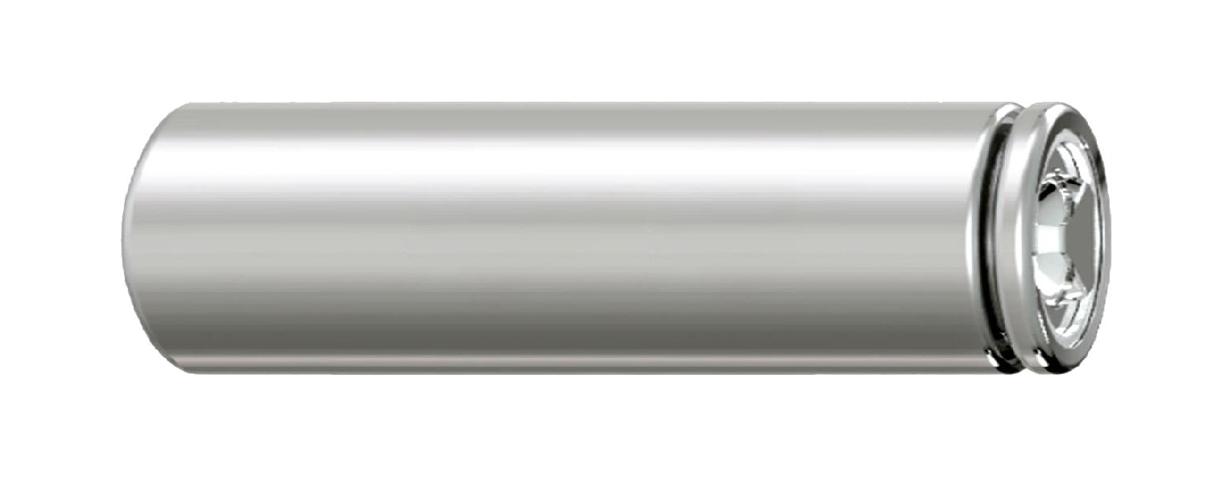
The designation "21700" describes the cell's physical size: 21 millimeters in diameter and 70 millimeters long. This format marks a size increase from the earlier 18650 standard (18mm × 65mm), providing roughly 50 percent more internal volume per cell.
The 21700 format was created to balance cell dimensions against manufacturing efficiency. Larger cells reduce the total unit count needed in a battery pack, which cuts down on assembly work and lowers the number of BMS channels required. At the same time, the 21mm diameter stays compact enough to preserve effective thermal behavior and avoid the localized overheating problems sometimes seen in bigger cylindrical or prismatic designs.
Initially deployed at scale by the electric vehicle sector around 2017, the 21700 battery format has since become a widely adopted standard across industries such as consumer electronics, e-mobility, and stationary energy storage.
A typical high-quality NMC 21700 cell offers the following baseline numbers:
- Nominal voltage: 3.6V to 3.7V
- Capacity range: 3Ah to 5Ah (storage-grade cells most often fall between 4Ah and 5Ah)
- Energy per cell: Around 13 to 18 watt-hours
- Continuous discharge rate: 0.5C to 2C, depending on chemistry and thermal rating
- Cycle life: 1,000 to 3,000 full cycles at 80 percent depth of discharge for NMC types
- Weight: Roughly 60 to 70 grams per cell
LFP-based 21700 cells work at a lower nominal voltage of 3.2V but deliver considerably longer cycle life and superior thermal stability. Actual specifications vary significantly across manufacturers, cell grades, and intended uses.
Nickel manganese cobalt (NMC) chemistry leads the 21700 cylindrical cell market. NMC 21700 batteries provide the highest energy density in this size class, with top-tier cells achieving 5Ah or more at 3.7V nominal—yielding approximately 18.5Wh per cell.
NMC cells suit applications where energy density and compact dimensions are key priorities. Their higher voltage also means fewer cells need to be placed in series to reach a given pack voltage compared with LFP alternatives.
The downsides include shorter cycle life relative to LFP, somewhat lower thermal stability, and supply chain sensitivity to cobalt and nickel costs. For many commercial storage applications, though, these compromises are acceptable in light of the energy density benefits.
Lithium iron phosphate (LFP) chemistry has been gaining ground in the 21700 format as manufacturers scale up LFP cylindrical production. LFP 21700 batteries operate at 3.2V nominal and generally provide 3Ah to 4Ah of capacity, with cycle life ratings ranging from 3,000 to over 6,000 full cycles.
For stationary energy storage where long cycle life and safety are top concerns, LFP 21700 cells present strong advantages. Their superior thermal stability reduces the burden on thermal management systems, and the lack of cobalt enhances both cost predictability and ESG profiles.
The main drawback is lower energy density—an LFP 21700 cell stores roughly 25 to 30 percent less energy than a comparable NMC cell of identical dimensions. This translates into more cells and a larger pack volume for the same energy content.
The choice between NMC and LFP 21700 battery cells depends on project priorities:
| Factor | NMC 21700 | LFP 21700 |
| Energy density | Higher (15–18Wh/cell) | Lower (10–13Wh/cell) |
| Cycle life | 1,000–3,000 cycles | 3,000–6,000+ cycles |
| Thermal stability | Moderate | Excellent |
| Nominal voltage | 3.6–3.7V | 3.2V |
| Cost per kWh | Moderate | Declining rapidly |
| Best for | Space-constrained systems | Long-cycle stationary storage |
For the majority of stationary energy storage deployments, LFP 21700 cells are increasingly becoming the go-to option, while NMC remains preferred for portable power and applications where space is at a premium.
When measured against the older 18650 format, 21700 battery cells deliver around 35 to 50 percent more energy per cell. This directly results in more compact, lighter battery packs for a given energy capacity—or increased energy within the same physical footprint.
For energy storage integrators, greater cell-level energy density means:
- Fewer cells per kWh, cutting assembly labor and BMS complexity
- Reduced pack size, saving cabinet or container space
- Lower packaging costs per kWh, improving overall cost efficiency
In applications with tight physical constraints—such as wall-mounted residential storage units or portable power stations—the energy density advantage of 21700 cells proves especially valuable.
In spite of their larger size, 21700 cells maintain favorable thermal characteristics. The cylindrical shape naturally promotes even heat distribution, and the 21mm diameter ensures that heat generated at the core has a relatively short distance to travel to the surface.
Quality 21700 cells also integrate multiple safety mechanisms:
- Positive temperature coefficient (PTC) devices that restrict current during overheating
- Current interrupt devices (CID) that disconnect the cell under overcharge conditions
- Vented casings engineered to release pressure in a controlled manner
When properly integrated into a pack with suitable thermal management, 21700 cells have demonstrated a solid safety record across both automotive and stationary applications.
A significant strength of the 21700 format is its mature, high-volume supply chain. Largely propelled by EV industry demand, global 21700 production capacity has expanded dramatically, driving down per-cell costs and enhancing availability.
For B2B storage integrators, this maturity translates to:
- Competitive pricing from several qualified manufacturers
- Shorter lead times for standard cell models
- Well-established quality benchmarks and testing procedures
- Multiple sourcing paths for supply chain resilience
Although prismatic cells still lead in utility-scale storage, the 21700 format offers an attractive blend of cost, performance, and supply chain depth for C&I and portable storage segments.
Designing a 21700 battery pack starts with defining the correct series-parallel layout. Cells are grouped in parallel to achieve the target capacity, then stacked in series to obtain the required pack voltage.
A popular configuration for low-voltage commercial storage is 14S (14 cells in series), yielding roughly 50.4V nominal with NMC cells—compatible with numerous standard inverter platforms. Higher-voltage systems may employ 96S or more for utility-scale applications.
Physical arrangement options include:
- 18650-style holders: Plastic trays that position cells in uniform grids
- Cell bonding: Adhesive or thermal glue for rigid construction
- Welding techniques: Spot welding, laser welding, or ultrasonic welding for tab connections
The selected assembly method influences both manufacturing cost and thermal performance, and should align with production volume and application needs.
Effective thermal management is crucial for extending 21700 pack life and ensuring safety. Cylindrical cells pose both challenges and opportunities for thermal design: their round shape creates air gaps between cells, yet the uniform geometry also allows consistent cooling.
Typical thermal approaches for 21700 packs include:
- Air cooling: Forced or natural convection through cell gaps. Simple and economical, suitable for low-C-rate scenarios.
- Liquid cooling: Cold plates or tubing systems circulating coolant. More efficient for high-power or heavy-cycling applications.
- Phase-change materials: Thermal pads or potting compounds that absorb heat during peak loads. Useful for passive cooling setups.
For stationary storage systems operating at moderate charge-discharge rates (typically 0.5C or less), passive or active air cooling is often adequate when cell spacing is properly engineered.
A correctly specified battery management system is essential to 21700 battery pack performance and longevity. The BMS must accommodate the total number of series cells in the pack and deliver cell-level voltage monitoring with adequate accuracy.
Key BMS considerations for 21700 packs:
- Cell count support: BMS boards are rated for specific maximum series counts; confirm compatibility with your pack layout.
- Current sensing: Shunt or Hall-effect sensors rated for the pack's peak charge and discharge currents.
- Balancing functionality: Passive or active cell balancing to preserve voltage uniformity across series strings.
- Temperature monitoring: Multiple NTC thermistors placed throughout the pack to identify hot spots.
- Communication protocols: CAN bus, RS-485, or SMBus compatibility with the inverter or EMS platform.
For integrators assembling packs from individual cells, selecting a BMS with proven interoperability with the target inverter platform ranks among the most critical design choices.
21700 battery cells are extensively used in residential and small commercial energy storage systems. Their energy density enables manufacturers to build compact, wall-mountable units with capacities from 5 to 20 kWh—ample for most residential backup and self-consumption needs.
Many leading residential storage products on the market employ 21700 cells, in either NMC or LFP chemistry, housed in modular units that can be scaled by adding more battery modules.
The high energy density of 21700 cells makes them an excellent fit for portable power stations and off-grid storage systems. These uses prioritize small size and low weight, where the Wh-per-kg edge of 21700 NMC cells directly enhances product value.
Portable power stations spanning 500Wh to 5kWh commonly utilize 21700 cell configurations, combined with built-in inverters and charge controllers to deliver all-in-one power solutions for construction sites, outdoor events, emergency backup, and remote installations.
For larger commercial and industrial systems, 21700 cells are built into rack-mountable battery modules—usually 48V or 52V units with 50 to 200Ah capacity. These standard modules can then be connected in series and parallel within battery cabinets to construct multi-MWh energy storage systems (ESS).
While very large utility-scale projects often favor prismatic cells for their lower assembly costs, 21700 battery modules stay competitive in the C&I segment, where the mix of proven cell technology, modular scalability, and attractive pricing fits project requirements well.
When buying 21700 cells for commercial energy storage projects, confirming quality and certifications is critical. Key standards to seek include:
- IEC 62133: Safety standard for portable sealed secondary lithium cells and batteries
- UN 38.3: Transportation safety testing mandated for lithium battery shipping
- UL 1642: Standard for lithium battery safety testing
- ISO 9001: Manufacturer quality management certification
Beyond formal certifications, trustworthy cell manufacturers supply detailed datasheets featuring cycle life curves, temperature derating data, and impedance specifications—all vital for sound pack design and performance modeling.
For B2B storage integrators sourcing 21700 cells at volume, several factors shape the procurement strategy:
- MOQ requirements: Top-tier cell manufacturers frequently impose high minimum order quantities, whereas tier-2 suppliers may accommodate smaller orders at a higher per-unit price.
- Lead times: Standard cells usually ship in 4 to 12 weeks; custom versions demand longer lead times and NRE investment.
- Cell grading: Cells sorted by capacity and internal resistance (matched cells) boost pack performance but increase cost. For quality-sensitive storage applications, graded cells are generally worth the extra expense.
- Supply agreements: Annual volume commitments can lock in better pricing and allocation priority, but carry inventory risk in a market where costs are declining rapidly.
Partnering with established distributors or directly with manufacturers—depending on volume—helps guarantee consistent quality, traceable production lots, and a reliable long-term supply.
The 21700 battery has secured its position as a versatile and cost-effective cylindrical cell format for energy storage applications. Its blend of respectable energy density, proven thermal performance, and a mature high-volume supply chain renders it a solid choice for everything from residential storage units to commercial battery systems and portable power solutions.
For system integrators and procurement professionals, the path to successful 21700-based storage design involves picking the right chemistry for the application, engineering appropriate thermal and BMS systems, and sourcing cells from qualified manufacturers delivering consistent quality. As the global energy storage market keeps expanding, the 21700 format will remain a foundational technology within the cylindrical cell segment, propelled by continuous improvements in both NMC and LFP chemistries.
The main difference is physical size: 18650 cells measure 18mm × 65mm, while 21700 cells measure 21mm × 70mm. The larger 21700 format delivers about 35 to 50 percent more energy capacity per cell, allowing for smaller and lighter battery packs. 21700 cells also benefit from newer manufacturing techniques developed after the 18650 standard was set. For new energy storage designs, 21700 is generally the preferred cylindrical format unless a specific reason exists to stick with 18650.
Cycle life depends heavily on chemistry and operating conditions. NMC 21700 cells typically provide 1,000 to 3,000 full cycles at 80 percent depth of discharge, whereas LFP 21700 cells can reach 3,000 to over 6,000 cycles. In practical stationary storage terms—with daily cycling and moderate DOD—this equates to 5 to 15 years of useful service life before dropping to 80 percent capacity retention. Operating temperature, charge rate, and depth of discharge all significantly influence actual lifespan.
Mixing cells from different manufacturers—or even different batches from the same manufacturer—is generally discouraged. Differences in internal resistance, capacity, and charge characteristics lead to unbalanced operation, faster degradation, and possible safety hazards. Packs should always be built with matched cells from a single production batch, properly graded for consistency in capacity and internal resistance.
It hinges on the application. 21700 cylindrical cells offer superior thermal uniformity, a well-established safety track record, and a highly competitive supply chain fueled by EV production volumes. Prismatic cells generally provide greater packing density and lower assembly cost per kWh at very large scales. For residential, portable, and small-to-medium commercial systems, 21700 cells often represent the stronger choice thanks to their maturity, availability, and thermal performance. For utility-scale systems in the hundreds of MWh range, prismatic cells usually hold a cost advantage.
Most storage-grade 21700 cells are rated for 0.5C to 1C continuous charging, with peak rates up to 2C for brief periods. For stationary storage applications intended for daily cycling, a 0.5C charge rate is standard and helps maximize cycle life. Faster charging generates more heat and speeds up degradation, so it should only be employed when application demands require it and the thermal management system is designed to cope. Always adhere to the cell manufacturer's datasheet specifications for charge and discharge current limits.
Welcome to contact us:
Inquire more product details from the: Lithium Ion Battery Suppliers
WhatsApp/Wechat/Mobile: +86 13326321310
Email: info@battery-energy-storage-system.com
Website: www.battery-energy-storage-system.com
Ready to power your energy systems with the best in the industry?
Contact us today to get the latest pricing and discuss your needs with our team!
Next:12V 100Ah Lithium LiFePO4 Battery Pack Shipped to Ireland
Previous:Winston 3.2V 700Ah LiFeYPO4 Batteries Shipped to New Zealand