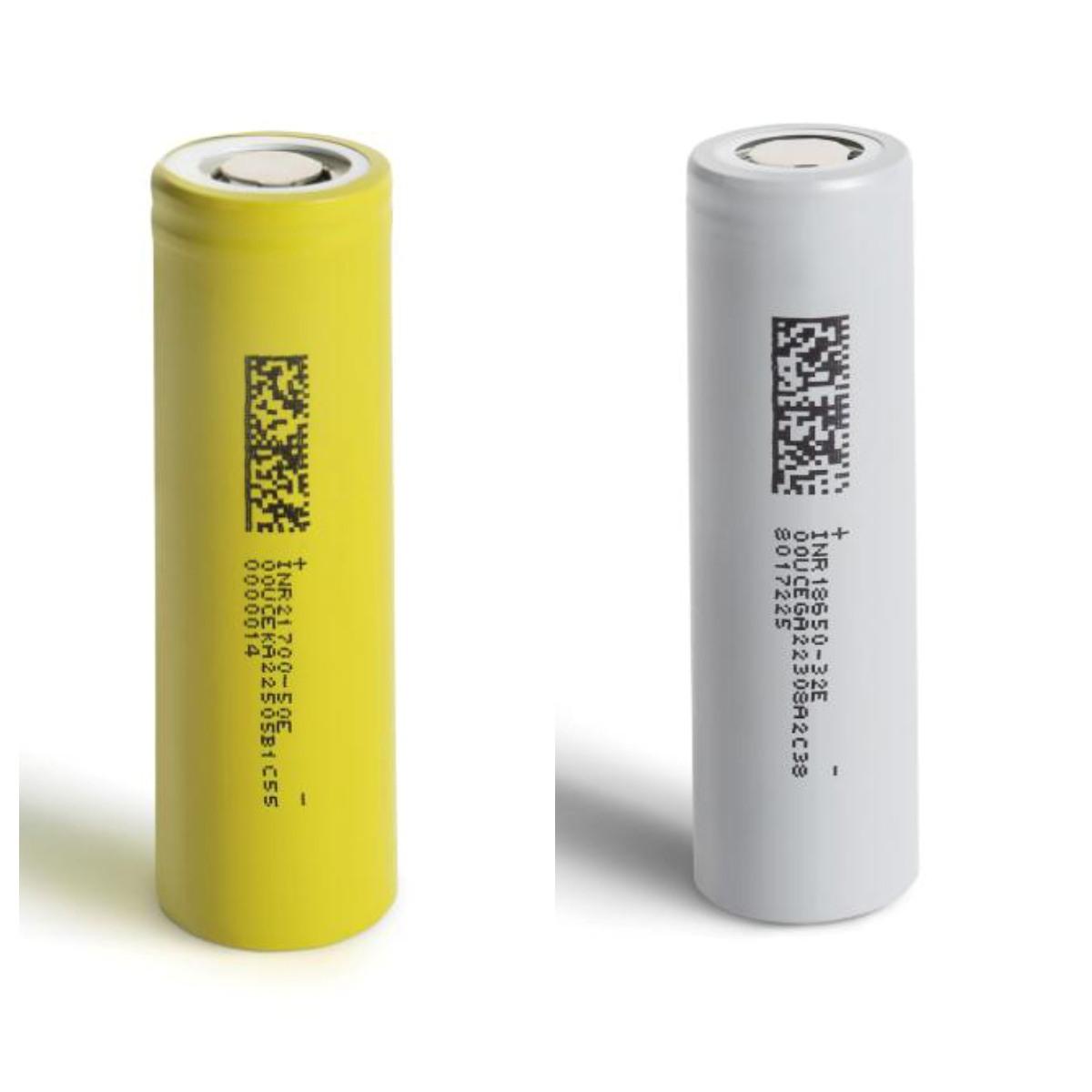
Cylindrical lithium battery names encode their physical dimensions in millimeters. The first two digits stand for diameter, the next two for length, and the final zero signals a cylindrical shape. By way of illustration, an 18650 cell measures 18 mm across and 65 mm long, while a 21700 cell comes in at 21 mm by 70 mm. At the cell level, typical energy densities land around 600–700 Wh/L for 18650s and 650–750 Wh/L for 21700s.
This naming system is uniform across the lithium battery sector, so cells that share the same numeric code from different manufacturers are mechanically interchangeable in most pack configurations.
The 18650 form factor is the older and more established of the two. It was originally created for laptop computers and later found its way into electric vehicles, power tools, and energy storage systems. The 21700 format appeared more recently, spurred by the EV industry’s push for greater per-cell energy density.
The dimensional gap between these two formats is more substantial than the numbers alone suggest. A 21700 cell offers roughly:
- 47% greater volume than an 18650
- 35–50% higher energy capacity per cell
- About 40% more weight per cell
A quality NMC 18650 cell typically delivers 2.5–3.5 Ah (9–13 Wh), whereas a comparable 21700 cell provides 4–5 Ah (14–18.5 Wh). This per-cell energy advantage is the main reason the industry is shifting toward 21700 and larger formats.
For pack designers, larger cells mean that fewer individual units are needed to reach a target capacity. That cuts down on assembly complexity and reduces the number of BMS channels required—though it also introduces different thermal and mechanical design challenges.
When evaluating energy density in the 21700 versus 18650 debate, the picture is subtle. At the individual cell level, 21700s usually achieve slightly better gravimetric energy density (Wh/kg) because the bigger format reduces the share of inactive materials like casing and terminals relative to active material.
However, the real edge shows up in volumetric terms:
- 18650 cells: roughly 600–700 Wh/L at cell level
- 21700 cells: roughly 650–750 Wh/L at cell level
When assembled into modules, 21700 cells can reach higher packing efficiency because fewer cells translate to fewer gaps and less structural overhead per kilowatt-hour. The result is more compact, lighter battery packs for the same energy content. In space-constrained storage applications—containerized systems, portable power stations, or vehicle-based storage—this higher density is a meaningful benefit.
A larger footprint doesn’t automatically mean higher discharge rates. Power delivery hinges on cell chemistry and internal construction, not on physical size alone. Both formats come in a spectrum of power ratings:
- Energy-oriented cells: 0.5C to 1C continuous discharge, suited for storage
- Power-oriented cells: 2C to 5C continuous discharge, for high-power applications
- High-drain cells: 10C and above, used in power tools and motorsports
When comparing cells of equivalent chemistry and quality grade, 21700s generally support higher absolute current (more amps) thanks to their larger electrode area, but the C-rate relative to capacity remains similar. For stationary storage operating at 0.5C or lower, both formats handle the discharge demands with ease, so power capability is seldom the deciding factor.
Thermal management is one area where the smaller 18650 format holds an advantage. The reduced diameter means heat from the core travels a shorter path to the surface, aiding heat dissipation per unit volume.
Larger 21700 cells carry more thermal mass and hold heat longer, which can cut both ways:
- Upside: steadier temperatures during transient loads, less susceptible to rapid fluctuations
- Downside: slower to cool down, higher core temperatures under sustained high-current operation
For low-C-rate stationary storage where heat buildup is modest, the thermal difference between the two formats is negligible. In high-power scenarios or systems with limited cooling, however, the 18650’s better surface-to-volume ratio can prove valuable.
One of the biggest system-level distinctions between 21700 and 18650 is the cell count needed per kilowatt-hour of storage capacity.
A typical 1 kWh NMC battery pack will use:
- 18650 cells: around 80–110 cells (depending on grade)
- 21700 cells: around 55–70 cells (depending on grade)
Having fewer cells per kWh brings several advantages:
- Fewer BMS monitoring channels, reducing BMS cost and complexity
- Fewer weld joints, meaning fewer potential failure points and quicker assembly
- Simpler cell matching, since fewer cells need to be graded and paired for consistent performance
This reduction in cell count is a primary cost driver behind the industry’s move to larger formats. At high production volumes, savings on BMS components and assembly labor can be significant.
On the manufacturing floor, both formats rely on similar processes—spot or laser welding of interconnects, cell holders or bonding for mechanical integrity, and integration with BMS and thermal management elements.
Working with 21700 cells introduces certain tradeoffs:
- Fewer cells to handle, which shortens pick-and-place and material handling time
- Larger, heavier cells that may call for more robust handling equipment
- Higher energy content per cell, raising the safety stakes if a cell is damaged during assembly
- Standardized holders that are widely available but less diverse than the 18650 ecosystem
For manufacturers already running 18650 production lines, moving to 21700 requires retooling but doesn’t demand a fundamental process overhaul.
In stationary commercial and industrial storage, the 21700 versus 18650 decision often hinges on cost and supply chain factors rather than pure technical performance. When properly engineered, both formats can deliver the needed energy capacity, cycle life, and safety.
Advantages of 21700 for stationary storage:
- Fewer cells per kWh lower BMS and assembly costs
- Higher packing density reduces cabinet or container footprint
- The industry trend toward 21700 suggests stable long-term supply
Advantages of 18650 for stationary storage:
- A broader supplier base with more competitive pricing at moderate volumes
- A longer track record in storage deployments
- Superior thermal performance for high-C-rate or high-temperature environments
For large-scale utility storage, 21700 cells generally offer a better cost per kWh at high volumes. For smaller C&I systems or specialty projects, 18650 may still be more economical, depending on supplier pricing and availability.
For portable power stations, mobile energy storage, and vehicle-integrated applications, 21700 cells are typically the go-to choice. Their higher energy density directly yields:
- Greater capacity within the same physical space
- Lighter weight for a given capacity, enhancing portability
- Fewer cells, which simplifies internal pack design
Virtually all new portable power station designs now employ 21700 cells (or even larger formats) rather than 18650, because the density advantage directly boosts product competitiveness in a market where size and weight heavily influence purchasing decisions.
The cost comparison between 21700 and 18650 cells fluctuates with market dynamics, production volumes, and raw material prices.
General trends:
- At very high volumes, 21700 cells often achieve lower $/kWh pricing due to economies of scale and fewer cells per kWh
- At moderate volumes, 18650 cells can be cheaper because of more competing suppliers and broader commodity market availability
- Over the long term, 21700 pricing is falling faster as EV industry demand drives larger-scale production
For B2B buyers, the format decision should factor in total system cost, not just cell price. BMS savings, reduced assembly labor, and enclosure cost reductions from higher density can make 21700-based systems cheaper overall even if the per-cell price is marginally higher.
21700 cells are generally the better option when:
- Energy density matters—portable power, mobile storage, space-constrained installations
- Production volumes are high—fewer cells lower assembly and BMS costs at scale
- You are creating a new product design with no legacy 18650 tooling or supply chain to preserve
- Future-proofing is a priority, since the industry is moving toward larger cell formats
- Weight reduction carries value, such as in vehicle-integrated or transportable systems
Most new cylindrical-cell storage product designs now start with 21700 as the baseline, treating 18650 as a consideration only for specific use cases where the smaller format offers a distinct advantage.
18650 cells remain the right fit when:
- Supply chain diversity is essential, with more manufacturers and distributors to choose from
- Production volumes are moderate, offering better pricing and availability at lower minimum order quantities
- Thermal performance is critical, such as in high-temperature environments or high-C-rate operation
- Legacy compatibility matters for existing products or systems designed around 18650s
- Proven reliability is paramount, backed by decades of real-world deployment data across applications
The 18650 format is far from obsolete. Its long production history, wide supplier base, and field-proven reliability continue to make it a strong contender for many storage applications, especially for smaller companies or projects with moderate volume needs.
The 21700 versus 18650 comparison ultimately comes down to aligning the cell format with specific application requirements. 21700 cells deliver higher energy density, fewer cells per kWh, and represent the forward direction of the industry, making them the default choice for most new product designs—especially where size and weight are at a premium. Meanwhile, 18650 cells remain a proven, widely accessible option with superior thermal characteristics and a more diversified supply chain.
For energy storage integrators and procurement teams, the decision should rest on a holistic evaluation: application demands, production scale, cost targets, supply chain strategy, and thermal management constraints. Neither format is universally superior, but grasping the tradeoffs enables informed specification choices that balance performance, cost, and reliability.
As the lithium battery industry continues evolving toward even larger cylindrical formats (such as 4680 cells), the 21700 vs. 18650 conversation will eventually expand to encompass these newer sizes. For now, both formats remain viable, cost-effective solutions for energy storage, and both will continue to fill important roles in the market for years to come.
The fundamental difference is physical size: 21700 cells are 21 mm × 70 mm, while 18650 cells are 18 mm × 65 mm. The larger 21700 format provides about 35–50% more energy capacity per cell, enabling smaller, lighter battery packs with fewer individual units. Both formats share the same cylindrical lithium-ion construction and are available in similar chemistries (NMC, LFP) and performance tiers.
Not across the board. 21700 cells offer higher energy density and lower pack complexity, but 18650 cells deliver better thermal performance per unit volume, a wider supplier base, and often more attractive pricing at moderate volumes. For portable power and high-density applications, 21700 is usually preferred. For stationary storage with moderate C-rates and ample space, both work well, and the choice hinges on cost, supply chain, and project-specific requirements.
No, the two formats are not mechanically interchangeable. 21700 cells are larger in both diameter and length, so they will not fit into 18650 cell holders or enclosures designed for the smaller format. Additionally, the different cell capacities would alter the pack’s total capacity and current distribution, requiring a BMS reconfiguration. Converting a pack from 18650 to 21700 demands a complete mechanical and electrical redesign.
Cycle life is primarily determined by cell chemistry, quality grade, and operating conditions—not by physical format. A premium 18650 cell from a top-tier manufacturer will outlast a budget 21700, and vice versa. When comparing cells of equivalent chemistry, grade, and manufacturer, cycle life is generally similar. The format difference influences energy density and pack design, not inherent cycle longevity.
The overall trend favors larger cell formats, with 21700 gaining substantial market share driven by EV and portable power demand. However, 18650 remains a high-volume format with continuing production and a broad supply base. In the foreseeable future, both formats will coexist, with 21700 dominating new high-volume designs and 18650 staying common in legacy products, lower-volume applications, and markets where supply chain diversity is a priority.
Welcome to contact us:
Inquire more product details from the: Lithium Ion Battery Suppliers
WhatsApp/Wechat/Mobile: +86 13326321310
Email: info@battery-energy-storage-system.com
Website: www.battery-energy-storage-system.com
Ready to power your energy systems with the best in the industry?
Contact us today to get the latest pricing and discuss your needs with our team!
Next:48V 150A 9kW Forklift Battery Chargers Shipped to South Korea
Previous:3.2V 50Ah LiFePO4 Cells Shipped to Italy