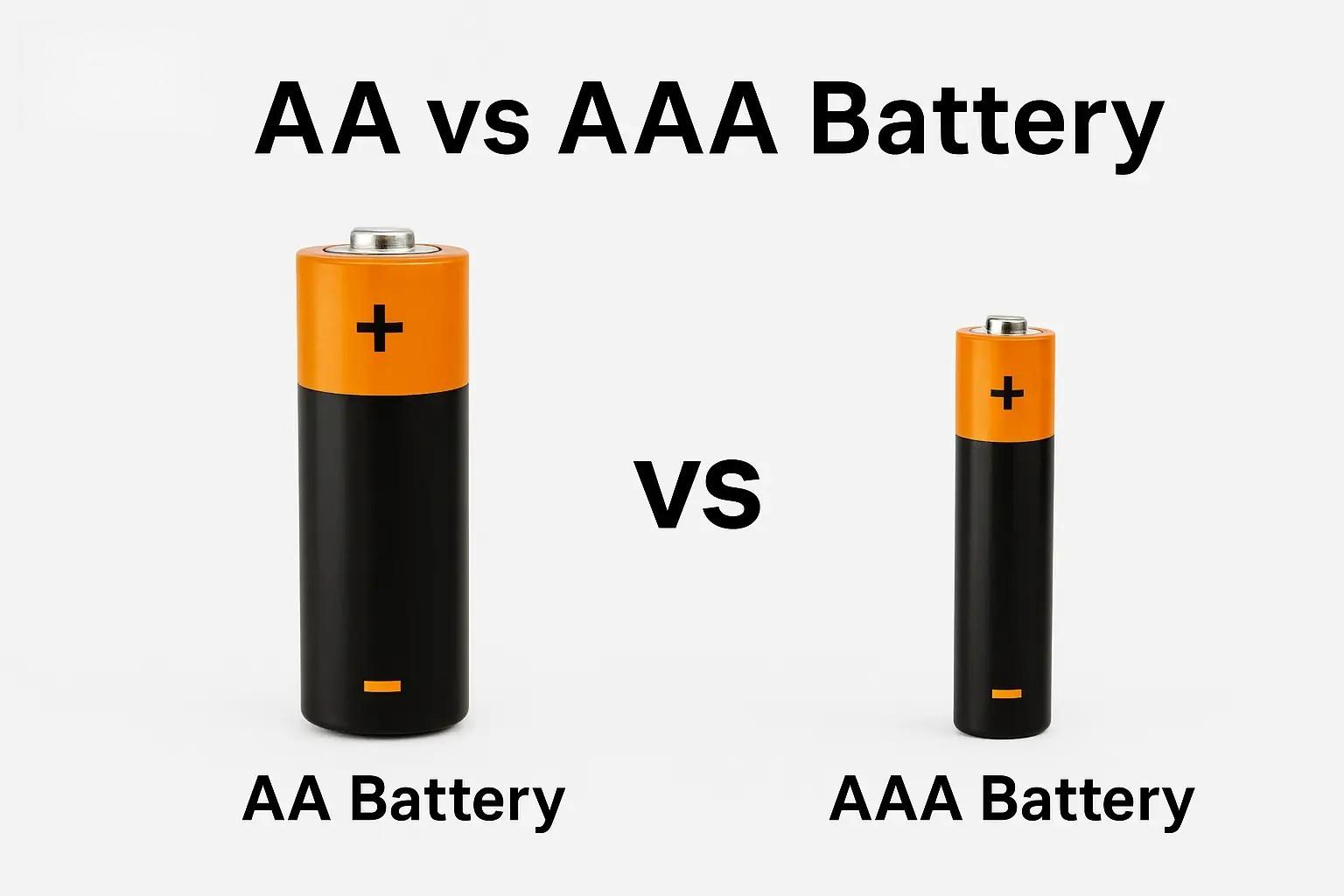
Countless everyday items – from remote controls and toys to cameras and flashlights – run on batteries. Two of the most familiar sizes are AA and AAA. Although they look similar, these two battery types differ significantly in capacity, physical dimensions, runtime, and the kinds of devices they power.
Understanding how AA and AAA batteries compare helps you pick the right power source, get better performance from your electronics, and avoid unnecessary replacements. This guide lays out everything you need to know about AA versus AAA batteries, covering size, voltage, lifespan, typical uses, and compatibility.
The “A” is part of an international classification system for cylindrical batteries. The number of A’s tells you the physical size:
- Fewer A’s mean a larger battery.
- More A’s mean a smaller battery.
| Battery Label | Meaning | Size Trend |
| A | Cylindrical format | Largest in the A series |
| AA | Smaller than A | Standard household size |
| AAA | Slimmer and more compact | Designed for compact devices |
The “A” designation is about shape and dimensions only – it says nothing about battery chemistry or voltage. It simply ensures you match the right battery to the right device.
AA batteries are among the most widely used sizes worldwide. Their larger body holds more energy, making them well suited for medium- and high-drain electronics.
Key features of AA batteries:
- Dimensions: 50.5 mm length × 14.5 mm diameter
- Nominal voltage: 1.5V
- Typical capacity: 2000–3000 mAh
- Common chemistries: alkaline, lithium, NiMH (rechargeable), and NiCd
Because they contain more active material, AA cells generally run longer than smaller batteries.
Devices that commonly use AA batteries include digital cameras, flashlights, wireless gaming controllers, motorized toys, portable radios, and remote controls.
AAA batteries perform the same job as AA batteries but come in a smaller, lighter package. Their slim profile makes them ideal for portable, low-power gadgets.
Key features of AAA batteries:
- Dimensions: 44.5 mm length × 10.5 mm diameter
- Nominal voltage: 1.5V
- Typical capacity: 800–1200 mAh
- Common chemistries: alkaline, lithium, and NiMH (rechargeable)
Even though they deliver the same voltage, AAA batteries store less total energy because of their compact size.
Common devices powered by AAA batteries include TV remotes, wireless computer mice, small flashlights, clocks, thermometers, and other slim portable electronics.
1. Physical Size
AA batteries measure 50.5 × 14.5 mm, while AAA batteries come in at 44.5 × 10.5 mm. AA cells are noticeably thicker and longer; AAA cells are slimmer and lighter.
2. Capacity
In alkaline versions, a typical AA battery provides 2000–3000 mAh, whereas a AAA battery offers 800–1200 mAh. AA batteries can store more than twice the energy, which means longer operation in demanding devices.
3. Runtime
Thanks to their higher capacity, AA batteries last longer in power-hungry electronics. AA is the better choice for high-drain equipment; AAA works best in low-power devices.
4. Weight
An AA battery weighs roughly 23 grams, about double the 11 grams of a AAA battery.
5. Typical Applications
- AA batteries: cameras, larger flashlights, toys, portable speakers, game controllers
- AAA batteries: remote controls, small flashlights, wireless mice, compact gadgets, thermometers
- Same voltage: both typically supply a nominal 1.5V.
- Chemistry options: you can find both in alkaline, lithium, and nickel-metal hydride (NiMH) formulations.
- Rechargeable choices: rechargeable AA and AAA batteries are widely available and can be a cost-effective, reusable alternative.
- Global standard: both sizes are universally standardized and easy to buy almost anywhere.
- Recyclability: most AA and AAA cells today can be recycled, helping to reduce environmental waste when disposed of properly.
| Battery Type | Shape | Dimensions | Voltage | Capacity | Typical Devices |
| AAA | Cylindrical | 44.5 × 10.5 mm | 1.5V | 800–1200 mAh | Remote controls, wireless mice |
| AA | Cylindrical | 50.5 × 14.5 mm | 1.5V | 2000–3000 mAh | Toys, cameras |
| C | Cylindrical | 50 × 26.2 mm | 1.5V | 6000–8000 mAh | Lanterns, portable radios |
| D | Cylindrical | 61.5 × 34.2 mm | 1.5V | 12000–18000 mAh | Motors, large flashlights |
| 9V | Rectangular | 48.5 × 26.5 × 17.5 mm | 9V | 400–600 mAh | Smoke alarms |
AA batteries are the right call when your device needs more power or longer battery life. This includes high-drain electronics such as digital cameras, motorized toys, portable speakers, large LED flashlights, and wireless gaming accessories.
AAA batteries are designed for compact electronics with modest power needs. Think TV remotes, wireless keyboards, small flashlights, clocks, thermometers, and other slim portable gadgets.
No. Although both usually provide 1.5V, their physical dimensions are entirely different. Device battery compartments are built to fit only one size, and forcing the wrong battery can damage the equipment or prevent it from working. Always check your device’s battery compartment markings or manual before installing batteries.
Choosing between AA and AAA batteries comes down to your device’s size constraints, power requirements, and runtime expectations. AA batteries pack more energy and deliver longer performance, making them ideal for high-drain electronics. AAA batteries, by contrast, are lightweight and compact, perfect for portable and low-power devices.
Knowing these differences helps you maximize device performance, extend battery life, and use your electronics more efficiently. Whether you’re powering household gadgets, toys, flashlights, or professional equipment, picking the correct battery size is essential for reliable, trouble-free operation.
Why isn’t a plain “A” battery common?
Single A batteries do exist, but they are rarely used in today’s consumer electronics, which is why you seldom see them in stores.
Which lasts longer, AA or AAA?
AA batteries last longer because their higher capacity allows them to deliver more energy over time.
Are AAA batteries cheaper than AA?
Generally, yes. AAA batteries use less material and have a lower energy capacity, so they tend to be slightly more affordable.
Do AA and AAA batteries have the same voltage?
Yes. Both typically supply 1.5 volts. The difference is in how long they can maintain that voltage under load.
Why do so many toys use AA batteries?
Toys often demand higher power output and longer play times, making the extra capacity of AA batteries a better fit.
Can rechargeable AA and AAA batteries replace disposable ones?
In most compatible devices, yes. Rechargeable NiMH AA and AAA cells can substitute for standard alkaline batteries, offering a reusable and cost-saving alternative.
Inquire more product details from the: Lithium Ion Battery Suppliers
WhatsApp/Wechat/Mobile: +86 13326321310
Email: info@battery-energy-storage-system.com
Website: www.battery-energy-storage-system.com
Next:BAK Battery Unveils Solid State, Cylindrical & Prismatic Battery Portfolio at CIBF 2026
Previous:EVE Energy Signs 8GWh Energy Storage Deal with India's GNEPL