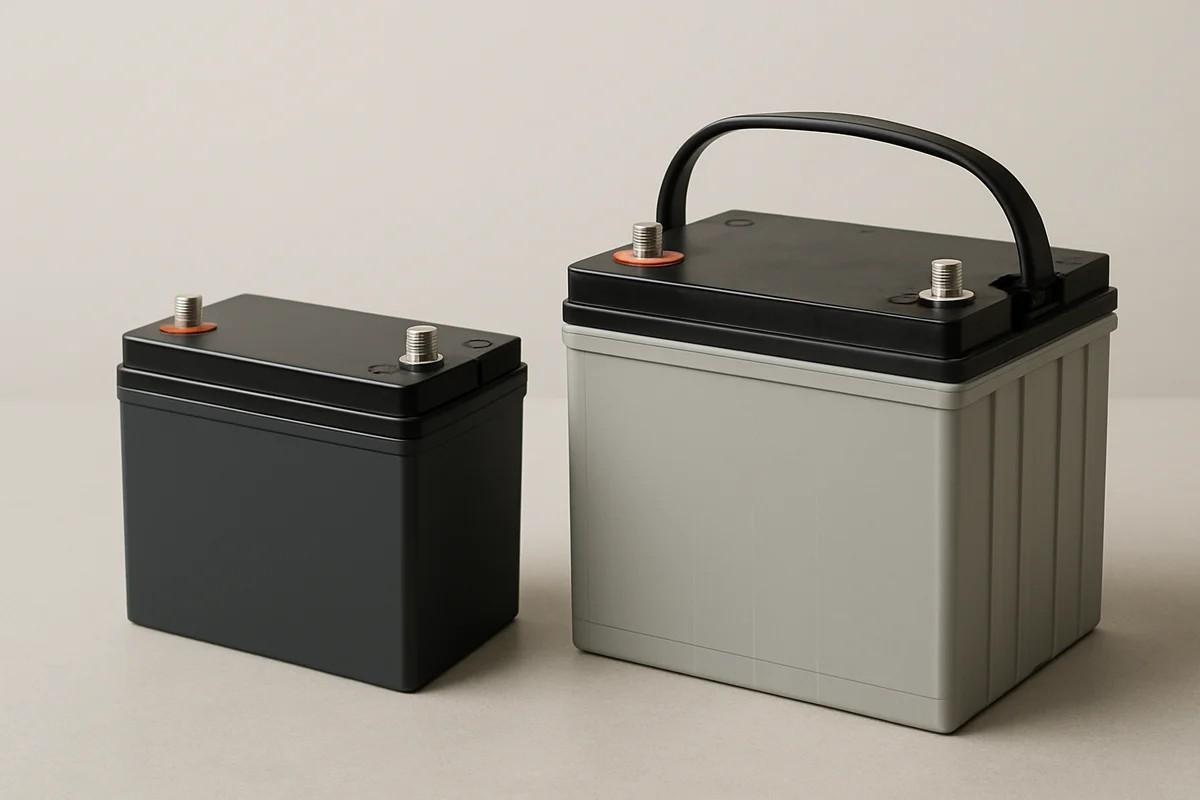
Deep cycle batteries are a fundamental power source for off-grid solar systems, marine applications, RV energy systems, and commercial backup power installations. Unlike starter batteries, which are designed to deliver a high current for a short period, deep cycle batteries are built for repeated charging and discharging, consistent power delivery, and extended standby operation.
For B2B integrators, system developers, and bulk purchasers, one of the most important decisions is choosing between traditional AGM deep cycle batteries and modern lithium deep cycle batteries.
There is no single battery chemistry that is ideal for every application. AGM and lithium deep cycle batteries differ significantly in their performance, cost structures, maintenance requirements, and environmental adaptability. Focusing only on the lowest purchase price or the highest performance can result in an unsuitable system configuration, higher operating expenses, and a shorter project service life.
This B2B guide provides a practical comparison of AGM and lithium deep cycle batteries, covering their operating characteristics, advantages, limitations, suitable applications, and key procurement considerations to help commercial buyers make more informed decisions.
Deep cycle batteries are energy storage devices designed to withstand repeated discharge cycles. Depending on the battery chemistry and application, they can be discharged to a substantial portion of their rated capacity before being recharged.
Unlike conventional cranking batteries, which provide short bursts of high current for engine starting, deep cycle batteries are designed to deliver steady power over extended periods. This makes them particularly useful for off-grid energy systems, backup power, mobile applications, and other scenarios requiring repeated cycling.
Both AGM and lithium batteries are available in deep cycle configurations. However, their internal chemistry, construction, charging characteristics, and long-term durability are quite different. Understanding these differences is essential for B2B buyers seeking to avoid improper product selection and improve overall project economics.
A qualified deep cycle battery should maintain reliable capacity and stable performance through repeated charge-discharge cycles. It should also withstand variations in load demand and provide dependable operation in systems that may operate with limited human supervision.
These requirements make cycle life, usable capacity, charging efficiency, self-discharge, temperature performance, maintenance, and total lifecycle cost important factors when comparing AGM and lithium technologies.
AGM, or Absorbent Glass Mat, is a mature sealed lead-acid battery technology commonly used in deep cycle applications. AGM batteries use fiberglass mats to absorb and immobilize the electrolyte, creating a sealed and largely maintenance-free design.
Because there is no freely flowing electrolyte, AGM batteries offer good resistance to leakage and can be installed in a wide range of conventional backup and energy storage systems. Their relatively low purchase price also makes them attractive for budget-conscious projects.
Lower upfront cost: AGM batteries generally have established manufacturing processes and relatively low material costs. This makes them an economical option for short-term projects, smaller installations, and applications where initial capital expenditure is a major concern.
Reliable and familiar technology: AGM technology has been widely used for years, making it compatible with many conventional charging systems, UPS installations, and solar applications.
Good safety characteristics: The sealed construction reduces the risk of electrolyte leakage and minimizes routine maintenance requirements. AGM batteries are also well suited to many standard standby and backup applications when operated within their recommended charging and discharge limits.
Good cold-weather discharge performance: AGM batteries can provide reliable discharge performance in cold environments. This can make them attractive for certain cold-region applications, although their charging performance and available capacity can still be affected by low temperatures.
Simple system integration: AGM batteries can often be integrated into existing lead-acid-based systems without major changes to charging equipment or communication protocols, helping reduce system integration costs.
Despite their cost advantages, AGM batteries have several limitations in demanding long-term cycling applications.
Their cycle life is generally much shorter than that of quality lithium iron phosphate (LiFePO4) batteries, particularly when regularly subjected to deep discharge. Repeated deep cycling can accelerate capacity degradation and shorten service life.
AGM batteries also have lower energy density, greater weight, and higher self-discharge than lithium alternatives. These characteristics can become significant disadvantages in applications requiring frequent cycling, extended backup periods, limited installation space, or mobile operation.
Lithium deep cycle batteries, particularly those based on LiFePO4 chemistry, have become an important alternative to traditional lead-acid batteries in commercial energy storage.
These batteries combine lithium cells with a battery management system (BMS) that monitors and protects the battery during charging and discharging. Compared with conventional lead-acid technology, lithium batteries can provide substantially longer cycle life, higher usable capacity, lower weight, and greater charging efficiency.
Long cycle life: High-quality LiFePO4 deep cycle batteries can typically support thousands of cycles, depending on operating conditions, depth of discharge, temperature, and product design. This can significantly extend service life compared with conventional AGM batteries.
Higher usable capacity: Lithium batteries generally allow a much greater portion of their rated capacity to be used without the rapid degradation associated with repeatedly deeply discharging lead-acid batteries. As a result, a lithium battery with the same nominal capacity can provide considerably more practical usable energy.
Low self-discharge: Lithium batteries typically have a very low self-discharge rate, making them well suited to equipment that remains idle or on standby for extended periods.
Lower weight and higher energy density: Lithium deep cycle batteries are substantially lighter than comparable AGM batteries. Their compact design can save installation space and reduce overall equipment weight, which is particularly valuable for RVs, boats, mobile power systems, and space-constrained installations.
High charging efficiency: Lithium batteries generally offer high charge efficiency and can accept charging current more efficiently than lead-acid batteries. This can improve the overall performance of solar and other energy storage systems.
The primary disadvantage of lithium deep cycle batteries is their higher initial purchase price. Although their longer service life and lower maintenance requirements can reduce total lifecycle costs, the larger upfront investment may be challenging for projects with strict initial budgets.
Temperature is another important consideration. LiFePO4 batteries generally require protection against charging at very low temperatures. Charging below the manufacturer’s specified temperature limit can cause permanent cell damage. Cold-climate installations may therefore require low-temperature charging protection or battery heating systems.
For B2B procurement, comparing the most important performance indicators can help buyers quickly determine which battery technology is better suited to a specific project.
AGM deep cycle batteries generally provide a significantly lower cycle count than lithium batteries, especially when operated at deeper discharge levels. Regularly cycling an AGM battery at around 50% DOD can result in hundreds of cycles, while repeated deeper discharge can shorten its lifespan.
Quality LiFePO4 deep cycle batteries can provide several thousand cycles under appropriate operating conditions. Their longer service life can reduce replacement frequency and help lower long-term operating expenditure for continuously cycling systems.
Depth of discharge is one of the most important differences between AGM and lithium batteries.
To achieve reasonable service life, AGM batteries are commonly operated at a relatively conservative DOD. Using only a portion of the rated capacity means that a larger nominal battery bank may be required to deliver the desired amount of usable energy.
Lithium batteries generally support a much higher usable DOD. This allows a greater percentage of the rated capacity to be used and can reduce the total battery capacity required for a particular application.
AGM batteries have a higher self-discharge rate than lithium batteries. For equipment that remains unused for long periods, periodic charging may therefore be necessary to maintain battery condition.
Lithium batteries typically have a much lower self-discharge rate, making them better suited to long-term standby applications where regular maintenance is difficult or inconvenient.
AGM batteries require more charging time and may experience reduced charging efficiency as they approach full charge. Lithium batteries generally accept charge more efficiently and can support faster charging under suitable conditions.
For solar systems and other applications with limited charging windows, the higher charging efficiency of lithium technology can improve overall energy utilization.
AGM batteries are relatively heavy because of their lead-based construction. A large AGM battery bank can add considerable weight to a vehicle, boat, or mobile energy system.
Lithium batteries offer substantially higher energy density and lower weight. This can simplify installation, reduce structural load, and provide more flexibility when space is limited.
AGM batteries typically have the advantage when comparing initial purchase prices. However, the calculation changes when replacement frequency, maintenance, energy efficiency, installation requirements, and service life are included.
Lithium batteries generally require a larger initial investment but can deliver lower lifecycle costs in applications involving frequent cycling and long operating periods.
For B2B buyers, total cost of ownership is therefore more meaningful than purchase price alone.
The right battery technology should be selected according to the project’s actual operating requirements rather than simply choosing the cheapest or most advanced option.
· Short-term commercial projects with tight upfront budgets
· Low-frequency cycling and standby power applications
· Smaller backup power systems
· Projects using existing lead-acid charging infrastructure
· Applications where initial purchase price is more important than maximum cycle life
· Long-term energy storage projects focused on lower lifecycle costs
· High-frequency cycling applications such as off-grid solar systems
· Marine, RV, and mobile energy storage systems
· Installations where weight and space are important considerations
· Unattended systems requiring low maintenance
· Applications requiring high usable capacity and efficient charging
When purchasing deep cycle batteries in bulk, B2B buyers should evaluate more than nominal voltage and capacity. Product quality, certifications, operating conditions, warranty terms, and supplier reliability can all have a major impact on project performance.
For AGM batteries, buyers should pay particular attention to cycle performance, construction quality, capacity consistency, and resistance to leakage.
For lithium batteries, important considerations include the quality and consistency of the cells, BMS protection functions, thermal management, low-temperature charging protection, communication capabilities, and applicable certifications.
Buyers should also verify whether the manufacturer’s stated cycle life is based on a specific DOD, temperature, charging method, and end-of-life capacity threshold. Comparing specifications under different test conditions can otherwise lead to misleading conclusions.
AGM and lithium batteries are both established technologies with distinct strengths in deep cycle applications.
AGM deep cycle batteries remain an attractive option for short-term, low-frequency, and budget-sensitive projects because of their lower upfront cost, familiar technology, and straightforward system integration.
Lithium deep cycle batteries, particularly LiFePO4 models, are generally better suited to long-term and high-frequency cycling applications where cycle life, usable capacity, energy efficiency, weight, and maintenance requirements are important.
For B2B integrators, distributors, and project developers, the best approach is not simply to choose the battery with the highest specifications. Instead, battery chemistry should be matched to the project’s operating conditions, system requirements, budget, and expected service life. A well-matched battery solution can improve system reliability, control lifecycle costs, and deliver better long-term project ROI.
Yes. AGM batteries can be specifically designed for deep cycle applications. However, their cycle life and recommended depth of discharge are generally more limited than those of quality lithium deep cycle batteries.
Not always. Although the nominal voltage and physical dimensions may appear compatible, lithium batteries have different charging requirements and protection characteristics. The charge controller, charger, inverter, wiring, and battery management system should be checked before making a replacement.
Lithium deep cycle batteries are often a better fit for marine and RV applications because of their lower weight, higher usable capacity, low self-discharge, and long cycle life. However, AGM can still be a practical choice when the initial budget is the primary concern or when an existing lead-acid system is already in place.
The actual lifespan depends heavily on discharge depth, temperature, charging practices, cycling frequency, and product quality. In general, AGM batteries have a considerably shorter cycle life than LiFePO4 batteries, while properly managed lithium batteries can provide several thousand cycles and many years of service.
Welcome to contact us:
Inquire more product details from the: Lithium Ion Battery Suppliers
WhatsApp/Wechat/Mobile: +86 13326321310
Email: info@battery-energy-storage-system.com
Website: www.battery-energy-storage-system.com
Ready to power your energy systems with the best in the industry?
Contact us today to get the latest pricing and discuss your needs with our team!
Next:Customized 12V 690Ah LiFePO4 Battery Pack for Surveillance Camera
Previous:9kW and 18kW Forklift Chargers Shipped to Thailand