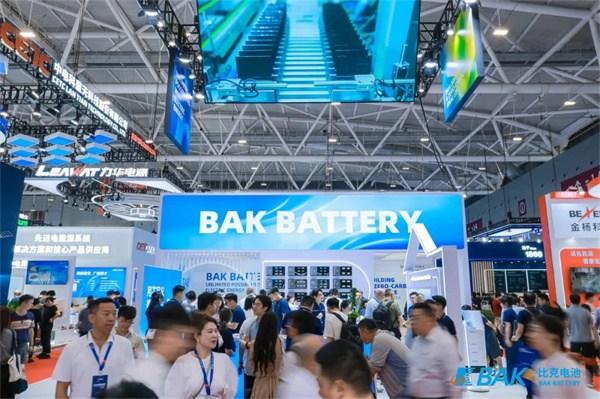
SHENZHEN, China, May 13, 2026 – The 18th China International Battery Fair (CIBF 2026) opened on May 13 at the Shenzhen World Exhibition & Convention Center. BAK Battery is exhibiting its solid-state, cylindrical, and prismatic battery lines. Spanning materials innovation through system-level safety, the complete portfolio highlights the company’s role in driving the clean-energy transformation.
According to EVTank, global lithium-ion battery shipments reached 2,280.5 GWh in 2025, with China accounting for 1,888.6 GWh, or 82.8% of the worldwide total, reflecting continued market expansion. At the same time, China’s Ministry of Industry and Information Technology and three other government bodies recently met with companies across the power and energy storage battery sector to address curbing irrational price competition and strengthening product quality oversight, as the industry shifts toward a more orderly development model. Against this backdrop, BAK Battery is presenting its solid-state, cylindrical, and prismatic battery platforms side by side at CIBF 2026. From inherently safer semi-solid-state cells to higher-performance tabless cylindrical cells and large-capacity prismatic solutions serving a variety of energy storage scenarios, BAK Battery is aligning its full portfolio with the industry’s next imperative: value-driven energy innovation.
Safety is the bedrock of battery performance, and solid-state technology is tackling this challenge at the materials level. At CIBF 2026, BAK Battery is showcasing a range of semi-solid-state cells. For drones and premium electric two-wheelers, the company has developed semi-solid-state cells with capacities from 30 Ah to 68 Ah. Engineered through large-format designs to deliver longer range, high power output, and lightweight construction, these cells incorporate advanced silicon-carbon anode materials, substantially boosting cell safety while retaining high energy density. For consumer applications such as security devices, smart wearables, and power banks, BAK Battery is introducing a standard 5,000 mAh cell that achieves a strong balance between performance and portability, supports flexible stacking and expansion, and enables broad use-case coverage. Its 1,200 mAh and 1,900 mAh cells are optimized for lightweight designs and the tight space constraints of specialized devices. From consumer electronics and security applications to the low-altitude economy, BAK Battery’s semi-solid-state technology is delivering safer, higher-performance energy solutions across a wide spectrum of scenarios.
BAK Battery has invested more than two decades in advancing cylindrical cell technology, building a comprehensive cylindrical cell platform that unites high capacity, high power, and high safety. For high-capacity applications, the BAK 21700-65E leverages a high-nickel chemistry to reach a volumetric energy density of 928 Wh/L and a gravimetric energy density of 315 Wh/kg within a standard form factor, giving end devices extended runtime. In high-power use, the 2170-50D2 employs solid-electrolyte coating technology and achieves an internal resistance below 5 mΩ. It supports 60 A continuous discharge and operates across a temperature range of -20 °C to 80 °C, maintaining stable power delivery under demanding loads such as power tools. The 2170-55B merges high energy density with high power, sustains 27 A high-current discharge, and retains more than 80% capacity after 1,000 cycles, making it a fit for high-performance applications including passenger vehicles and eVTOL. In terms of safety, the 21700-45M combines reduced material reactivity with physical fail-safe protection. It has passed stringent tests under China’s updated national standard, including nail penetration and overcharge, and is designed to avoid lithium-plating risks over long-term use, fully meeting the standard’s demands for intrinsic cell safety. Also on display is the 4695-330B large-format cylindrical cell, which pairs fast charging with high capacity to satisfy the continuous operation requirements of robotics.
Spanning high capacity, high power, and high safety, BAK Battery’s cylindrical cell lineup serves a broad spectrum of end markets — including power tools, electric two-wheelers, eVTOL, and artificial intelligence applications — turning every “energy capsule” into a high-efficiency power source.
In the prismatic cell segment, BAK Battery is spotlighting four representative products. Its LFP lineup features an 85 Ah cell that supports 6C high-rate discharge and delivers a cycle life exceeding 4,000 cycles, striking a precise balance between high power output and long-term reliability. The 230 Ah cell handles charge and discharge rates up to 4C and can charge from 10% to 80% state of charge in 15 minutes. By combining high energy density with high-rate performance, this cell is tailored to meet the fast-charging needs of commercial and industrial energy storage scenarios. The 314 Ah semi-solid-state LFP cell raises intrinsic safety through its materials system, supports discharge across a wide temperature range from -20 °C to 60 °C, and achieves a cycle life beyond 10,000 cycles, making it well-suited for applications ranging from C&I energy storage and residential storage to telecom base stations and data centers.
While continuing to advance lithium battery technology, BAK Battery is also prioritizing sodium-ion batteries as a key strategic focus for energy storage. Aligned with the 15th Five-Year Plan’s emphasis on scaling up emerging storage technologies such as sodium-ion, the company has launched a 150 Ah prismatic sodium-ion cell with a cycle life of over 20,000 cycles, positioning it among the industry’s leading products. Thanks to the intrinsic characteristics of sodium-ion chemistry and the abundance of sodium resources, the cell provides strong low-temperature adaptability and cost efficiency. It can deliver stable discharge performance in extremely cold regions, helping to address winter energy storage challenges in northern markets and enabling a more optimized balance between performance and cost in large-scale energy storage.
Building on the cell as its foundation, BAK Battery has spent more than twenty years cultivating deep expertise across materials chemistry, cell architecture, and manufacturing processes, contributing sustained momentum to the new energy era. Looking ahead, BAK Battery will continue to invest in technology R&D and product innovation, providing higher-value energy solutions to customers around the world.
Next:Guide to Custom High-Capacity Lithium Battery Packs for Outdoor Energy Storage
Previous:AA vs AAA Batteries: A Complete Guide to Their Differences, Sizes, Applications, and Battery Life