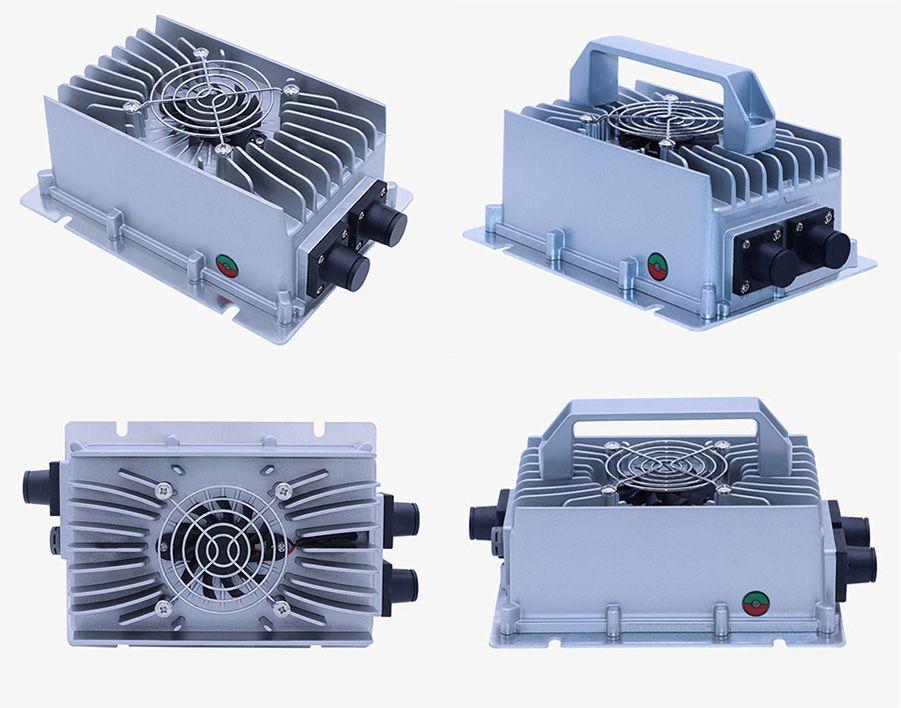
You have a perfectly functional lead-acid battery charger sitting in your garage, and you’ve recently upgraded to a lithium battery. The question feels almost too simple: can you just connect it and let it charge? The brief answer is no — and attempting it can be risky. But there’s a bit more to the full story.
This guide will walk you through exactly why lead-acid chargers aren’t compatible with lithium batteries, what actually takes place if you try it anyway, and what equipment you should be using instead to protect your batteries and maximize their lifespan.
The central problem lies in charging chemistry. Lead-acid and lithium batteries — whether lithium iron phosphate (LiFePO4), lithium-ion (Li-ion), or lithium polymer (LiPo) — follow completely different charging rules.
Lead-acid chargers operate in a multi-stage cycle (bulk, absorption, float) that matches the voltage characteristics of lead-acid cells. As a final step, most apply a continuous float charge to hold capacity — typically around 13.8V for a 12V lead-acid battery.
Lithium batteries have an entirely different voltage response and absolutely must avoid any float charge. A lithium cell is fully charged at an exact cutoff voltage (usually 3.65V per cell for LiFePO4). Once that voltage is reached, charging must cease. Full stop.
When a lead-acid charger continues delivering current after a lithium battery is already full, you face several dangers:
- Overcharging — which rapidly degrades the cells
- Overheating — an overcharged lithium battery can swell, vent, or in extreme cases catch fire
- BMS disruption or failure — most lithium packs include a Battery Management System (BMS) that may disconnect under mismatched charging signals, potentially leaving your battery partially or permanently damaged
Let’s look at specific scenarios, because not every situation carries the same level of risk.
Scenario 1: Basic, unregulated lead-acid charger
This is the most hazardous situation. Inexpensive chargers without proper voltage regulation will keep pushing current indefinitely. Plugging one into a lithium battery is likely to overcharge and ruin the pack — possibly triggering a thermal incident.
Scenario 2: Smart or multi-stage lead-acid charger
A "smart" charger is better, but still not suitable. Even though it stops bulk charging at a defined voltage, the float stage — usually 13.6–13.8V for a 12V system — is too high for a fully charged LiFePO4 battery (which needs zero float). Long-term use will accelerate your lithium pack’s degradation beyond normal rates.
Scenario 3: The BMS saves you (on occasion)
Many lithium batteries have an internal BMS that can disconnect the pack when it detects overvoltage. In this case, the charger might seem to "work" — but the battery isn’t really receiving a complete, healthy charge. Letting the BMS trip repeatedly is not a sustainable solution.
The only safe path is to use a charger purpose-built for lithium batteries — one that precisely matches your battery’s chemistry and voltage profile.
Here’s what you need to look for:
- Correct chemistry label: The charger should clearly state "LiFePO4," "Li-ion," or "LiPo" — whatever your battery requires.
- Correct voltage: A 12V lithium charger should bring the battery to ~14.4–14.6V (for LiFePO4) and then shut off entirely, with no float.
- Automatic cutoff: The charger must stop delivering current as soon as the battery reaches full charge.
- CC/CV charging: Quality lithium chargers employ Constant Current / Constant Voltage (CC/CV) — constant current until near-full, then constant voltage until the current tapers off, followed by a complete stop.
Recommended charger types by application
| Application | Battery Type | What to Purchase |
| RV / marine / solar | LiFePO4 12V | Dedicated LiFePO4 charger |
| Power tools | Li-ion packs | OEM charger from the tool brand |
| Motorcycles / powersports | LiFePO4 | LiFePO4-compatible battery maintainer |
| Drones / RC | LiPo | Dedicated LiPo balance charger |
There is one narrow exception worth noting: a handful of modern multi-chemistry smart chargers include a dedicated lithium mode. If your charger has a switch or menu option labeled "LiFePO4" or "lithium," and it’s confirmed to deliver the correct voltage profile, you might be able to use it.
How to verify:
- Check the manual for lithium-specific charging profiles and their target voltages.
- Make sure the lithium mode charges to ~14.4–14.6V (for 12V LiFePO4) and then turns off completely — no float.
- Never assume a charger marked "smart" or "automatic" is lithium-compatible unless the documentation states it explicitly.
If there’s any uncertainty, contact the charger’s manufacturer directly. Don’t guess when it comes to lithium — purchasing a new charger costs far less than replacing a lithium pack or dealing with a fire.
Recognizing the fundamental differences makes the incompatibility clear:
| Feature | Lead-Acid | Lithium (LiFePO4) |
| Charge cutoff voltage (12V) | ~14.7V | ~14.4–14.6V |
| Float voltage | ~13.6–13.8V | None — must stop |
| Overcharge tolerance | Moderate (vents gas) | Very low — dangerous |
| Internal protection | None | BMS (usually) |
| Charge cycles | 300–500 | 2,000–5,000+ |
Lithium’s impressive lifespan evaporates quickly when charged incorrectly. Safeguarding that investment begins with the right charger.
Using a lead-acid charger on lithium batteries isn’t just a poor choice — it puts your battery, your equipment, and possibly your safety at risk. The two chemistries follow different voltage rules, and the float-charge behavior built into every lead-acid charger is fundamentally incompatible with what lithium cells require.
Will a lead-acid charger destroy a lithium battery?
Yes, in most circumstances a lead-acid charger will gradually damage a lithium battery. The float stage — applied continuously by most lead-acid chargers after bulk charging — overcharges lithium cells, causing faster degradation or, in the worst case, dangerous overheating. Always stick to a lithium-compatible charger.
Can I use a trickle charger on a lithium battery?
No. Conventional trickle chargers are built to sustain lead-acid batteries with a low, steady voltage — precisely the kind of float charge that harms lithium batteries. Some trickle chargers specifically marketed for lithium do exist, but you must verify they are designed for your battery chemistry before use.
What voltage should a 12V lithium battery charger reach?
A 12V LiFePO4 battery charger should peak at 14.4 to 14.6 volts and then stop supplying current entirely. It must not apply any float voltage. A charger that continues to hold at 13.6–13.8V after that point is behaving like a lead-acid charger and is unsafe for lithium.
Is it safe to use a lithium charger on a lead-acid battery?
Generally, no. Lithium chargers are tuned for a different voltage profile. Using one on a lead-acid battery can lead to undercharging (the charger quits before the lead-acid battery is genuinely full) or may confuse a smart charger’s logic. Always use the charger made for your specific battery type.
How do I figure out which charger my lithium battery needs?
Consult your battery’s documentation or the label on the unit. It will identify the chemistry (LiFePO4, Li-ion, etc.) and nominal voltage. Buy a charger that explicitly supports that chemistry and voltage. When unsure, reach out to the battery manufacturer — most publish a list of compatible chargers.
Inquire more product details from the: Lithium Ion Battery Suppliers
WhatsApp/Wechat/Mobile: +86 13326321310
Email: info@battery-energy-storage-system.com
Website: www.battery-energy-storage-system.com
Next:CATL Unveils China’s First Standardized Battery Swap Ecosystem for Light Trucks
Previous:Ganfeng Lithium Begins Small-Scale Production of 500 Wh/kg Solid-State Batteries