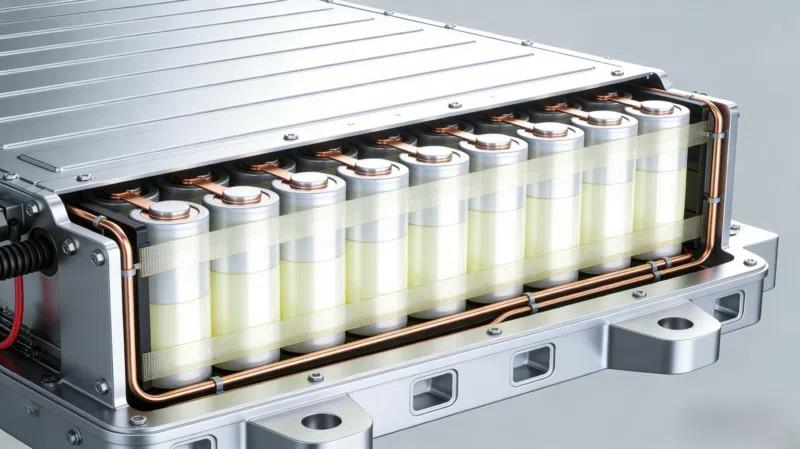
A group from the Chinese Academy of Sciences has reported a sodium-ion battery design that completely prevents thermal runaway at the ampere-hour scale. The findings, led by Hu Yongsheng of the Institute of Physics, appeared on April 6 in Nature Energy. The innovation centers on a polymerizable non-flammable electrolyte (PNE) that creates an internal "firewall," effectively severing heat transfer pathways and halting the cascade of internal reactions that typically lead to battery failure.
Rather than merely adding flame-resistant substances to the mix, the PNE approach combines thermal endurance, interfacial stability, and physical separation into a unified, multi-tiered safety mechanism. During routine operation, the electrolyte behaves as a conventional liquid. Should internal temperatures climb past 150 °C, however, the material undergoes a phase change, solidifying into a barrier that physically isolates the cell's reactive elements. This stops failure propagation at the source instead of simply slowing down ignition.
The system was proven in a 3.5 Ah cylindrical sodium-ion cell subjected to severe abuse conditions, including nail puncture and external heating to 300 °C. Throughout these rigorous evaluations, the cell emitted no smoke, flames, or explosive force, indicating a total disruption of the thermal runaway sequence. Importantly, the enhanced safety profile does not come at the expense of operational capability. The cell functions dependably across a wide temperature span from –40 °C to 60 °C, maintains voltage above 4.3 V, and delivers an energy density of 211 Wh/kg at the cell level.
This work is associated with Zhongke Haina (HiNa), a sodium-ion battery venture incubated by the same institute. Preliminary field data from heavy-duty truck demonstrations point to roughly a 15 percent reduction in per-kilometer energy use and an approximate 20 percent gain in range under standard driving conditions. HiNa projects that manufacturing costs for sodium-ion systems will align with those of lithium-ion alternatives around 2027, with price brackets expected to overlap as production volumes ramp up through 2028.
Concurrent industry activity reinforces the growing traction of sodium-ion technology. A major automotive manufacturer has separately disclosed a sodium-ion cell capable of reaching a full charge in about 11 minutes, while also demonstrating reliable performance from –40 °C to 60 °C and resilience under high-temperature stress.
Next:BYD Solid State Battery Hits Breakthrough Stage But Faces Scaling Hurdles
Previous:Electric Bike Battery Guide: How to Choose the Right Battery for Your E-Bike