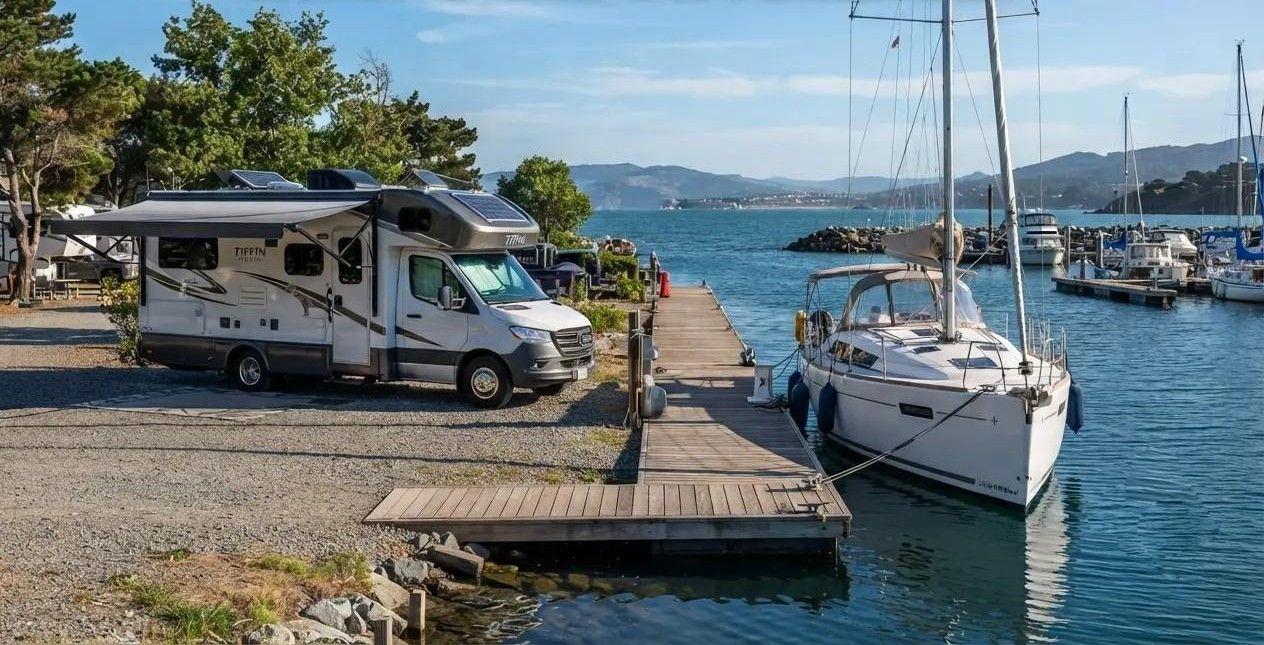
Before comparing marine and RV models, it helps to clarify what makes a battery “deep cycle.” A starting battery is designed to deliver a short, powerful burst of current to crank an engine. A deep cycle battery, by contrast, is built to be discharged deeply—often to 50% or more of its capacity—and then recharged many times.
These batteries use thicker plates, stronger internal components, and chemistry optimized for repeated cycling rather than high cranking current. A well-made deep cycle unit can survive hundreds or even thousands of discharge/recharge cycles, while a starting battery would degrade quickly under the same demands.
Marine and RV house batteries both belong to this deep cycle category, but their design emphasis varies according to the environment.
At first glance, marine and RV batteries look similar. Both are commonly 12V, can be arranged into 24V or 48V banks, power house loads, and are sold in flooded lead-acid, AGM, gel, and lithium chemistries. Because retailers often market them interchangeably, the distinction becomes blurred.
However, their operating conditions are quite different:
- Marine: continuous vibration, salty and humid air, movement and tilting, and strict safety regulations for enclosed compartments.
- RV: road shocks, extreme temperatures, varied charging sources such as shore power, generator, and solar, and limited airflow in battery compartments.
These differences influence how the batteries are built, what safety features they include, and which certifications they carry.
A marine deep cycle battery is specifically designed to withstand the boating environment:
- Vibration resistance: strengthened internal construction, bonded plates, and durable terminals help the battery tolerate constant engine and wave motion.
- Corrosion resistance: terminals and coatings are selected to resist salt air and high humidity.
- Tilt tolerance: the battery can operate at an angle without leaking electrolyte or damaging internal parts.
- Ignition protection: sealed designs reduce the chance of sparks and explosions in enclosed engine spaces.
- Dual-purpose capability: many marine batteries can support both house loads and occasional engine starts, which is common on smaller boats.
Marine batteries also tend to have thicker cases and stronger terminal posts to handle the demands of boating.
Several chemistries are available for marine deep cycle use:
- Flooded Lead-Acid: the traditional and least expensive option, but it requires regular watering and ventilation. Marine versions have reinforced plates and handle vibration better than automotive flooded batteries.
- AGM (Absorbent Glass Mat): currently the most popular marine choice. These batteries are sealed, spill-proof, maintenance-free, and very resistant to vibration. They charge faster than flooded batteries and manage deep cycling well.
- Gel: sealed and maintenance-free, with good deep cycle capability and spill safety. However, they are sensitive to overcharging and need precise voltage control, making them less forgiving than AGM.
- Lithium (LFP): the fastest-growing segment. Lithium iron phosphate batteries last much longer, weigh less, allow deeper discharges, and charge faster. High-quality marine lithium batteries include a built-in BMS with marine-specific protections.
Reputable marine batteries meet certifications that verify their suitability for marine use:
- ABYC standards cover marine electrical systems, including battery installation and safety.
- USCG requirements address ignition protection and safety on gasoline-powered boats.
- BCI marine classifications set standards for marine battery construction and performance.
- UL 1973 is a safety standard for stationary and motive batteries, increasingly required for lithium marine systems.
Marine batteries used for starting engines on gasoline-powered boats must also meet ignition protection standards to prevent sparks that could ignite fuel vapors.
RV deep cycle batteries, often called house batteries, supply power to living-area loads such as lights, appliances, water pumps, and entertainment systems. Their key design traits include:
- Cycle life optimization: engineered for daily deep discharge and recharge during camping.
- Standard group sizes: available in BCI group sizes like 24, 27, 31, GC2, and 8V to fit standard RV battery trays.
- Parallel/series configuration: easy to connect in parallel for more capacity or in series for 24V/48V systems.
- Charge source flexibility: capable of handling power from converters, generators, solar panels, and alternators with varying quality and voltage.
- Temperature tolerance: built to survive hot summer storage and cold winter conditions, often without climate control.
RV batteries are generally placed in dedicated compartments, often under the vehicle or in exterior storage bays, with varying ventilation and temperature management.
- Flooded Lead-Acid (FLA): the traditional RV house battery, frequently in 6V golf cart format wired in series for 12V. It is the cheapest but needs regular upkeep and ventilation.
- AGM: increasingly popular because it is maintenance-free, more vibration-resistant, and safer to install in living spaces. AGM RV batteries charge faster and tolerate partial state-of-charge operation better than flooded batteries.
- Lithium (LFP): rapidly gaining ground in RVs. Lithium RV batteries deliver 2–3 times the usable capacity of similar lead-acid batteries, far longer cycle life, and much lower weight—an important factor for weight-limited vehicles.
RV battery setups range from a single 12V unit in small campers to large multi-battery banks of 400Ah to over 1000Ah for full-time living with solar.
Most RVs have two independent battery systems:
- House batteries (deep cycle) power the living space. These are what people typically mean by “RV batteries.”
- Chassis battery (starting) starts the vehicle engine, similar to an automotive starter battery.
The two systems are normally separate, though many RVs include a battery disconnect or emergency start function that allows house batteries to help start the engine if needed. Some newer RVs use DC-DC converters or battery isolators to control charging between the two banks.
Both battery types face vibration, but the patterns differ:
- Marine: lower-frequency, continuous vibration from engines and waves, with less peak shock.
- RV: intermittent, higher-impact shocks from rough roads and potholes, with greater peak forces.
Marine batteries generally use stronger plate bonding and internal bracing for continuous vibration. RV batteries focus more on terminal retention and case strength for impact shock. AGM batteries handle both types better than flooded batteries because their compressed mat construction holds plates securely.
The biggest design difference is corrosion resistance:
- Marine batteries feature corrosion-resistant terminals, often tin-plated or stainless, sealed tops, and materials suited to salt air and high humidity. Many use threaded terminals for secure connections that resist loosening.
- RV batteries typically use standard automotive-style terminals, with less emphasis on corrosion resistance because road environments are drier and free of salt spray.
For saltwater boats, marine-grade corrosion resistance is essential for safety and reliability, not optional.
Although both are deep cycle batteries, their typical discharge patterns differ:
- Marine duty often involves moderate discharge over long periods—running navigation, lights, and refrigeration for days at anchor—followed by recharging from an alternator, generator, or shore power. Many marine batteries also serve dual-purpose roles on smaller boats.
- RV duty usually involves a daily deep discharge while camping, followed by recharging from shore power, generator, or solar. RV house batteries rarely need to provide high cranking current.
As a result, true marine dual-purpose batteries balance deep cycling with some starting ability, while dedicated RV house batteries are optimized purely for deep cycling.
Safety requirements differ considerably:
- Marine: subject to Coast Guard and ABYC standards. Ignition protection is required in gasoline engine compartments, and flooded batteries must meet strict ventilation rules. Lithium battery systems face increasingly strict standards on boats.
- RV: governed by RVIA standards and the NEC for installations, with generally less prescriptive rules for battery design itself.
The enclosed, often poorly ventilated nature of boat engine compartments, plus the risk of fuel vapors, explains the stricter marine safety requirements.
Choose a deep cycle marine battery when:
- The battery will be installed on a boat or watercraft.
- Saltwater or high humidity is expected.
- Ignition protection is required, such as in gasoline engine compartments.
- The battery must withstand continuous vibration and tilting.
- Marine certification or ABYC compliance is needed.
- Dual-purpose house and starting capability is required.
For any boat application, a battery specifically designed and certified for marine use is strongly recommended for safety and service life.
Choose an RV deep cycle battery when:
- It will power house loads in an RV or camper.
- Standard BCI group sizes fit the existing battery compartment.
- Road shock and vibration are the main mechanical stress.
- Multiple charge sources such as solar, converter, and alternator will be used.
- Weight and capacity optimization for off-grid camping is a priority.
RV batteries are also widely used in other mobile off-grid setups like van conversions, food trucks, and mobile workstations, where conditions are closer to road use than marine use.
In a pinch, a deep cycle battery from one application can often work in the other, with some caveats:
- RV battery in a boat: it will function electrically, but may fail early due to corrosion, vibration, or lack of ignition protection. It is not recommended for saltwater or gasoline engine compartments and may violate marine safety regulations.
- Marine battery in an RV: it will work and may even be more durable, but it often costs more than an equivalent RV battery and may have different terminals requiring adapter cables.
For commercial and OEM installations, always use the battery type designed and certified for the specific application to ensure safety, compliance, and warranty coverage.
Marine and RV deep cycle batteries may serve a similar purpose—storing energy for off-grid house loads—but they are designed with different priorities based on their environments. Marine batteries emphasize corrosion resistance, vibration tolerance, tilt safety, and ignition protection to meet boating demands and regulations. RV batteries focus on deep cycling, standard sizing for vehicle integration, and compatibility with multiple charging sources.
For system integrators and procurement teams, the key point is that these battery types are not universally interchangeable. Marine applications require marine-certified batteries for safety, compliance, and longevity. RV applications can use marine batteries if necessary, but are better served by purpose-built RV batteries that provide better value and fit.
As lithium technology continues to expand in both markets, the design differences between marine and RV lithium systems will likely become even more distinct, with marine lithium batteries adding stronger safety features, corrosion protection, and marine-specific certifications. Understanding these differences helps ensure every installation meets safety standards and delivers the expected service life.
Both are deep cycle batteries that power auxiliary loads, but marine batteries are built for boating with better corrosion resistance, vibration tolerance, tilt capability, and often ignition protection. RV batteries are optimized for house loads in recreational vehicles, with standard group sizes, road-shock durability, and flexibility for multiple charging sources. Marine batteries must meet Coast Guard and ABYC standards, while RV batteries follow RVIA and NEC guidelines.
Yes, a marine deep cycle battery will work in an RV and may even be more durable due to its rugged build. However, it often costs more than an equivalent RV battery, and terminal styles may differ—marine batteries frequently use threaded terminals instead of automotive-style posts. The main drawbacks are higher cost and possible terminal differences. For most RV applications, a purpose-built RV deep cycle battery is more cost-effective.
Not necessarily—they are optimized for different environments. Marine batteries offer better corrosion resistance and ignition safety, making them superior on boats. RV batteries are designed for deep cycling house loads and come in standard sizes for RV compartments. A marine battery in an RV adds durability but costs more. An RV battery on a boat may fail early and might not meet safety regulations.
The best chemistry depends on budget and how the battery will be used. AGM is the most popular mid-range choice for both marine and RV applications because it is maintenance-free, vibration-resistant, and offers good cycle life at a moderate price. Lithium LFP is the premium option, delivering 2–3 times the usable capacity, much longer life, and far less weight, but at a higher upfront cost. Flooded lead-acid remains the budget option but requires regular maintenance and ventilation.
Lifespan depends on chemistry, depth of discharge, charging quality, and operating conditions. Flooded lead-acid deep cycle batteries typically last 3–6 years in marine or RV service. AGM batteries last 5–8 years with proper care. Lithium LFP batteries can last 10–15 years or more, with cycle life ratings of 3,000 to over 6,000 full cycles. Batteries exposed to deep discharges, poor charging, high heat, or constant vibration will fail sooner than those operated under ideal conditions.
Welcome to contact us:
Inquire more product details from the: Lithium Ion Battery Suppliers
WhatsApp/Wechat/Mobile: +86 13326321310
Email: info@battery-energy-storage-system.com
Website: www.battery-energy-storage-system.com
Ready to power your energy systems with the best in the industry?
Contact us today to get the latest pricing and discuss your needs with our team!
Next:24V 100Ah LiFePO4 Battery Packs Shipped to Italy
Previous:SQT32145H 2.4V 10Ah LTO Batteries Shipped to Canada