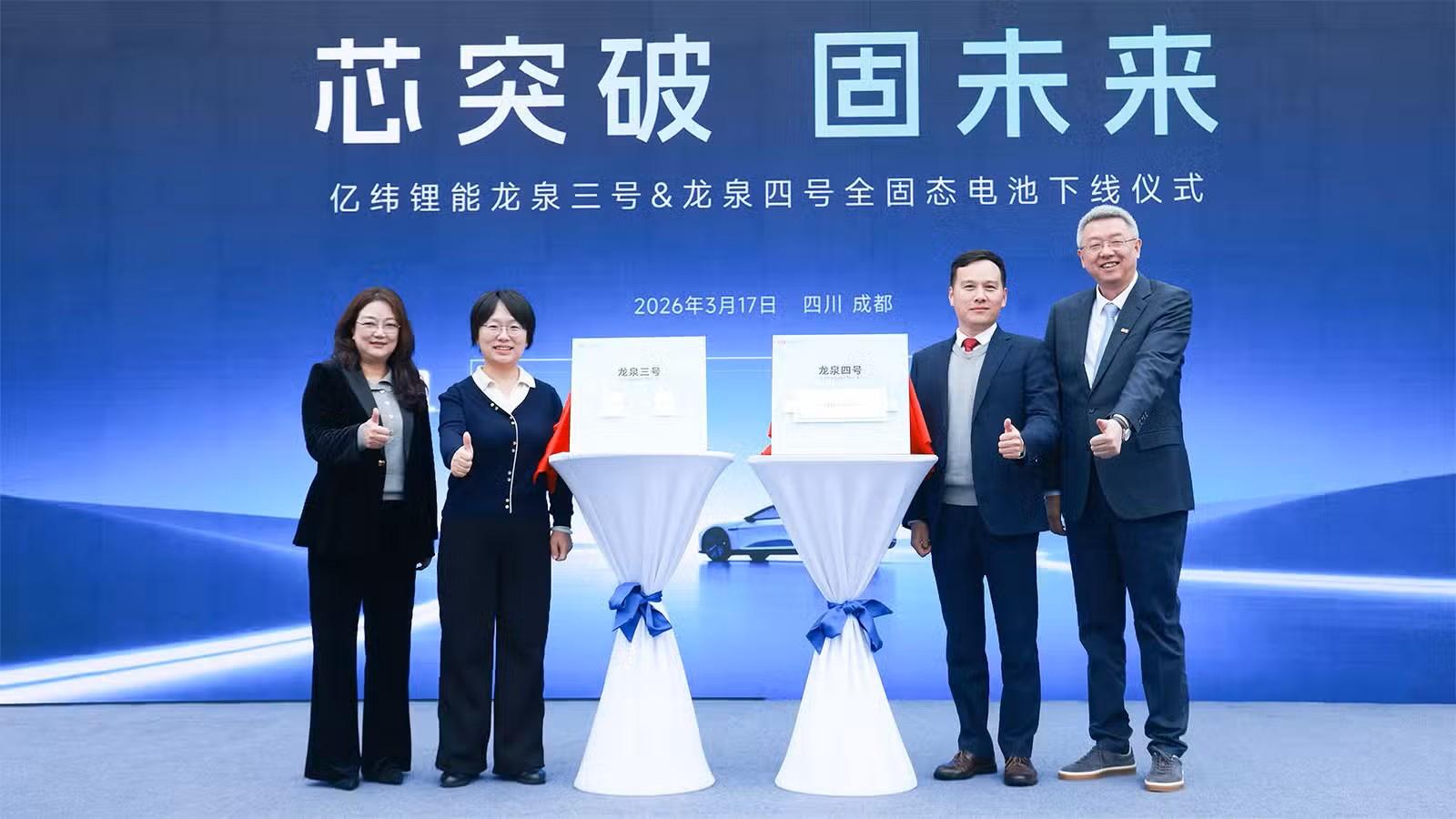
EVE Energy has taken a major leap forward in next-generation energy technology, rolling two new all-solid-state batteries off its production line. The milestone underscores the Chinese battery giant’s accelerating push to commercialize advanced solid-state solutions.
According to a company statement released on Wednesday, the two new models—named Longquan No. 3 and Longquan No. 4—officially entered production on March 17 during a rollout ceremony at EVE Energy’s manufacturing base in Chengdu, Sichuan province.
The Longquan No. 3 all-solid-state battery is tailored for the consumer electronics sector. It operates efficiently in low-pressure environments below 2 megapascals (MPa) and boasts high volumetric energy density—ideal for space-constrained devices.
Meanwhile, the Longquan No. 4 is engineered for the electric vehicle (EV) power battery market. With capacity now boosted to 60 ampere-hours (Ah), the battery can cycle under pressures of 5 MPa or less, marking a significant step toward real-world EV application. Company executives attended the ceremony to celebrate what they described as a pivotal moment in the firm's technological evolution.
EVE Energy’s Chengdu base has been central to its solid-state ambitions. In 2022, the company launched a 9 GWh conventional battery production line in the Chengdu Economic and Technological Development Zone, and soon after began constructing a mass production base tied to its solid-state battery research institute.
These efforts have gradually built out a comprehensive product portfolio at the site—spanning consumer, power, and energy storage batteries. These cells are now being deployed across EVs, low-altitude transport, and even humanoid robotics.
By 2025, the Chengdu facility had developed production capabilities for all-solid-state batteries ranging from 10 to 60 Ah, laying the groundwork for next-gen manufacturing processes. That progress paved the way for the September 2025 launch of the Longquan No. 2, a solid-state cell aimed at powering humanoid robots, low-altitude aircraft, and AI-driven equipment.
Today, EVE Energy continues to scale up its solid-state battery operations in Chengdu. Spanning 11,000 square meters, the facility is on track to reach an annual production capacity of 100 GWh by December 2026, according to a statement from last September.
The company has committed to both sulfide and halide solid-state electrolyte technology routes as it pushes the boundaries of battery innovation.
On the global stage, EVE Energy ranked as the world’s eighth-largest EV battery maker in 2025, capturing a 2.6% market share, according to data from South Korea’s SNE Research.
Next:A Complete Guide to UN3480 & UN3481 Lithium Ion Battery Shipping Regulations
Previous:Battery Management System (BMS) Guide: Core Functions, System Architecture, and Hardware Design