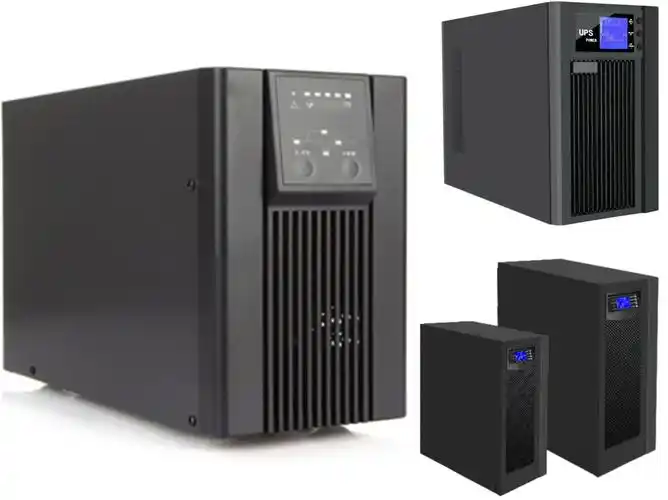
Power disruptions can cost businesses thousands of dollars a minute. Whether you're protecting a home office, a server room, or an entire data center, the battery technology inside your UPS determines whether you get a seamless failover or a disastrous shutdown. If you're looking into a UPS with a lithium-ion battery, this guide covers performance, lifespan, cost, safety, and the applications that stand to gain the most.
An Uninterruptible Power Supply (UPS) delivers backup power the instant grid electricity fails. For decades, UPS units relied almost entirely on valve-regulated lead-acid (VRLA) batteries. Today, lithium-ion technology is rapidly replacing that standard.
A lithium-ion UPS operates just like any other UPS — it sits between your equipment and the mains, monitoring voltage continuously. When it senses an outage, it switches to battery power in milliseconds. The distinction is on the inside: lithium-ion cells paired with a Battery Management System (BMS) that tracks voltage, temperature, and charge state to keep operation safe and efficient.
Two lithium chemistries lead the UPS market:
- Lithium Iron Phosphate (LiFePO4) — emphasizes stability, safety, and long cycle life
- Lithium Nickel Manganese Cobalt Oxide (NMC) — delivers higher energy density and a smaller footprint
1. Significantly Longer Lifespan
This is the single biggest advantage. VRLA batteries typically need replacing every 3 to 5 years. Lithium-ion UPS batteries, in contrast, last 8 to 10 years or more — often matching the entire service life of the UPS unit itself. That can mean zero battery replacements over the life of the system.
Looking at cycle durability, the gap is even wider: lead-acid handles about 200 to 500 charge/discharge cycles, while lithium-ion can manage 3,000 to 5,000 cycles before degrading. That’s up to 25 times more cycles, directly adding years of extra service.
2. Smaller Footprint and Lighter Weight
Lithium-ion batteries are 40% to 60% lighter than equivalent VRLA batteries and occupy roughly 40% less volume. In rack-mounted deployments, that frees up valuable space. For installations in cramped or hard-to-reach locations — edge computing sites, industrial cabinets — the reduced weight makes handling and installation much easier.
3. Greater Energy Efficiency
Most lithium-ion batteries operate at 95% round-trip efficiency or higher, versus 80–85% for lead-acid. Less energy wasted as heat during charging lowers operating costs and eases the cooling load on your facility.
Lithium-ion batteries can also be discharged up to 85% of their rated capacity before performance dips, while lead-acid is typically limited to a safe depth of discharge around 50%. You get substantially more usable energy from the same rated capacity.
4. Faster Recharge Times
After a power event, you want your UPS back at full readiness as quickly as possible. Lead-acid batteries can take 8 to 16 hours to fully recharge. Lithium-ion batteries charge in a fraction of that time, making them ideal for environments where outages are frequent or unpredictable.
5. Better High-Temperature Performance
Heat is the enemy of lead-acid batteries. For every 15°F rise above the optimal 77°F operating temperature, VRLA batteries lose roughly half their expected lifespan. Lithium-ion batteries, by contrast, can operate at temperatures up to 104°F with no meaningful performance degradation. This makes them far better suited for industrial environments, outdoor enclosures, and edge deployments where temperature control is limited.
6. Lower Total Cost of Ownership (TCO)
The upfront cost of a lithium-ion UPS is higher — typically 15% to 30% more than comparable lead-acid solutions. But when you factor in fewer battery replacements, reduced labor, lower energy waste, and less cooling overhead, lithium-ion can deliver total cost of ownership savings of up to 50% over its lifetime. For any long-term deployment, the numbers almost always favor lithium.
| Aspect | Lithium-Ion UPS | VRLA Lead-Acid UPS |
| Service life | 8–10+ years | 3–5 years |
| Charge/discharge cycles | 3,000–5,000 | 200–500 |
| Usable depth of discharge | Up to 85% | ~50% |
| Round-trip efficiency | ≥95% | 80–85% |
| Weight | 40–60% lighter | Heavier baseline |
| Volume | ~40% smaller | Larger footprint |
| Max operating temperature | Up to 104°F (40°C) | Best at 68–77°F (20–25°C) |
| Initial cost | Higher | Lower |
| Long-term TCO | Up to 50% lower | Higher due to replacements |
| Maintenance | Minimal | More frequent checks needed |
Lithium-ion UPS systems make the most sense in these scenarios:
- Data centers and server rooms — Uptime is non-negotiable, replacement downtime is disruptive, and energy efficiency directly impacts operating expenses. Lithium-ion meets every requirement.
- Edge computing deployments — Remote sites with limited space, infrequent maintenance visits, and variable temperatures benefit enormously from lithium-ion’s durability and compact size.
- Industrial and manufacturing environments — High ambient temperatures and demanding power cycles make lead-acid a poor fit. Lithium-ion handles harsh conditions without the performance penalty.
- Any facility planning for 10+ years of operation — If you’re building infrastructure meant to last a decade, paying more upfront for a battery that lasts just as long is simply smart planning.
Lead-acid may still make sense for budget-constrained, short-term deployments, or facilities where the power infrastructure is already sized around VRLA systems and replacement cycles are accepted as routine.
- Fire suppression compatibility — Lithium-ion battery fires require water-based suppression systems. Many older data rooms use Halon or CO₂ systems, which are ineffective on lithium fires. Verify your facility’s fire safety infrastructure before deployment.
- BMS quality — Not all lithium-ion UPS systems are created equal. A robust Battery Management System is critical to safe operation and long life. Look for features like cell balancing, over-temperature protection, and state-of-health reporting.
- Recycling and disposal — Lithium-ion recycling infrastructure, while growing, is less established than the well-developed lead-acid recycling chain. Check with your vendor about end-of-life disposal options and any associated costs.
- Compatibility with existing UPS frames — If you’re retrofitting an existing UPS, confirm that lithium-ion battery modules are available for your specific model and that the UPS firmware supports the new chemistry.
Switching to a UPS with lithium-ion battery is one of the most impactful upgrades you can make to your backup power infrastructure. The longer lifespan, compact size, higher efficiency, and dramatically lower total cost of ownership make lithium-ion the right choice for most modern deployments — from home server rooms to enterprise data centers.
Key takeaways:
- Lithium-ion batteries last 2–3x longer than lead-acid, with up to 10x more charge cycles
- They’re 40–60% lighter, 40% smaller, and operate efficiently at higher temperatures
- The higher upfront cost is offset by savings in replacement, labor, and energy over the system’s lifetime
If you’re planning a new UPS installation or approaching a battery replacement cycle, evaluate lithium-ion first. The technology has matured significantly, deployments are well-proven, and for long-term reliability, it’s simply the better investment.
What is the typical service life of a lithium-ion UPS battery?
Under normal operating conditions, a lithium-ion UPS battery lasts 8 to 10 years, compared to 3 to 5 years for traditional lead-acid batteries. With 3,000 to 5,000 charge/discharge cycles available, a lithium-ion battery often outlasts the UPS unit itself, eliminating the need for mid-life replacements.
Does the higher upfront cost of a lithium-ion UPS pay off?
Yes, in most long-term deployments. While lithium-ion UPS systems cost 15% to 30% more than lead-acid alternatives upfront, the savings from fewer replacements, lower energy waste, and reduced maintenance labor can result in a total cost of ownership that is up to 50% lower over the battery’s lifetime. The higher initial investment typically pays for itself within a few years.
Can I replace a lead-acid UPS battery with lithium-ion?
It depends on your UPS model. Some manufacturers offer lithium-ion retrofit battery modules for existing UPS frames, but the UPS firmware must be compatible with lithium-ion charging profiles. Always check with your UPS manufacturer before attempting to swap battery chemistries.
What operating temperatures can a lithium-ion UPS battery handle?
Lithium-ion UPS batteries can operate safely at temperatures up to 104°F (40°C) with no performance loss. Lead-acid batteries perform best between 68°F and 77°F, and lose roughly half their lifespan for every 15°F increase above that range. This makes lithium-ion far superior for installations in warmer or variable-temperature environments.
Are lithium-ion UPS batteries safe?
Yes, when properly designed and managed. The Battery Management System in a lithium-ion UPS continuously monitors voltage, temperature, and charge state to prevent dangerous conditions. However, in the rare event of a lithium-ion fire, water-based suppression is required — Halon systems are ineffective. Verify your facility’s fire safety setup before deployment.
Welcome to contact us:
Inquire more product details from the: Lithium Ion Battery Suppliers
WhatsApp/Wechat/Mobile: +86 13326321310
Email: info@battery-energy-storage-system.com
Website: www.battery-energy-storage-system.com
Ready to power your energy systems with the best in the industry?
Contact us today to get the latest pricing and discuss your needs with our team!
Next:Shipment of 3.3kW On Board Battery Charger to Ireland
Previous:18 pcs CALB CA100 3.2V 100Ah LiFePO4 Batteries Shipped to Jeddah Islamic Port, Saudi Arabia