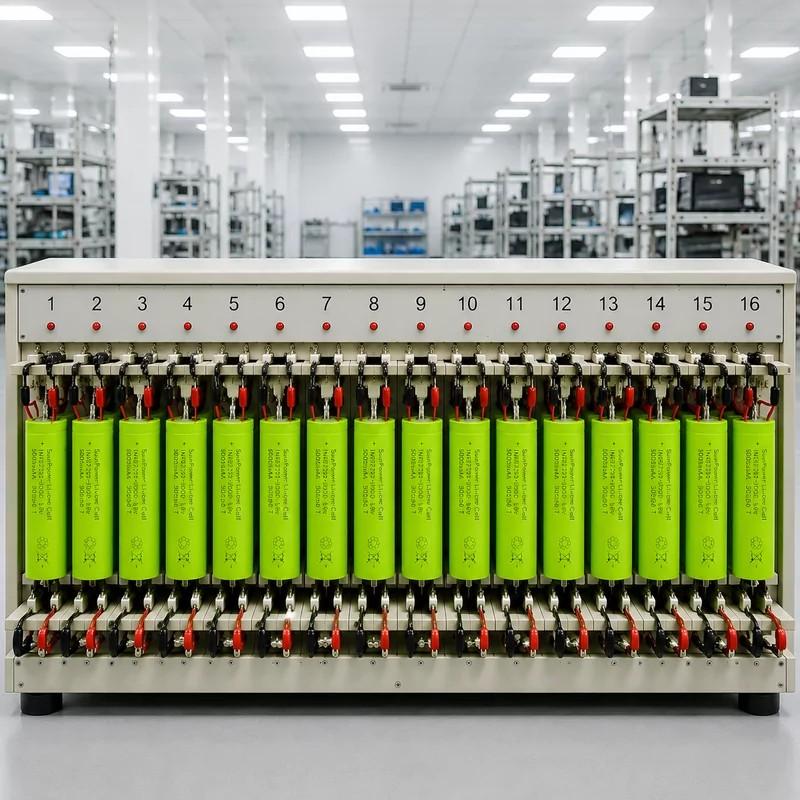
At first glance, a drone battery seems simple enough: several cells wired in series or parallel, plus connectors, cabling, an optional BMS, and a protective shell. But nominal cell capacity tells only a small part of the story. Flight duration, burst power, safety, and service life are shaped by much more than the number printed on a spec sheet.
For UAVs used in agriculture, surveying, inspection, logistics, and high-end cinematography, the battery often works under severe conditions: steep climbs, heavy payloads, sudden throttle changes, cold weather, and repeated cycling. In such situations, one weak cell can hold back the entire pack.
That is why capacity grading, cell binning, and cell matching are not optional extras in drone battery production.
Capacity grading is a controlled test sequence. Each cell is charged, rested, and discharged under defined conditions. The measured result reveals its real capacity and allows it to be placed into a capacity bin.
Cells from the same model, batch, and production line are never perfectly identical. Differences in coating weight, calendering, electrolyte fill, formation, separator properties, and process drift all create small variations. These show up as differences in capacity, resistance, self-discharge, and high-rate behavior.
So grading is not a hunt for the highest-capacity cells. It is a way to find cells that behave alike—similar capacity, resistance, self-discharge, voltage curve, and high-load performance—so they can be grouped into one pack.
For drone packs, the goal is not a collection of individually impressive cells. The goal is a team of cells that respond and age together.
Drone batteries often use many cells in series: 4S, 6S, 8S, 12S, or more. In a series string, the weakest cell sets the limit.
Suppose one cell has less usable capacity. It will hit cutoff sooner. The other cells may still hold energy, but the pack can no longer safely provide full power.
Resistance mismatch creates another failure mode. Takeoff, climb, acceleration, and heavy lift demand sudden high current. A higher-resistance cell drops more voltage and heats up faster.
The consequences can include:
- Lower power output
- Earlier low-voltage alarms
- Reduced ESC output
- Shorter real flight time
- Higher battery temperature
- Faster cell degradation
- Greater safety risk under extreme conditions
High-performance drone packs are therefore not designed around maximum capacity alone. They are designed around consistency and predictable high-current behavior.
Capacity, usually expressed in mAh or Ah, is fundamental. When cells in a pack have closely matched real capacity, their state of charge stays aligned more easily. If capacities differ widely, the smallest cell reaches its discharge floor first and limits the whole pack.
For example, two cells may be rated the same but actually measure 5200mAh and 4900mAh. After repeated high-rate cycling, that gap can become increasingly important. Professional drone battery makers therefore grade cells by measured capacity before matching them with other performance data.
Capacity says how much energy is stored. Resistance says how easily it can be released.
The relationship can be simplified as:
Voltage Drop ≈ Current × Internal Resistance
At higher current, the effect becomes more severe. A high-resistance cell sags more and gets hotter at the same load.
For drone batteries, this matters greatly during takeoff, acceleration, climbing, and heavy-load flight.
Matching should consider both absolute resistance and the spread between cells. ACIR and DCIR tests give different values. ACIR is useful for fast screening; DCIR and pulse discharge better reflect high-power use.
K-value tracks voltage loss over a set rest period. It is a practical screen for self-discharge and cell stability.
A cell can pass capacity and resistance checks but still lose voltage abnormally over several days. If it falls faster than its peers, it needs investigation.
Possible causes include internal leakage, micro-shorts, contamination, separator flaws, or other defects.
For drones, this matters because packs may sit in storage or transit for long periods. One cell that self-discharges faster can create growing voltage imbalance inside the pack. K-value testing helps screen long-term reliability.
Equal capacity does not mean equal discharge curve. Some cells hold voltage well early and then fall sharply late. Others deliver a flatter curve.
Drone loads vary constantly. A stable voltage curve helps the ESC and motors receive reliable power.
If cells in one pack have very different curves, they may hit low-voltage limits at different times. That can trigger early warnings, power loss, or weak performance at the end of a flight.
Good sorting looks at the full discharge profile, not just the final capacity number.
Drone packs are high-power devices. Low-rate tests alone cannot prove a cell is suitable.
A cell may look excellent at 0.2C or 0.5C but sag, overheat, or lose efficiency at high C-rates.
For high-rate drone use, testing should examine:
- Voltage under load
- Cell temperature rise
- Continuous discharge ability
- Short pulse power
- Voltage recovery after discharge
- Performance at the target C-rate
These results reveal far more about propulsion suitability than nominal capacity.
Capacity grading and cell sorting are related but distinct.
Grading asks: how much capacity does this cell really have?
Sorting and matching ask: which cells belong together in one pack?
Professional production combines multiple data points:
| Parameter | What It Tells You | Why It Matters for Drones |
| Capacity | Real energy storage | Flight duration |
| Internal resistance | Internal losses | Power, sag, heat |
| K-value | Self-discharge behavior | Long-term balance |
| Discharge curve | Voltage behavior | Stable flight |
| Temperature rise | High-rate efficiency | Safety and performance margin |
Only by combining these can a manufacturer build a sound matching strategy.
A pack made from mismatched cells may seem fine at first. But with cycling, small differences grow.
A typical decline pattern looks like this:
Shorter flight time → voltage imbalance → uneven charging → more sag → more heat → faster capacity loss.
Without a BMS, or with weak balancing, the problem worsens. Some cells may overcharge or over-discharge early, causing permanent damage.
Good grading and matching are not about producing attractive test reports. They are about making the pack behave predictably in real use.
A pack with one standout cell is not necessarily good. A quality pack needs every cell to behave as similarly as possible.
During high-current takeoff, cells should sag by similar amounts. During cruise, their state of charge should move together. Near cutoff, they should approach their limits evenly.
Professional drone battery production usually follows this path:
Cell testing → capacity grading → sorting → matching → pack assembly → final testing.
Pack quality is not defined by one impressive cell. It is defined by whether the whole group stays stable and predictable under high load, high rate, and repeated cycling.
As industrial, agricultural, logistics, and professional aerial drones advance, battery requirements go beyond simple capacity. They demand high discharge rates, tight cell consistency, cold-weather reliability, long cycle life, and predictable safety.
Capacity grading establishes real cell capacity. When combined with resistance, K-value, discharge curves, and temperature-rise data, it helps manufacturers choose cells that belong together.
So why does drone battery production need capacity grading? Not merely to chase higher capacity, but to achieve pack-level consistency.
With systematic testing, strict binning, and accurate matching, manufacturers can build drone batteries that hold voltage and power more steadily during takeoff, hover, climb, acceleration, and return-to-home.
For demanding UAV missions, consistency is a foundation of reliable flight.
Welcome to contact us:
Inquire more product details from the: Lithium Ion Battery Suppliers
WhatsApp/Wechat/Mobile: +86 13326321310
Email: info@battery-energy-storage-system.com
Website: www.battery-energy-storage-system.com
Ready to power your energy systems with the best in the industry?
Contact us today to get the latest pricing and discuss your needs with our team!
Next:None
Previous:32 pcs EVE LF105 105Ah LiFePO4 Cells and 2 pcs 16S 150A BMS Shipped to the UK