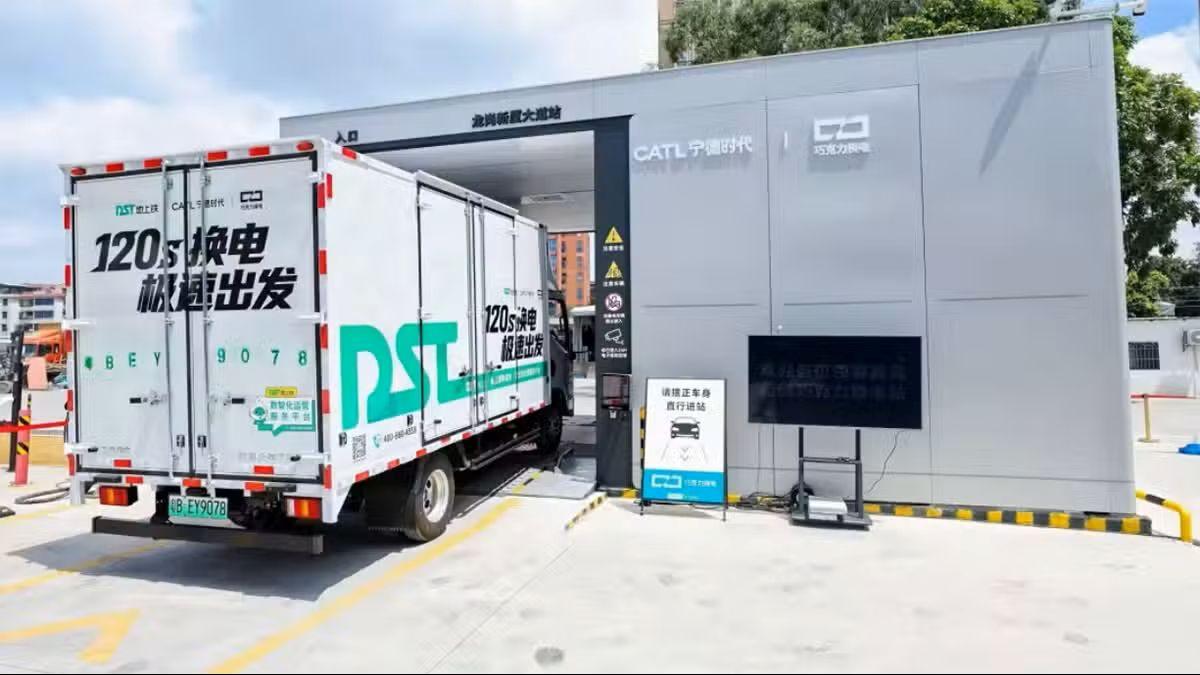
CATL has joined forces with logistics operator DST (Digital Sustainable Transport Shenzhen) to officially roll out China’s first standardized battery-swap ecosystem for light trucks.
The initial fleet of standardized swap-enabled light trucks has been delivered and entered urban logistics service, the Chinese power battery leader said in a statement on Monday.
Under the battery-swap model, branded Choco-swap, the entire energy replenishment takes just 120 seconds. Over an eight-year vehicle lifecycle, it can eliminate more than 2,000 hours of refueling time, while energy replenishment costs are roughly half those of a diesel light truck, according to CATL.
The modular swap stations accommodate both passenger vehicles and trucks with wheelbases ranging from 2.7 to 3.75 meters. They are compatible with CATL’s 25# and 35# battery packs, enabling battery interoperability between passenger and commercial vehicles, the statement noted.
To date, 31 light truck battery-swap stations have been built across the Guangdong-Hong Kong-Macao Greater Bay Area. CATL said the number of its swap stations in the region will rise to 140 by the end of this year, with a focus on covering key expressway corridors and logistics distribution nodes.
CATL, its subsidiary Contemporary Amperex Energy Service Technology (CAES), and DST will jointly deploy 5,000 standardized battery-swap light trucks in the Greater Bay Area by the end of 2026. The initiative is set to become the country’s largest standardized urban distribution battery-swap operation cluster and is planned for nationwide expansion, CATL highlighted.
The latest move is part of CATL’s long-term push to scale up its battery-swap business. The company aims to build a cumulative total of more than 3,000 passenger car and light truck swap stations by 2026, with an ultimate goal of 30,000 stations.
In the heavy-duty truck segment, CATL entered a trunk-line logistics electrification partnership with STO Express last month to accelerate fleet electrification. Using the 400-kilometer Shanghai-Ningbo route as an example, the electric heavy trucks delivered energy savings of 0.8 yuan ($0.12) per kilometer compared with conventional fuel vehicles, the company stated on April 3.
CATL’s Qiji Energy unit plans to build a cumulative total of 900 heavy-duty truck battery-swap stations by 2026. Additionally, the company signed an agreement with Guangzhou Public Transport Group last month to plan a battery-swap network for taxis.
Next:LiFePO4 Battery for Solar Energy Storage: A Complete Guide
Previous:Can I Charge My Lithium Battery with a Lead Acid Battery Charger?