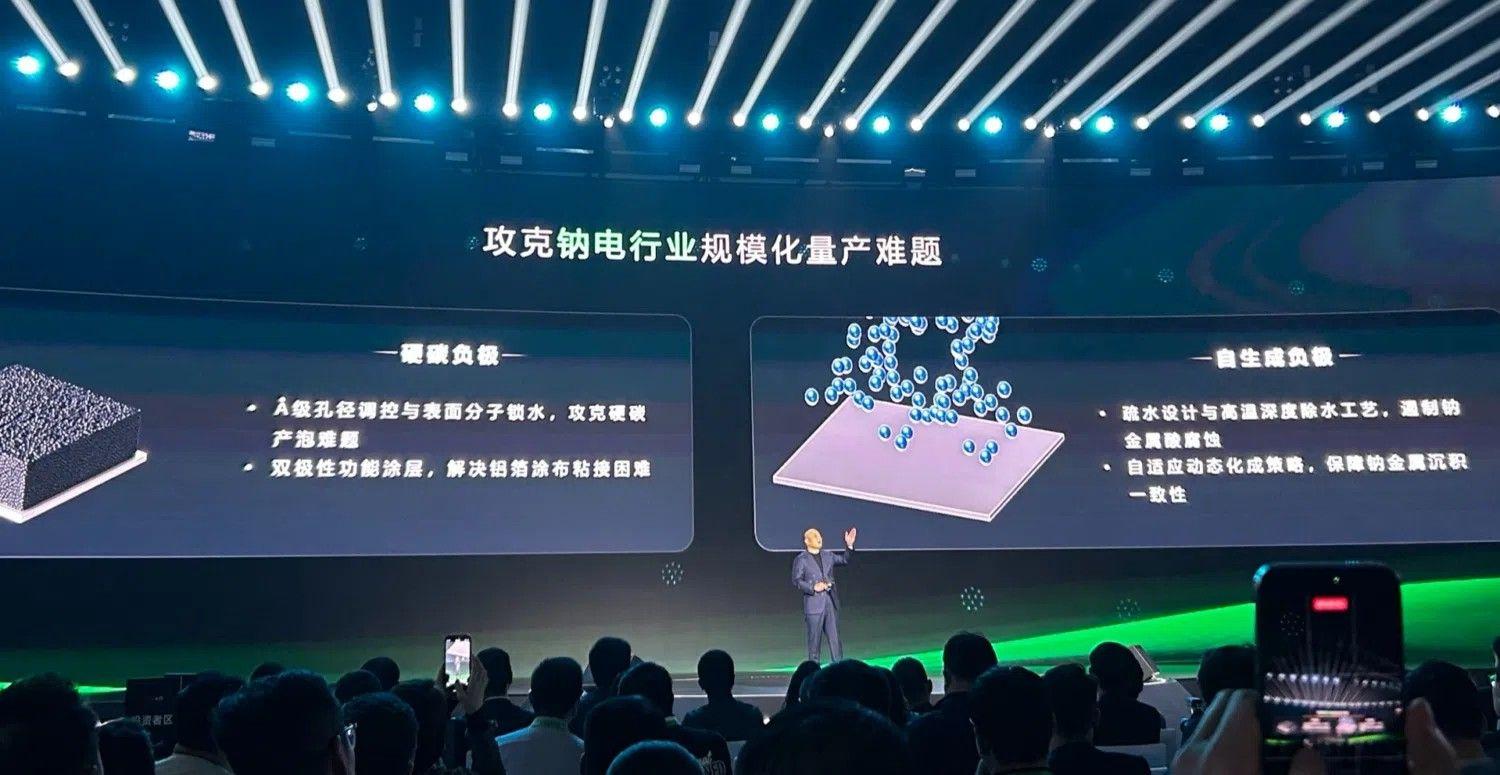
At its Tech Day event on April 21, CATL announced that its sodium-ion batteries are on track to enter mass production by 2026. Chief Scientist Wu Kai said the core manufacturing challenges have been solved, clearing the path for large-scale output as early as the fourth quarter of this year. Once the supply chain fully matures, the company expects vehicles fitted with these batteries to deliver driving ranges of up to 600 kilometers.
Sodium-ion cells offer several key advantages over lithium iron phosphate and nickel-manganese-cobalt chemistries. They can retain roughly 90% of their nominal capacity even at minus 40 degrees Celsius, and their production cost is forecast to be about 30% lower than that of LFP batteries. Because they do not depend on lithium or other scarce minerals, they also help broaden the supply chain. The main trade-off remains a relatively low energy density, currently around 175 watt-hours per kilogram.
According to Chief Technology Officer Gao Huan, CATL has overcome four major technical barriers: extreme moisture control, gas generation from hard carbon, difficulties in aluminum foil bonding, and the large-scale fabrication of self-generating anodes. By tackling more than 100 engineering issues, the company has laid the groundwork for commercial-scale deployment. By 2025, CATL had already poured close to 10 billion yuan into sodium battery R&D. Chairman Robin Zeng envisions sodium-ion technology eventually capturing 30% to 40% of the broader battery market.
Commercial applications are already moving forward. In December 2025, CATL unveiled plans to roll out sodium-ion batteries across four segments—battery swapping services, passenger vehicles, commercial vehicles, and stationary energy storage. Early in 2026, it introduced the Tectrans II light commercial vehicle solution, featuring its first mass-produced sodium system. On February 5, the first mass-produced sodium-ion passenger car, developed together with Changan Automobile, was revealed ahead of a mid-year launch. A variant of the Aion UT Super, co-developed with JD.com and GAC Group, is set to begin production in the second quarter of 2026.
Although lower energy density currently restricts applications mainly to micro EVs priced under 100,000 yuan, CATL remains optimistic about future performance gains. As the supply chain matures, the company sees pure electric vehicles reaching 600-kilometer ranges and extended-range hybrids delivering 300 to 400 kilometers on electric power—covering over half of market demand.
Next:18650 Battery Specs Guide: Size, Voltage, Capacity and How to Choose the Right Cell
Previous:NMC vs LFP Battery: Choosing the Best Battery for Mission Critical Industrial Test Equipment